The air in a quiet neighborhood has a specific weight. It is thick with the scent of freshly cut grass, the low hum of distant traffic, and the unspoken contract that when you close your front door, the world stays out. But in the dead of a Tuesday night, that contract was shredded. It didn’t start with a shout or a siren. It started with the dull, wet thud of a heavy glass bottle hitting a carpeted floor.
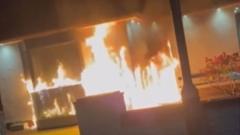
Then came the light. Not the soft glow of a streetlamp, but a jagged, hungry orange that licked at the ceiling.
This is the reality of a gangland feud. We often read about these conflicts as if they are chess matches played by invisible kings in high-rise apartments. We talk about "territory" and "supply chains" as if they are abstract business terms. They aren't. They are the smell of gasoline in a child’s bedroom. They are the sound of a father’s bare feet slapping against the floorboards as he tries to outrun a chemical fire.
The Anatomy of a Grudge
When the court handed down the sentences for the men behind the firebomb attacks, the headlines focused on the years—fifteen, twelve, eight. Numbers. Clean, clinical, and finite. But the numbers don’t tell you why a twenty-four-year-old man decides to fill a milk bottle with petrol and rags. They don't explain the toxic alchemy of a feud.
A feud is a living thing. It breathes. It requires constant feeding. It usually begins with a slight—a debt unpaid, a perceived insult in a nightclub, or a social media post that bruised a fragile ego. In this specific case, the spark was a power vacuum. One group moved into a space another thought they owned.
Imagine two families living on the same street. For years, they’ve ignored each other. Then, one day, a fence is broken. Instead of fixing it, one neighbor throws a stone. The other throws two. Within a month, they aren't just neighbors; they are combatants in a war that neither of them can remember starting, yet neither can afford to lose.
The men involved in these attacks weren't masterminds. They were soldiers of opportunity. They were young men who traded their futures for a moment of belonging and a few hundred pounds in cash. When they stood in the dock, they looked smaller than their crimes. They wore cheap suits and avoided the eyes of the families sitting in the gallery. The bravado of the night, fueled by adrenaline and the dark mask of a hoodie, had evaporated under the fluorescent lights of the justice system.
The Invisible Stakes
We tend to think of "victims" as the people directly targeted by the flames. The homeowners. The rivals. But the collateral damage of a firebombing ripples outward like a stone dropped in a well.
Consider the grandmother three doors down. She didn't see the flash, but she heard the glass break. Now, every time a car door slams too hard after midnight, her heart hammers against her ribs. She doesn't sleep through the night anymore. She has reinforced her letterbox. She has stopped sitting by the window.
The neighborhood has changed its DNA.
The streets aren't just streets; they are corridors of risk. This is the hidden cost of gangland violence. It isn't just the property damage, which was estimated in the tens of thousands. It is the theft of peace. The attackers didn't just burn a living room; they incinerated the sense of safety that an entire community spent decades building.
The Mechanics of the Attack
A firebomb—or a Molotov cocktail—is a primitive weapon. It is imprecise. It is chaotic. That is exactly why it is used. It isn't meant to kill with the surgical precision of a bullet; it is meant to terrorize.
The attackers arrived in a stolen vehicle, plates swapped, headlights dimmed. They moved with a frantic, clumsy energy. One man stood watch, eyes darting toward the corners of the street, while the other prepped the wick. The smell of petrol is overwhelming in an enclosed space. It clings to your skin. It gets under your fingernails.
When the bottle is thrown, physics takes over. The glass shatters, releasing the liquid, which atomizes for a split second before the flame catches it. It’s a "fireball" in the literal sense. It doesn't just sit on the floor; it splashes. It climbs curtains. It melts plastic. It creates a thick, black smoke that chokes the lungs before the heat even reaches the skin.
In the case of these attacks, the intent was clear: intimidation. They wanted the rival faction to know that nowhere was safe. Not even your bed. Not even with your family sleeping in the next room.
The Fallacy of the Hard Man
There is a myth that surrounds these "gangland" figures. We see it in movies—the stoic, wealthy kingpin who operates with a code of honor. The reality is far grubbier.
The reality is a damp flat, a burner phone that won't stop ringing, and the constant, gnawing paranoia that your "brothers" are looking for a way to replace you. The men who carried out these firebombings weren't motivated by a grand vision. They were motivated by fear. Fear of looking weak. Fear of being the one who didn't step up when the "boss" gave the order.
When the police began their investigation, the "code of silence" crumbled almost immediately. Forensics found a single drop of blood on a broken windowpane. Digital forensics tracked a series of panicked text messages sent in the minutes following the fire. CCTV captured the silhouette of a limping man fleeing the scene—he had managed to set his own trouser leg on fire during the toss.
There is no dignity in a firebombing. There is only the frantic, messy desperation of people who have run out of words.
The Weight of the Gavel
The sentencing judge spoke about "deterrence." He spoke about the "sanctity of the home." These are the pillars of a functioning society. If we cannot be safe in our homes, the entire social contract collapses.
The sentences were long, and they were deserved. But as the men were led down to the cells, there was no sense of victory in the air. Only a profound sense of waste.
The men will spend the best years of their lives behind bars. Their children will grow up visiting them through glass partitions. The families they targeted will likely move, unable to ever truly feel comfortable in those rooms again. The gang leaders, the ones who gave the orders from a safe distance, are likely already recruiting the next batch of twenty-somethings who think a petrol bomb is a shortcut to respect.
We have to ask ourselves why the fire was so easy to light in the first place.
It isn't just about the supply of gasoline or the availability of stolen cars. It's about a culture that prizes "retribution" over resolution. It’s about young men who feel they have nothing to lose, and everything to gain from a five-second burst of violence.
The fire is out now. The charred furniture has been hauled to the landfill. The walls have been repainted. But if you walk down that street at 3:00 AM, you can still feel the tension. You can see the new security cameras blinking their red eyes from every porch.
The attackers are in jail, but the neighborhood is still a prisoner.
The real tragedy of the firebomb isn't the flame itself. It’s the ash it leaves behind in the minds of everyone who watched it burn.
A home is more than bricks and mortar. It is the belief that you are safe. Once that belief is burned away, no amount of paint can truly cover the marks.