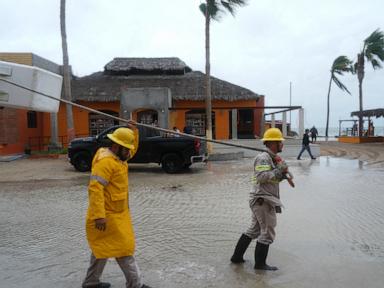
The sea does not knock before it enters. It does not ask for papers, nor does it check if the concrete pilings of your porch were poured to code. On a Tuesday night in Baja California, Hurricane Polo arrived with a heavy, wet shoulder, shoving against the fragile edge of a peninsula that spent millennia dreaming it was safe from the deep.
Listen.
That is not wind. Wind is a rush of air through mountain gaps, a clean whistle. This is a freight train dragging chains across a gravel roof. It is the sound of atmosphere collapsing under its own weight, heavy with the moisture of warm tropical water that has nowhere else to go but up, over, and through.
Meteorologists call it a storm track. They draw neat orange cones on flat computer monitors in air-conditioned rooms hundreds of miles away. They use words like sustained velocities and barometric descent. But out here, where the salt spray stings raw skin and the power grid dies with a dull pop down the block, those lines on a map translate into something entirely physical: the sudden, terrifying realization that the walls of your home are only as strong as the glue holding them together.
Consider Mateo.
Mateo is not a statistic in a disaster relief report. He is a fifty-four-year-old mechanic in a coastal town south of La Paz who spent the afternoon wedging sandbags against a wooden door that warped forty years ago. He knows the smell of a coming storm. It smells like ozone, rotting kelp, and a strange, metallic sweetness that rises off the desert floor when the humidity climbs past ninety percent.
"The water always wins," Mateo told his grandson hours before the eye wall struck, his voice flat with the exhausted wisdom of men who live on thin strips of land between mountains and abyssal plains. "You just try to convince it to take the porch instead of the kitchen."
When Polo made landfall, it brought more than wind. It brought a storm surge that treated paved highways like temporary riverbeds. In Baja, roads are lifelines. Cut the highway, and you cut the supply of fresh water, medicine, and human contact. For twenty-four hours, small fishing communities become islands in a brown, churning sea of runoff.
The danger of a hurricane in an arid region is a cruel paradox. Deserts do not drink fast. Pour ten inches of rain onto parched, sun-baked earth in a single night, and the ground rejects it like glass. The water sheet-flows down the arroyos, turning dry riverbeds—arroyos secos—into roaring torrents of mud, boulders, and uprooted mesquite trees. A family can sit safely inside a dry room while, fifty yards away, a flash flood tears through the valley, washing away cars, livestock, and the very foundations of bridges.
This is why the warnings matter. When emergency broadcasts repeat phrases like life-threatening winds, they are trying to pierce through the normalcy bias that plagues every coastal resident on earth. We believe in the strength of our roofs because we slept under them yesterday. We believe the storm will veer left, weaken at the shelf, or lose its teeth against the sierra mountains.
Polo did not veer.
As the pressure dropped, car alarms began to wail across the neighborhoods—a chorus of mechanical panic answering the fury of the sky. Tin roofs peeled back like the lid of a sardine tin. Power transformers blew in bright, electric-blue flashes that illuminated the driving rain for split seconds, carving ghostly snapshots of bending palms and flying debris out of the absolute dark.
Then came the silence.
It is the most unsettling part of the whole machine. The eye passes overhead. The wind drops to a deceptive whisper, the clouds break just enough to show a patch of indifferent stars, and people step outside to check their trucks or look for a lost cat.
Do not go outside.
Every veteran of these coasts knows that the calm is only the monster catching its breath before it turns around and kicks the door in from the opposite direction. The second half of a hurricane is always meaner because the ground is already saturated, the roots are already loose, and human endurance is running on fumes.
When the backside of Polo hit, it came from the west, driving water back into places that had just drained. It tore down what the first half had merely loosened.
By morning, the sun rose over a landscape painted in fifty shades of gray and brown. The sea had retreated, leaving behind mounds of tangled plastic, dead fish, and salt-crusted driftwood that reached the doorsteps of beachfront palapas. Neighbors emerged from back rooms and concrete cisterns, checking fences, trading matches, and looking up at the sky to see if another feeder band was trailing behind the monster.
There is a strange solidarity born in the wreckage. Someone is always brewing coffee on a camp stove. Someone else is pulling a neighbor's truck out of a ditch with a rusted chain. The storm takes the roofs, the electricity, and the illusion of control, but it leaves behind the raw, unvarnished truth of where we live and who we share it with.
The orange lines on the computer screen are gone now. The meteorologists have packed up their gear and turned their eyes toward the next warm patch of the Atlantic or Pacific. But down in the dust and salt of Baja, the work of rebuilding begins with a shovel, a bucket, and a long look at the horizon, waiting to see what the water is planning next.