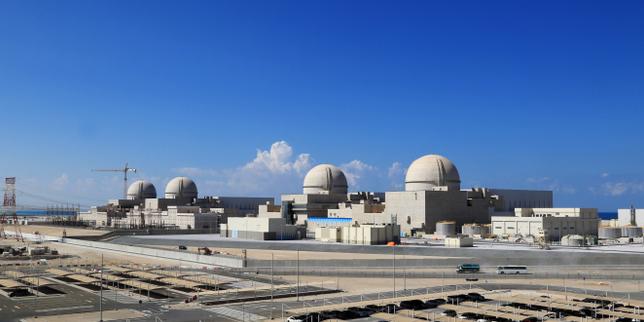
The desert outside Ruwais has a specific kind of silence. For years, the only sound vibrating through the salt flats of the western United Arab Emirates was the low, rhythmic hum of the Persian Gulf licking the shoreline. Then came the Barakah nuclear power plant. Four massive, gleaming white domes rising out of the sand, a multi-billion-dollar testament to a nation trying to engineer its way into the future.
To the engineers working the night shift, Barakah was a temple of predictability. You monitor the water pressures. You watch the digital telemetry. You trust the concrete.
Then the sky ripped open.
It happened in the dark, pre-dawn hours. A sudden, high-pitched whine cut through the ambient noise of the facility—a sound that has become terrifyingly familiar across the modern Middle East. It is the signature buzz of an uncrewed aerial vehicle. A drone. Seconds later, a flash of blinding orange shattered the darkness, followed by a concussive thud that rattled the thick glass of the monitoring stations.
Smoke began to billow, thick and black, painting the pristine white walls of the facility’s perimeter with soot. A fire had broken out. Not inside the reactors, but close enough to make every heart in the complex skip a beat.
This is no longer a theoretical war of geopolitics played out in air-conditioned diplomatic chambers. It is a reality where a lawnmower engine strapped to a few pounds of explosives can threaten the clean energy lifeline of an entire region.
The Illusion of Distance
We have spent decades believing that nuclear facilities are fortresses, islands of absolute security isolated from the chaos of the world around them. The concrete containment vessels are designed to withstand the direct impact of a commercial airliner. They are marvels of human ingenuity.
But a modern conflict does not care about your containment walls.
When the news broke that a drone strike had caused a fire near Barakah, the International Atomic Energy Agency (IAEA) did what it always does: it expressed "deep concern." It is a phrase worn smooth by repetition. Yet, behind the sterile vocabulary of international diplomacy lies a profound panic. The threat is not necessarily that a rogue drone will pierce the heart of a nuclear reactor and cause a meltdown. The threat is much more insidious.
Consider the anatomy of a nuclear plant. The reactor core is just one organ. To survive, it relies on a delicate, sprawling nervous system. It needs external power lines to keep cooling pumps running. It needs water intake channels. It needs a small army of security personnel, engineers, and technicians who must be able to log into systems and move freely around the site.
When an explosion occurs near the gates, that nervous system is shattered. A fire near the perimeter means emergency crews must deploy under the threat of a secondary strike. It means control room operators, already managing the immense psychological pressure of split-second decisions, must now wonder if the roof over their heads is about to collapse.
The true weapon of the modern drone is not its explosive yield. It is the chaos it injects into highly sensitive environments.
The Democratization of Terror
To understand why this moment feels so precarious, we have to look at how warfare has fundamentally changed. A generation ago, targeting a critical infrastructure asset like a nuclear plant required a nation-state. It required stealth bombers, cruise missiles, satellite intelligence, and billions of dollars in military spending.
Today, it requires a garage, an internet connection, and a few thousand dollars.
The drones utilized in these asymmetric attacks are often terrifyingly simple. They fly low, hugging the terrain, slipping beneath the radar nets designed to detect supersonic fighter jets. They move slowly, blending in with the thermal clutter of the desert heat. By the time the automated defense systems register their presence, the sky is already on fire.
This is the nightmare scenario that keeps nuclear security experts awake at night. The playing field has been flattened. The barrier to entry for strategic disruption has plummeted to zero. A localized conflict thousands of miles away can instantly spill over into a sovereign nation's flagship energy project, turning a symbol of technological progress into a hostage of fortune.
Inside the Control Room
Imagine sitting in the glow of the monitor screens when the alarms trip. Your training covers every conceivable internal failure. You know what to do if a valve sticks. You know how to isolate a leaking pipe.
But the manual doesn't tell you how to calm your hands when the building shakes from an external detonation.
The human cost of these strikes is often measured in infrastructure damage and economic disruption, but the psychological toll is the real objective. By striking near Barakah, the perpetrators sent a message that echoes far beyond the borders of the UAE. They proved that nothing is untouchable. They demonstrated that the modern world’s most sophisticated technology is inherently vulnerable to the most primitive forms of modern warfare.
The IAEA’s warnings are not just bureaucratic box-checking. They are an admission of limitation. The international frameworks built to govern nuclear safety were designed for a world of clear borders and conventional armies. They were not built for an era of deniable, long-range drone strikes launched from hidden valleys by non-state actors.
The Unseen Fallout
The fire at Barakah was eventually contained. The reactors continued to hum, shielded by the brilliance of their engineering and the bravery of the first responders who rushed toward the smoke. The immediate physical damage can be repaired with concrete and steel.
But the psychological shield has been breached permanently.
Every country currently investing in nuclear energy as an answer to the climate crisis must now re-evaluate the calculus of risk. The question is no longer just about seismic faults, tsunami walls, or cyber security. The question is how to defend a grid against an invisible, omnipresent threat that can materialize from the clouds at any moment.
As the sun rose over the Arabian Peninsula the morning after the strike, the smoke began to clear, revealing the scorched earth just beyond the facility's perimeter. The pristine white domes remained standing, casting long shadows across the sand. They looked less like triumphant monuments to human progress, and more like fragile targets waiting for the next sound in the night.