The air in the Seoul World Cup Stadium on May 31, 2002, did not feel like history. It felt like humidity. It felt like the heavy, suffocating pressure of an foregone conclusion.
In the tunnel, the French national team stood like gods chiseled from marble. They were the reigning World Cup champions. They were the European champions. Their jerseys bore the golden star of 1998, a badge of absolute mathematical superiority. Marcel Desailly looked like an iron wall. Patrick Vieira moved with the casual grace of a man who owned the midfield by divine right. Even without the injured Zinedine Zidane, France did not just expect to win. They expected to begin a coronation.
A few feet away stood Senegal.
To the casual observer watching the television broadcast in Paris or London, the Senegalese players were a collection of names from the lower rungs of the French league. They were the boys from Lens, Sedan, and Auxerre. They spoke the same language as their opponents. They shared the same training grounds. But they carried something else into that tunnel—the invisible weight of history, culture, and a fierce, unspoken desire to rewrite the hierarchy of the world.
Rhythm dictates everything in football. France played with the steady, metronomic beat of a Swiss watch. Senegal played to the thumping, unpredictable pulse of the sabar drum.
The Anatomy of an Earthquake
Consider what happens when a system built on flawless logic meets absolute, unquantifiable belief.
From the opening whistle, the French team moved the ball with their usual elegance. They knocked it wide. They probed. David Trezeguet struck the post with a curling shot that left the stadium gasping. It seemed like a matter of time. The script had been written months in advance by pundits who looked at squad values and historical precedents.
But football is a game played by human beings, not spreadsheets.
Every time a blue jersey turned, a green or white jersey appeared. Senegal did not park the bus; they did not hide in their own penalty box. Instead, they hunted in packs. Salif Diao closed down passing lanes with a ferocious intensity. Papa Bouba Diop, a towering figure in the midfield, simply refused to be bypassed.
The turning point arrived in the thirtieth minute, born from pure, chaotic kinetic energy.
El Hadji Diouf, a twenty-one-year-old forward with bleach-blonde hair and a reputation for beautiful arrogance, chased a long ball down the left flank. He was matched against Frank Leboeuf. On paper, Leboeuf possessed the veteran savvy of a Chelsea defender. In reality, Diouf possessed the terrifying speed of a man running toward his destiny.
Diouf twisted. He turned Leboeuf inside out. He sent a low, sizzling cross into the six-yard box.
What followed happened in slow motion. Fabian Barthez, the French goalkeeper, lunged forward. The ball struck Emmanuel Petit, ricocheted into the path of Papa Bouba Diop, who had busted his lungs to get into the box. Diop stumbled. He fell. But as he went down, his right boot connected with the ball, shoving it into the roof of the net.
Silence in Paris. Madness in Dakar.
The Dance Around the Corner Flag
What Diop did next became the defining image of the tournament. He did not run to the cameras. He did not point to his own name. He sprinted to the corner flag, took off his jersey, and laid it gently on the grass.
His teammates gathered around it in a circle. They danced.
It was not a choreographed celebration designed for a video game. It was a traditional dance, a moment of pure collective catharsis that signaled to the entire globe that the hierarchy had cracked. They were not just leading the world champions; they were enjoying it. They were at home on the grandest stage of all.
The rest of the match was a masterclass in psychological warfare.
France threw everything into the attack. Thierry Henry struck the crossbar. Sylvain Wiltord tested Tony Sylva, the Senegalese goalkeeper who played like a man possessed. But the French attacks lacked soul. They looked like a machine whose gears had been jammed by a handful of sand. Every missed chance bred frustration. Every frustration bred panic.
The clock ticked. One minute. Two minutes. Three minutes of added time.
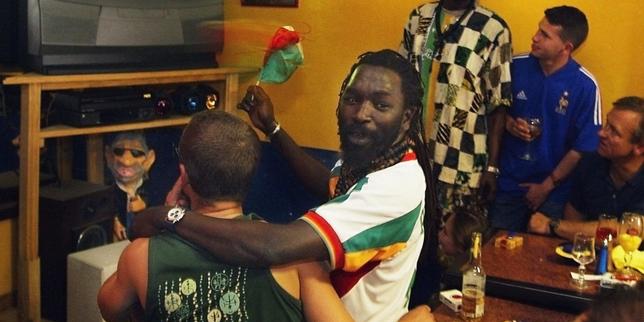
When the referee finally blew the whistle, the sound resonated far beyond the stadium walls in South Korea. It echoed through the cafes of Saint-Germain and the bustling markets of Sandaga.
The Aftershocks of a Thirty-Year Echo
To understand why this single match matters decades later, one must look past the scoreboard.
In 2002, Senegal was making its very first appearance at a World Cup. The country had spent decades in the sporting shadow of its former colonial ruler. All twenty-three players on the Senegalese roster made their living in the French leagues. They knew the French system inside out because they were a product of it.
Bruno Metsu, the eccentric French coach of Senegal with the long, flowing hair, understood this psychological dynamic perfectly. He didn't give a tactical lecture before the game. He simply reminded his players of who they were and who they were playing against. He told them that their opponents looked down on them.
The victory was not a fluke. It was a revelation. It proved that tactical discipline did not have to come at the expense of joyful expression. It opened the doors for an entire generation of African footballers to be viewed not just as raw athletic talent, but as strategic thinkers capable of outsmarting the best minds in Europe.
Now, the calendar turns to 2026.
The World Cup is back, and by a twist of fate and tournament brackets, France and Senegal find themselves on a collision course once more. The names have changed. Kylian Mbappé wears the blue jersey now; Sadio Mané and a new crop of Lions carry the hopes of Senegal. The modern game is more corporate, more analyzed, and more predictable than ever.
But history has a long memory.
The ghost of that May night in Seoul still lingers over this fixture. For France, it remains a cautionary tale about the dangers of complacency, a reminder that titles are not won on paper. For Senegal, it is a source of eternal oxygen, a permanent proof of concept that no giant is too big to fall.
As the lights come up on the stadium for this next chapter, the tension is palpable. The world will be watching to see if the hierarchy holds this time, or if the rhythm of the drum will once again overpower the ticking of the clock.