The phone does not ring the way it used to ring. In the dead of night, a sharp, metallic trill does not just demand attention; it announces an intrusion.
Picture a small storefront in suburban Surrey. The smell of freshly ground cardamom and warm oil hangs in the air. The owner, a man whose hands have grown thick and calloused from decades of early mornings and late nights, wipes down the counter. His ledger is balanced. His taxes are paid. His community knows him as a quiet fixture who remembers which customers prefer their flatbreads slightly charred.
Then the screen lights up with an unknown number.
He answers. A voice on the other end, cold and digitized or flatly terrifying in its casual menace, does not ask for money. It tells him what his storefront window costs. It tells him the exact time his daughter's school lets out. It gives him a number, a deadline, and a choice. Pay the tax, or watch the life you built turn into ash.
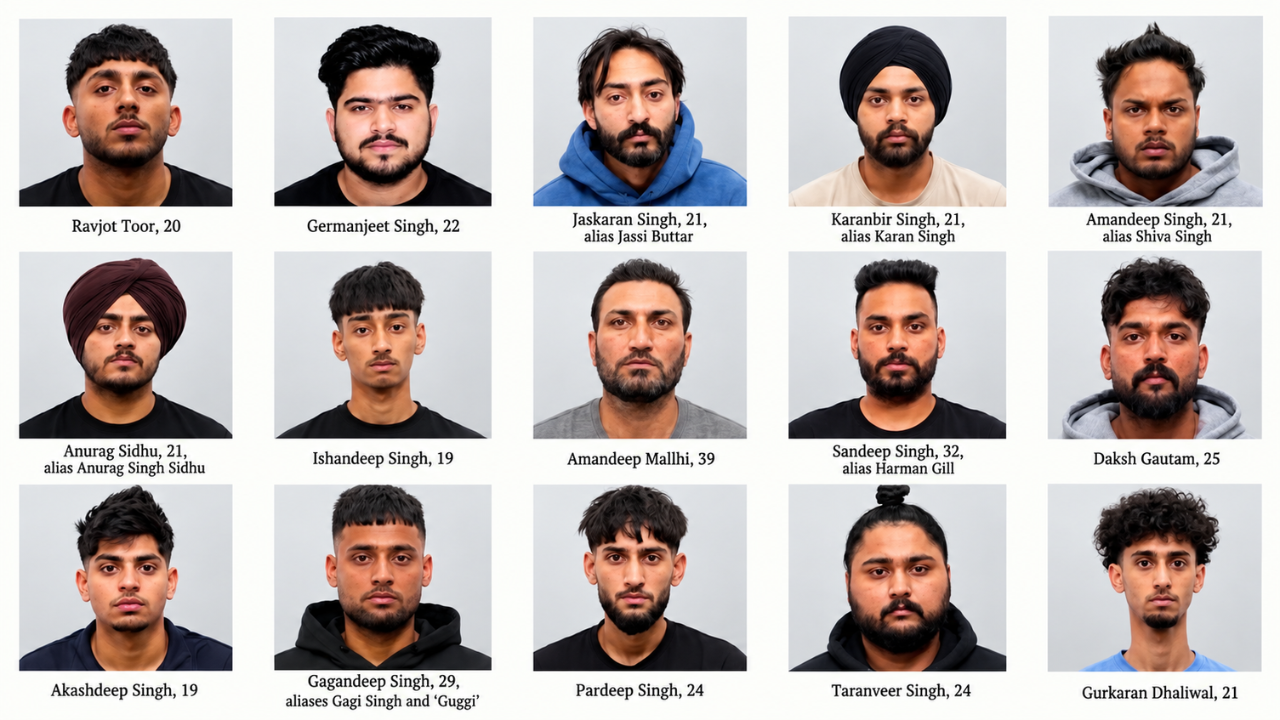
This is not a cinematic invention from a noir thriller. This is the raw, pulsing reality behind a cold police bulletin issued from the other side of the Atlantic. Fifteen Indian-origin men charged in a sweeping Canadian extortion probe. Faces flashed across news feeds. Mugshots lined up in neat, sterile grids. To the casual observer scrolling through a morning news feed, these are just names and pixels on a screen. Another headline about crime in the diaspora. Another data point in an escalating transnational headache.
Look closer.
Behind those fifteen mugshots lies an ecosystem of terror that has quietly choked neighborhoods from British Columbia to Ontario. For months, local police forces—operating under the heavy weight of an escalating public safety crisis—have tried to map a shadow network. They released the photos not just to aid an investigation, but to puncture a wall of silence.
Silence is the currency of extortion.
When you threaten a shopkeeper thousands of miles away from the ancestral villages they left behind, you rely on a very specific kind of isolation. You bank on the fear that local authorities are too slow, too distant, or indifferent. You whisper that your reach spans oceans, that calling the police will only invite a brick through the window before the squad car even turns the corner. The victims—mostly South Asian business owners, trucking company operators, and middle-class entrepreneurs—have lived in a state of suspended animation. Every creak of the floorboards at night sounds like a match striking. Every delayed shipment feels like a warning.
Consider the human cost of that silence. It looks like a father staring blankly at his ledger, wondering how to explain to his wife why their savings are suddenly vanishing into a digital wallet untraceable by traditional banking. It looks like teenagers learning to check the locks twice, whispering about rumors on WhatsApp groups that authorities refuse to fully confirm. It is the slow, corrosive erosion of the American and Canadian immigrant dream—the foundational belief that if you work hard, keep your head down, and respect the laws of your adopted home, safety is guaranteed.
When police finally step forward and name names, the relief is mixed with a lingering dread.
The charges leveled in this sprawling probe—extortion, firearms offenses, conspiracy, and property damage—reveal an unsettling sophistication. These are not unorganized street thugs operating on impulse. Investigators describe a coordinated campaign where suspects allegedly targeted specific members of the South Asian business community, using WhatsApp and encrypted messaging apps to demand massive cash payouts. Shots fired into empty storefronts served as terrifying exclamation points to their text messages. A shattered glass door spoke louder than any spoken threat.
Yet, naming fifteen men does not erase the trauma of the past year. It does not give back the sleep lost by families who spent months wondering if the next knock on the door would bring police or arsonists.
We often talk about crime through the dry, clinical vocabulary of the courts. We speak of dockets, warrants, jurisdictional overlaps, and transnational syndicates. We treat security as a mechanical failure of infrastructure rather than a fracture in the human spirit. But when an extortion ring targets a specific ethnic diaspora, it weaponizes cultural ties. It exploits the very networks of trust and community support that immigrants use to survive in a new land.
Think about what it means to build a life from scratch. You pack your entire existence into two suitcases. You trade your medical degree or your family farm for a night shift or a small retail lease. You rely on the guy three doors down who speaks your mother tongue to help you navigate the terrifying bureaucracy of a foreign tax system. When predators infiltrate those trusted spaces, turning community ties into vectors of fear, the psychological damage cuts deeper than any financial loss.
The release of these fifteen photographs is a fracture in that fear.
It tells the victims that they are not screaming into a void. It signals to the perpetrators that oceans do not provide immunity, and encrypted apps do not offer permanent sanctuary. But law enforcement bulletins alone cannot rebuild a shattered sense of security. That requires something far more difficult: a collective refusal to be intimidated, and a transparent reckoning within communities about how to protect their most vulnerable members from predatory actors who prey on shared heritage.
The phone will ring again tonight in cities across North America. Businesses will close their shutters. Families will lock their doors. But somewhere in the dark, the quiet certainty of absolute impunity has just been broken.
The light is finally on.