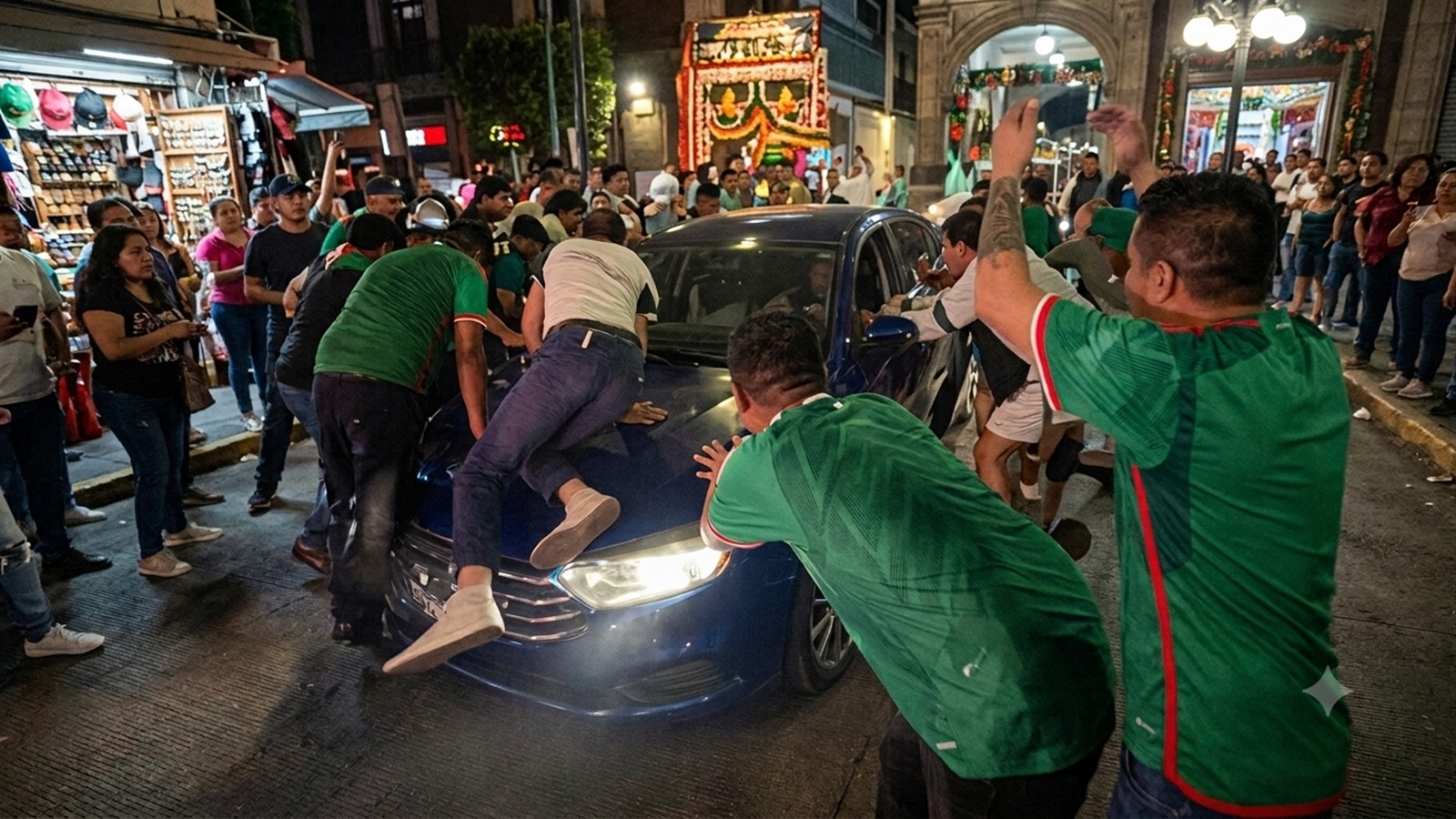
The plastic horns called vuvuzelas possess a unique, buzzing frequency that vibrates straight through the human sternum. When tens of thousands of them are blown simultaneously in a crowded public square, the sound ceases to be noise. It becomes a physical weight. It is the sound of collective euphoria, a deafening declaration that, for one brief evening, nothing else in the world matters but a leather ball crossing a white line.
That was the sound filling the air just moments before the metal buckled.
We have all seen the standard wire-service reports by now. They occupy the cold, clinical corners of the internet. A sterile headline reading Car hits crowd celebrating Mexico’s FIFA World Cup win, several injured tells you everything about the mechanics of the event, yet absolutely nothing about its reality. It reduces a moment of profound human terror and fractured joy into a math problem: one vehicle, a specific number of casualties, a localized geographic coordinate.
But history is not made of logistics. It is made of skin, bone, and the sudden, violent disruption of shared human happiness.
The Anatomy of a Second
To understand what happened, you have to understand the specific energy of a World Cup victory celebration. It is not like a holiday or a scheduled parade. It is spontaneous combustion. The final whistle blows thousands of miles away in a stadium under floodlights, and instantly, human beings spill from bars, living rooms, and restaurants into the open asphalt. They carry flags like capes. They hug strangers.
Let us ground this in a scene that played out across that very pavement. Imagine a father—we can call him Eduardo, a name to fit the thousands who were there. Eduardo had spent ninety minutes gripping the edges of a plastic bar stool, his heart rate spiking with every clearance, his voice growing hoarser by the minute. Beside him was his eleven-year-old daughter, wearing a jersey three sizes too big. When the whistle blew, ensuring Mexico's advancement, the relief was intoxicating. They spilled into the street, part of a massive, undulating sea of green, white, and red.
The air smelled of cheap beer, exhaust fumes, and the sweet, smoky scent of street vendor corn. The crowd was a single organism, moving to the rhythm of chants that had been passed down through generations.
Then came the headlights.
A car is not just a mode of transportation; it is two tons of kinetic energy waiting for a vector. When that energy intersects with a dense wall of human bodies, the sound is entirely different from the crunch of a two-car collision. It is a dull, sickening thud, followed immediately by the shattering of glass and the sudden, ragged tear in the fabric of the audio landscape.
The vuvuzelas did not stop all at once. They sputtered out, one by one, like dying engines, replaced by a high-pitched, collective intake of breath. Then, the screaming began.
The Fragility of the Public Square
We live under a tacit agreement with the machines we build. We walk along sidewalks separated from roaring engines by nothing more than a six-inch curb of poured concrete. It is an act of faith we perform every single day without thinking. We trust that the person behind the wheel is sober, attentive, and sane. We trust that the brakes will hold.
When that trust breaks, the psychological fallout is often more severe than the physical wreckage.
Consider what happens next in the immediate aftermath of such a strike. The crowd, previously bound by a shared sense of triumph, instantly fractures into two distinct psychological camps. The first group panics. They run, driven by the primal instinct that a threat is ongoing, creating a secondary danger of trampling and crush injuries. The second group freezes, paralyzed by the sheer incongruity of the scene. A moment ago, they were singing. Now, there is a bumper resting against a street lamp, and people are lying on the asphalt.
The reports will tell you that emergency services arrived quickly. They will list the response times in minutes and seconds. But ask anyone who has ever stood over an injured person on a dark street, and they will tell you that time stretches like warm rubber. A minute is an eternity when you are trying to remember how to apply pressure to a wound using nothing but a polyester replica football jersey.
The transition from a sporting celebration to a triage center is instantaneous and jarring. The green jerseys that signified unity suddenly become makeshift bandages. The flags used to wave in triumph are repurposed to shield the injured from the glare of passing headlights and the prying lenses of smartphones.
The Invisible Ripples
The standard news cycle moves with a brutal, forward-leaning velocity. By tomorrow, this incident will be pushed down the feed by political debates, economic forecasts, and the next round of sporting fixtures. The statistics will be filed away into municipal databases.
But for those who were on the asphalt, the story does not have a neat editorial conclusion.
The true cost of these events is found in the weeks and months that follow. It is found in the sudden panic a survivor feels when a car revs its engine a little too loudly at a crosswalk. It is found in the empty chair at a family dinner table while someone undergoes another round of orthopedic surgery. It is found in the quiet, lingering guilt of those who walked away without a scratch, wondering why they stepped to the left while someone else stepped to the right.
Sports have this incredible, almost mystical ability to erase our differences. For ninety minutes, socio-economic divides, political animosities, and personal anxieties melt away under the shared stress of a match. A stadium or a public square becomes a sanctuary of collective purpose.
To have that sanctuary violated by the blunt-force trauma of a traffic disaster is a specific kind of cruelty. It stains the memory of the victory. From that night onward, for the people who were in that crowd, that specific World Cup win will never just be about a beautiful goal or a heroic save by the goalkeeper. It will always taste like copper and asphalt.
The flashing red and blue lights of the ambulances eventually replaced the green flares of the supporters. The street was cleared, the shattered glass swept into plastic bins, and the abandoned flags collected by city sanitation workers. The city returned to its normal, grinding rhythm. But beneath the surface of the ordinary Tuesday morning commute, the memory of that sudden, violent intrusion remains, a stark reminder of how quickly the highest peak of human joy can be brought crashing down by the simple, terrible physics of a stray machine.