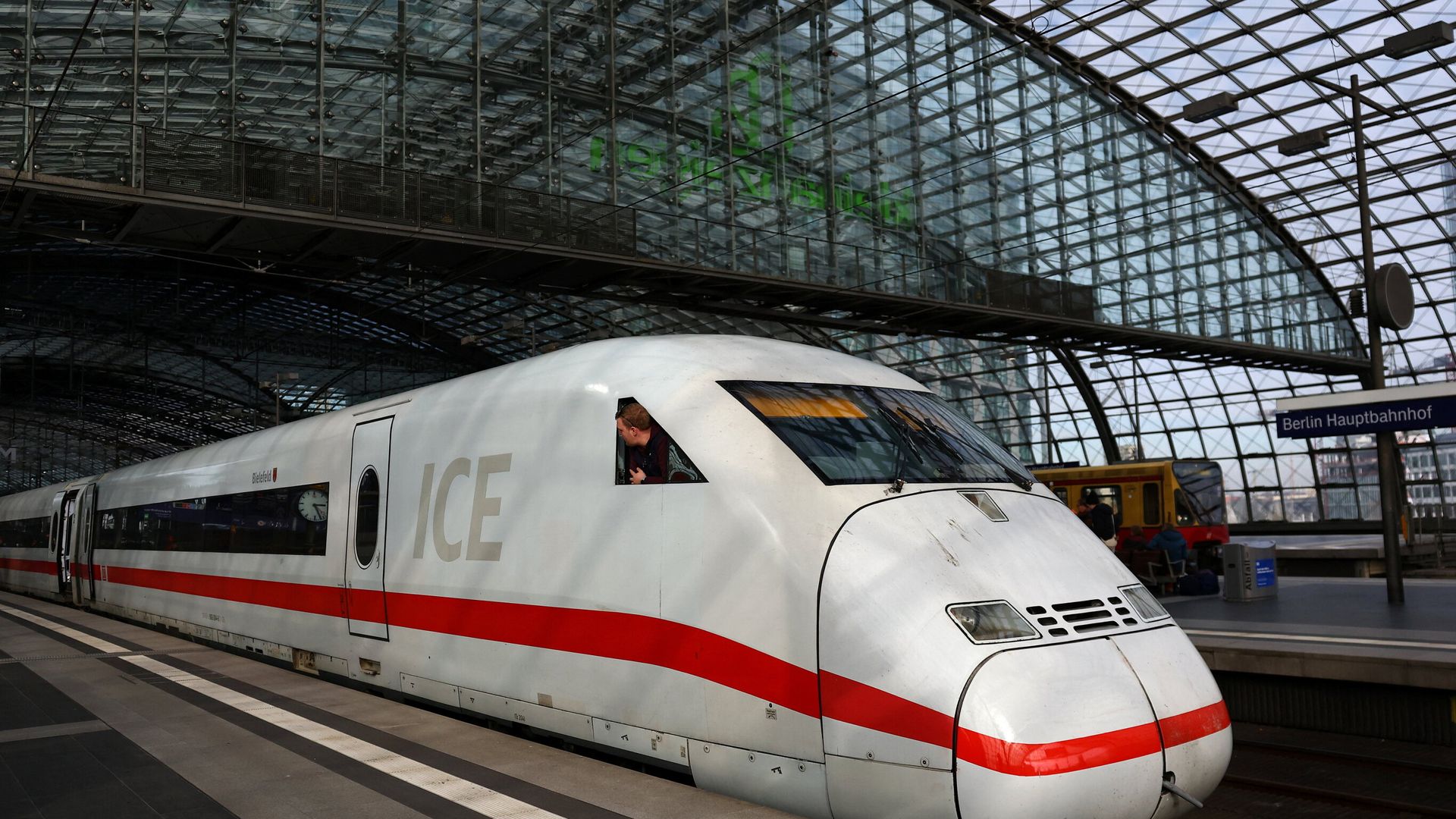
The coffee was still hot when the world stopped moving.
It was a standard Tuesday evening at Frankfurt Central Station. The air smelled of damp wool, roasted chestnuts, and the distinct, metallic tang of brake dust. Hundreds of people hurried beneath the massive steel rafters, eyes glued to phones or tracking the flipping numbers on the departures board. Then, at exactly 7:00 PM, a strange stillness crept over the tracks.
The low, rhythmic thrum of idling diesel engines and the hum of electric catenaries faded. Trains that should have been gliding out toward Munich, Hamburg, and Berlin sat frozen. On board Intercity-Express (ICE) 71, the lights stayed on, but the gentle vibration of readiness died beneath the passengers' feet.
Silence. It is the last thing you expect in the beating heart of European transit.
Germany’s railway network, the Deutsche Bahn, moves over seven million people a day. It is an intricate, clockwork machine. When it breaks, it does not just delay commutes; it fractures the delicate choreography of modern life. On this particular night, the culprit was not a fallen tree, a broken rail, or a blizzard. It was invisible. A software glitch had choked the Global System for Mobile Communications–Railway (GSM-R).
To understand why a digital hiccup can paralyze an entire nation, let us step into a hypothetical but entirely accurate reality inside the driver’s cab. Meet Lukas. He has been driving trains for twenty years. He knows the stretch of track between Frankfurt and Stuttgart like the back of his hand. But at 250 kilometers per hour, Lukas does not rely on his eyes alone. He cannot. The human brain cannot react fast enough to a signal light flashing in the distance when commanding thousands of tons of hurtling steel.
Lukas relies on a voice and data link. The GSM-R system is the invisible umbilical cord connecting his cab to the regional control centers. It tells him if there is debris ahead, if a switch has failed, or if another train has slowed down. It is a specialized, highly secure network built specifically for rail transit.
Suddenly, Lukas’s radio console went dead. The screen flickered, showing a connection error.
Protocol in the rail world is unforgiving. If you cannot talk to the network, you do not move. Safety is bought with absolute caution. Lukas reached for his controls and brought the massive train to a controlled, definitive halt. Multiply Lukas by thousands of drivers across northern, western, and central Germany, and you begin to grasp the scale of the gridlock.
The Anatomy of a Digital Ghost
For the average traveler sitting in a stranded carriage, the immediate reaction is frustration. We blame the conductors. We blame the ticket prices. But the reality of modern infrastructure is that we are constantly trading physical complexity for digital vulnerability.
Imagine a traditional railway as a series of physical pipes. If a pipe leaks, you see the water. You patch the hole. A digital network, however, is a labyrinth of code where a single misplaced character can act as a ghost in the machine. During this outage, the core server handling the radio data routing experienced an internal loop. It became so overwhelmed trying to process conflicting commands that it simply shut out new connections.
It was a data traffic jam that instantly created a real-world human crisis.
Consider what happens next when the digital cord is cut. It is not just about people arriving late for dinner. The stakes are deeply human, measured in missed moments and rising anxieties.
Inside one of those stalled carriages sat a woman named Marta. Let us use her to understand the ripple effect. Marta was traveling to Hanover. Her daughter was in labor with her first grandchild. As the minutes ticked away into hours, the cabin grew stuffy. The automated announcements could offer nothing but vague apologies about a "technical disruption." Marta watched her phone battery dwindle, stranded in a dark stretch of countryside, unable to do anything but stare at her own reflection in the window.
A few rows ahead, a small business owner faced the reality of a missed contract signing the next morning, a deal months in the making. Near the doors, a group of teenagers returning from a concert tried to laugh off the delay, but their laughter grew thin as the heating system began to cycle down to conserve power.
The vulnerability of our interconnected world becomes terrifyingly clear when the things we take for granted vanish. We have built a civilization that runs on invisible frequencies. We trust that when we flip a switch, electricity appears. We trust that when we buy a ticket, the tracks will guide us home. But when the software fails, the illusion of total control evaporates.
The Human Cost of Absolute Safety
The engineers at the central command centers did not go home that night. They sat in dimly lit rooms, surrounded by glowing monitors, tracing thousands of lines of data packets to find the bottleneck. It is a high-pressure environment where every passing minute costs millions of euros and erodes public trust.
Why not just drive the trains slowly? Why not use cell phones?
These are the questions that flooded social media as stranded passengers looked for alternatives. The answer lies in the uncompromising nature of railway safety engineering. Commercial mobile networks are fine for streaming videos or sending text messages, but they suffer from dropped calls and dead zones. They lack the absolute priority overrides required when an emergency broadcast must reach every train on a line instantly.
If a dispatcher needs to scream "Stop!" to every locomotive within fifty kilometers, that message cannot wait behind someone downloading a movie.
So, when the dedicated GSM-R system sputtered, Deutsche Bahn had no choice. They had to pull the emergency brake on the entire system. It was an act of profound logistical bravery—and immense public inconvenience. They chose a massive, costly headache over even the slightest fraction of a percent of physical risk.
By midnight, the engineers managed to deploy a backup routing protocol. The invisible ghost was purged from the servers. Slowly, the digital pulse returned to the network.
In the cabs, screens flickered back to life. Lukas received his clearance signal. With a heavy sigh of relief, he engaged the throttles, and the train crept forward into the dark. Marta eventually reached the hospital in Hanover, arriving just in time to hold a newborn baby girl, her hands still cold from the long wait on the tracks.
The trains are running again today. The departures board in Frankfurt is flipping its numbers once more, a hypnotic dance of cities and times. People rush past, complaining about minor delays, completely unaware of the massive, fragile digital web humming just above their heads, keeping the chaos of the world at bay.