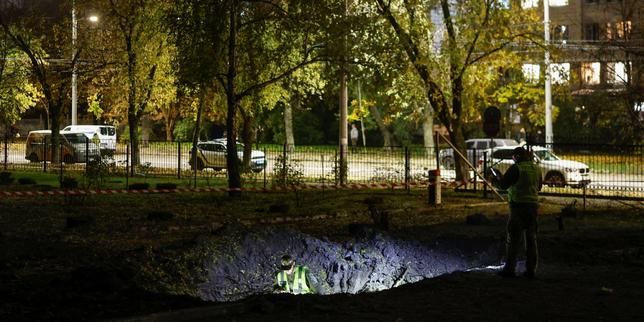
At 3:14 in the morning, the air in Kyiv does not just vibrate; it fractures.
You feel it in your molars before your ears ever register the shriek of the air raid alert. It is a heavy, metallic hum that rolls off the Dnieper River, rattling the taped-up panes of Soviet-era apartment blocks and sliding under the doors of newly built glass towers in Pechersk. For three minutes, the city holds its breath. Then comes the low, unmistakable thud of air defenses engaging high above the cloud line—a sound like a giant slamming a heavy oak door three miles underground. Learn more on a similar topic: this related article.
When the morning dispatches finally hit the wire services in Paris, London, and New York, the tragedy is compressed into a cold, tidy headline: At least one dead and ten injured in Russian attacks on Kyiv.
One dead. Ten injured. Additional reporting by The New York Times highlights similar views on this issue.
To the rest of the world, scrolling past the update over morning coffee, those numbers look like a statistical footnote in a war that has stretched across years. They look like a quiet night. A manageable night. A night where the shields mostly held and the city survived to see another dawn.
They do not look like a life erased in the middle of a dream, or ten families whose entire architecture of normalcy collapsed in the span of four seconds.
The Arithmetic of a Tuesday Night
To understand what actually happens when missiles and drones fall on the Ukrainian capital, you have to strip away the military jargon. You have to forget terms like ballistic trajectory, debris field, and critical infrastructure. You have to look at a kitchen table.
Picture a woman named Olena—a hypothetical composite of the millions of ordinary residents who refuse to abandon their city—standing in her hallway at 3:20 AM. She is following the "two-wall rule," the grim urban survival geometry every child in Kyiv now knows by heart. The first wall takes the blast; the second wall catches the shattering glass. She is wearing a winter coat over her pajamas, holding a carrier with a trembling gray cat in one hand and her phone in the other, watching a Telegram channel update the path of incoming Shahed drones in real time.
Two targets approaching from the northeast.
Air defense working.
Stay in shelters.
For Olena, the invisible stakes of this night have nothing to do with geopolitical chessboards or territorial concessions. The stakes are whether the heating pipes in her building will burst when the power grid takes a hit, leaving her eighty-year-old mother to freeze in a ninth-floor apartment where the elevator no longer runs. The stakes are whether the bakery on the corner will have enough generator fuel to bake bread by 7:00 AM.
When a missile is intercepted—a "successful" defense by every military metric—the physics do not simply vanish. Tons of twisted, burning metal still have to obey gravity. When that debris slams into a residential courtyard in the Darnytskyi or Solomianskyi district, it does not discriminate between a military target and a bedroom.
That is how you get "one dead."
It is never just one. A single death in an overnight strike is a stone dropped into a dark well; the ripples tear outward through generations. It is a husband who will never finish repairing the leaky faucet in the bathroom. It is a daughter who will spend the rest of her life flinching at the sound of fireworks or low-flying passenger jets. It is an empty desk at a local school, a silent phone number in a dozen contact lists, a pair of shoes left neatly by the front door that will never be laced up again.
The Mechanics of Exhaustion
Why do these strikes continue when they rarely shift the front lines hundreds of miles to the east?
The answer lies in a brutal, calculated strategy of psychological attrition. Think of a city's resilience like a suspension bridge. A single heavy truck crossing the span does not break the steel cables. Even a hundred trucks might only cause microscopic stress fractures. The goal of sustained, overnight aerial bombardment is not necessarily to collapse the bridge in a single blow; it is to shake the structure violently every single night until the metal fatigues, the bolts loosen, and the people crossing it lose the will to keep walking.
Sleep deprivation is a weapon as old as siege warfare, modernized with long-range telemetry and satellite guidance.
When emergency responders pull ten injured people from the rubble of a damaged apartment building before sunrise, the physical wounds—shrapnel lacerations, concussions, burns from shattered windows—are only the visible half of the ledger. The other half is carried by the three million people who stayed awake in their hallways, staring at the ceiling, calculating the odds of survival until the all-clear signal finally chimed at 5:45 AM.
And then, something remarkable happens. Something that defies the cold logic of the attackers.
By 7:30 AM, the municipal crews are already on the scene. Before the smoke has even finished curling out of the blown-out window frames, yellow-vested workers are sweeping up mountains of pulverized glass. Plywood sheets are hammered over empty sockets where balconies used to be. Down the street, the barista at a small kiosk hooks up a portable battery, grinds fresh beans, and hands a steaming espresso to a paramedic whose boots are still dusted with plaster and ash.
The Danger of the Routine
I have watched how the human brain adapts to impossible environments, and it is both a miracle and a trap.
In the first weeks of the full-scale invasion, every siren sent thousands sprinting into the deep, marble-lined vaults of the Kyiv Metro. People slept on yoga mats beside the escalators, sharing thermoses of tea and whispering in the dim light. Terror was sharp, immediate, and absolute.
Years later, the terror has hardened into something else. It has become a grim, calloused routine.
You see people walking their dogs while the sirens wail overhead, barely glancing up at the sky. You see commuters checking their watches on the platform, annoyed not by the threat of death, but by the fact that the red line train has halted above ground until the alert passes, making them late for a morning meeting.
This habituation is how a society survives without losing its collective mind. You cannot live in a state of peak adrenaline for years; the human heart simply is not built for it. So you normalize the abnormal. You turn an existential threat into a weather report. Tonight there is a forty percent chance of ballistic missiles; better charge the power banks before bed.
Yet, for those watching from the safety of peaceful cities thousands of miles away, that same habituation carries a lethal poison: indifference.
When the headlines repeat the same grim refrain—one dead, ten injured—our empathy begins to dull. The human mind struggles to process recurring tragedy. We start treating war like background noise, a tragic but permanent fixture of the international news cycle, no different than traffic reports or fluctuating interest rates.
We forget that behind every dry dispatch is a community forced to live at the absolute edge of human endurance. We forget that the "normalcy" visible in daytime videos of Kyiv—the open restaurants, the bustling flower markets, the couples walking along Khreshchatyk Street—is not proof that the war is over or that the danger has passed. It is a deliberate, defiant act of resistance. Every cup of coffee poured, every classroom taught, every shattered window boarded up before noon is a refusal to let the night dictate the terms of the day.
What Remains When the Dust Settles
Walk through a Kyiv neighborhood the afternoon after an attack, and you will notice the smell first. It is a sharp, lingering cocktail of cordite, burnt wiring, wet concrete, and pine sap from the fresh plywood covering the blast scars.
You will see neighbors standing in small clusters near the yellow police tape, speaking in low voices. Nobody is screaming. Nobody is panicking. They are passing around plastic cups of water, checking on the elderly man from the third floor who forgot his cane during the evacuation, and sweeping the last shards of glass off the hood of a parked car.
A few blocks away, life moves on at its relentless urban pace. Traffic hums. Delivery riders weave through intersections. Parents pick up their children from kindergarten, holding small hands tightly as they step over cracks in the pavement.
Tonight, the sun will go down over the golden domes of St. Sophia Cathedral. People will draw their blackout curtains, plug their phones into the wall, and check the battery levels on their flashlights. They will set their alarms for work, kiss their children goodnight, and hope that the sky stays quiet until morning.
And somewhere in the dark, the radars will keep turning, watching the horizon for the next spark.