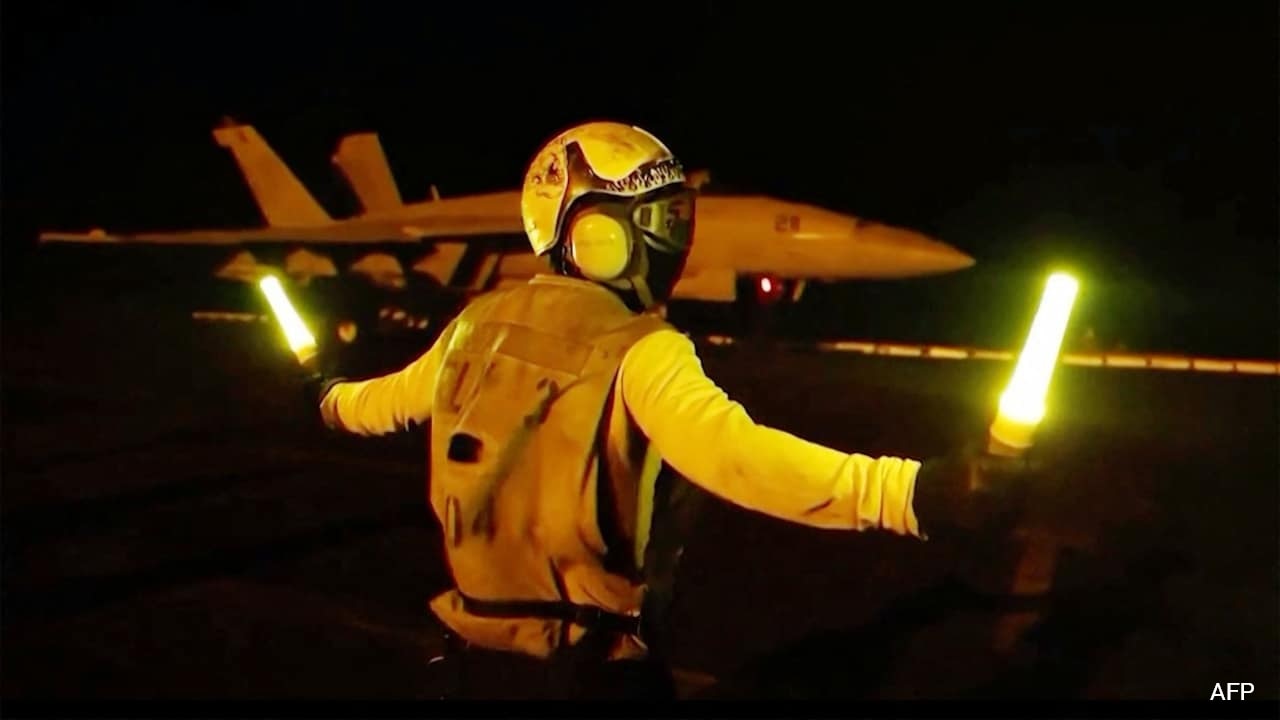
Shadows Over the Water
The sea off the coast of Bandar Abbas does not sleep softly. It smells of heavy fuel oil, salt, and raw humidity that sticks to your skin the moment you step outside an air-conditioned room. On a typical night, the water reflects the amber glow of distant oil tankers, moving slow and heavy like ancient beasts in the dark.
Then came the flash.
It was not a soft light. It was a searing, blinding white that swallowed the horizon whole, followed seconds later by a thunderous, bone-rattling roar that vibrated through concrete foundations and shattered the silence for miles.
High above, far beyond the reach of human eyes, metallic shapes tore through the upper atmosphere. Guided by precision satellites and powered by thousands of pounds of thrust, American ordnance found its targets across strategic Iranian military facilities.
To read the official press briefings hours later was to encounter a vocabulary designed to freeze the blood into bloodless statistics. Strategic deterrence. Infrastructure degradation. Proportional response. Defensive posture.
Words stripped clean of heat, sound, and terror.
To understand what happened, though, you have to leave the press rooms in Washington and Tehran behind. You have to look at the mechanics of power, the fragile geometry of deterrence, and the human beings standing in the shadows of giants.
The Cold Logic of Steel and Fire
Targeting a military apparatus is not an impulse decision. It is an act calculated down to the minute, measured in meters and payloads.
Military planners do not speak in emotional terms. They speak of operational capacity. When a nation decides to launch a strike against another sovereign state’s defense infrastructure, it targets specific nodes in an intricate network.
- Command and control centers: The nerve centers where decisions are transmitted to the field.
- Air defense installations: Radar sites and surface-to-air missile batteries designed to keep intruders out.
- Storage depots: Facilities holding ballistic missiles, assembly components, and long-range drones.
The goal in these specific operations is straightforward on paper: weaken the ability to strike out while signaling that any further escalation will carry a cost too heavy to bear.
Consider a radar array sitting on a barren plateau. To a military analyst sitting in an intelligence hub thousands of miles away, that array is merely a dot on a digital map—a threat vector that must be neutralized to secure airspace.
Destroying it requires precision. A single satellite-guided munition, dropping from an altitude where the air is too thin to breathe, travels at supersonic speeds. It strikes with a margin of error measured in inches.
The array crumples under the kinetic impact and explosive force. The screen goes black. The dot on the computer monitor in Washington vanishes.
Clean. Efficient. Abstract.
Except for the men sitting inside the control shed beneath that radar dish.
The View from the Floor
Imagine a young technician stationed at an air defense outpost near the coast. Let us call him Reza.
Reza is twenty-three. He took this assignment because it offered steady pay and a path toward an engineering degree. He knows the machinery around him intimately—the low hum of the cooling fans, the specific odor of warm circuitry, the flicker of green phosphor on older monitoring screens.
He knows the geopolitical tension exists, of course. He reads the same news everyone else does. But when you are on shift at 2:00 AM, geopolitics is abstract. Your world shrinks to the monitor in front of you, a plastic cup of lukewarm tea, and the quiet breathing of the colleague sitting three feet away.
Suddenly, the telemetry spikes.
There is no long, cinematic warning. No dramatic countdown. There is only a sharp, frantic chirp from the warning receiver, a sudden rise in electromagnetic noise, and then the world turns into light and pressure.
The shockwave hits like a physical fist. Dust that has settled in the ceiling tiles for twenty years rains down in an instant. The lights flick out, replaced by the eerie emergency red.
Reza does not think about foreign policy. He does not think about regional balance of power, nuclear enrichment percentages, or maritime shipping lanes.
He thinks about air. He thinks about getting his lungs to expand. He thinks about the noise in his ears that sounds like a scream that refuses to stop.
Hours away, across thousands of miles of ocean, a military spokesperson takes a podium. The room is quiet, filled with journalists holding digital recorders and laptops. The spokesperson reads from a prepared binder, their voice even and measured.
"Initial assessments indicate that targeted strikes successfully degraded key offensive capabilities without causing significant collateral damage."
Both versions of the story are true. That is the tragedy of modern warfare.
A World Built on Invisible Cables
It is tempting to view military action as something contained—a distant storm that flashes on the evening news and fades before breakfast. But the modern world does not allow for distance anymore. We live in an ecosystem bound together by thin, fragile threads of supply chains, energy markets, and digital data.
When missiles land along the Persian Gulf, the impact moves outward in invisible ripples that touch lives thousands of miles away.
Consider the Strait of Hormuz. It is a narrow strip of water, barely twenty-one miles wide at its narrowest point. Through this slender needle's eye passes nearly a fifth of the world's petroleum.
When the sky lights up over the coast, the maritime industry holds its breath.
- Container ships pause: Captains drop anchor in open water, waiting for assurances from naval escorts before entering the channel.
- Insurance rates skyrocket: The cost to insure a commercial vessel transiting the region can double overnight, adding millions in operational friction.
- Energy markets twitch: Automated trading algorithms detect the news bulletins and instantly buy up oil futures, driving prices higher before a single barrel has actually been lost.
Thousands of miles away, a gig worker in Chicago pulls up to a gas station at 5:30 AM. He notices the price per gallon has jumped twenty cents since yesterday. He groans, calculates the lost margin on his day’s deliveries, and swipes his card.
He does not link that extra twenty cents to a ruined radar array on a distant plateau. He just knows his life got slightly harder before the sun came up.
We are all connected to the strike zone by an unbroken line of economics and anxiety.
The Illusion of Control
Why do these cycles repeat? Why does deterrence so often feel like building a wall out of water?
The fundamental problem with force is that it relies on a rational opponent. It assumes that if you hit a target hard enough, the other side will perform a clear cost-benefit analysis and choose to step back.
History tells a different story.
Human beings, whether sitting in presidential palaces, military headquarters, or field command posts, are not cold calculating machines. They are driven by pride, survival instincts, domestic political pressures, and the deep, terrifying fear of looking weak.
When a strike occurs, the targeted side cannot simply absorb the hit and move on. To do so invites further action. And so, the machinery of retaliation begins to turn.
Plans that were drawn up years ago are pulled from steel filing cabinets and digital archives. Target packages are updated. Missiles are fueled. Statements are drafted in high-ceilinged offices, declaring that sovereignty will be defended at all costs.
Every actor in the drama believes they are acting defensively. Every actor believes they are responding to an intolerable provocation.
The result is a lethal dance where everyone moves to the same rhythm, yet everyone claims they were forced onto the floor.
What Remains in the Dust
When the smoke clears and the satellite imagery is analyzed, the assessments come out. Graphs are plotted. Maps are updated with red dots showing damaged facilities and green dots showing operational status.
The military objective was met. The infrastructure was degraded. The message was delivered.
But if you stand on the shoreline after the jet engines have faded into the clouds, the sea looks exactly as it did before. The humidity remains. The oil tankers still sit on the horizon, waiting for permission to move.
And somewhere in the dark, beneath a sky that briefly turned as bright as noon, men with dust in their hair and ringing in their ears clear away the debris, patch the wires, and prepare for the next time the night decides to burn.