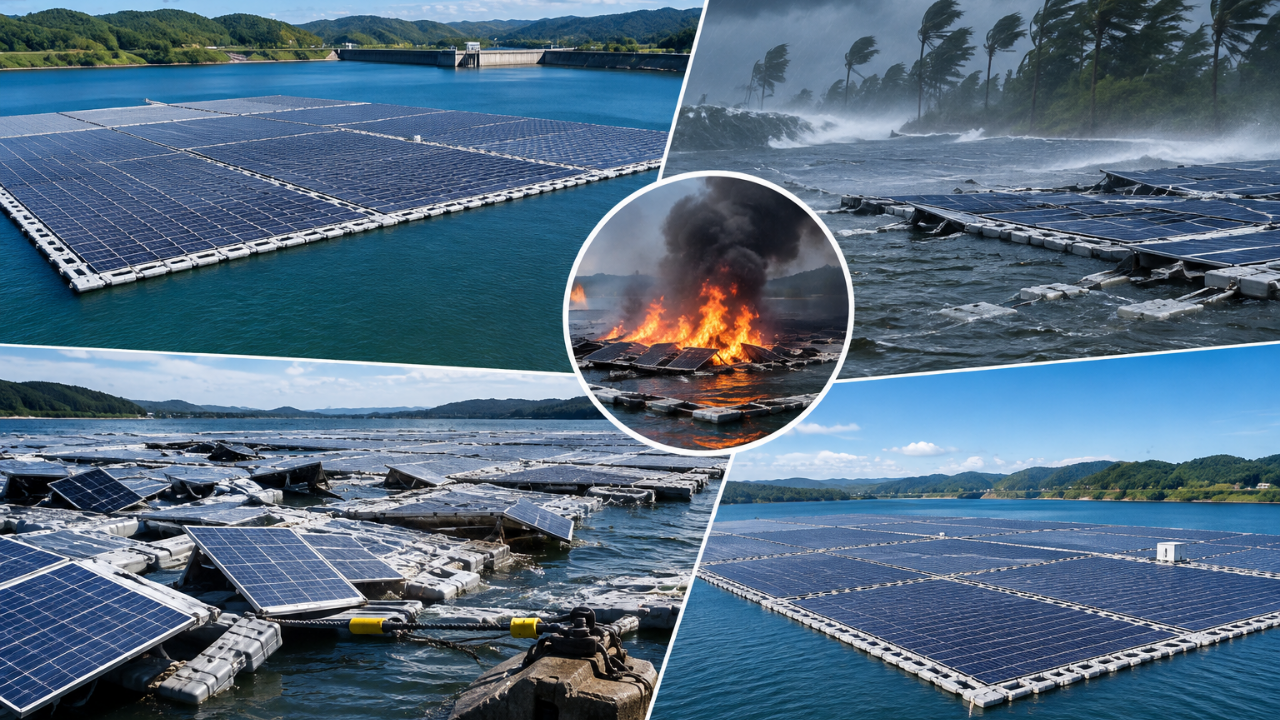
The wind does not blow in Japan; it screams. When Typhoon Faxai carved its violent path across the Chiba prefecture and zeroed in on Tokyo Bay in the autumn of 2019, it brought with it sustained winds of over one hundred miles per hour. This was not a storm that merely knocked over patio furniture or peeled shingles from rooftops. It was an atmospheric battering ram, a meteorological fury that tore through power grids, uprooted centuries-old cedar trees, and turned the placid surface of Yamakura Dam into a chaotic theater of survival.
Picture Kenji Sato, a fictional plant operator whose boots have crunched on gravel across a dozen hydroelectric and solar installations over thirty years. Kenji stood behind reinforced glass at midnight, watching the reservoir cameras. He knew the water. He respected the water. But he had never seen the water act like an angry ocean.
On that black, shrieking night, fifty thousand solar panels floated peacefully on the surface of the Yamakura Dam reservoir. Or at least, they were supposed to.
Engineers call it floating photovoltaic technology. The rest of us call it a marvel of modern desperation. Land is scarce in Japan, a crowded nation of mountains and tight valleys where every square meter of flat dirt is fiercely contested by housing, agriculture, and industry. To generate green energy at scale, Japanese innovators looked at the shimmering, underutilized mirrors of agricultural reservoirs and man-made lakes. Why build on the earth when you can anchor your ambitions to the water?
It is a brilliant concept until nature decides to test your knots.
Consider what happens when fifty-mile-per-hour winds become one hundred and ten miles per hour. The surface of a reservoir is not a flat sheet of glass. It ripples, it swells, it rolls in chaotic, multidirectional waves. The floating platforms—vast interlocking islands of high-density polyethylene anchored by massive cables to the lakebed—began to heave.
Kenji watched through the grainy infrared feed as the physics of destruction played out in slow motion. The massive mooring lines, engineered to withstand centuries of standard meteorological averages, began to groan. Then, under the sheer, relentless kinetic load of the storm, they failed.
The anchors snapped.
Modules broke loose. Stripped of their rigid geometry, the massive floating arrays collided with one another like tectonic plates. The plastic hinges buckled. The aluminum frames twisted like tin foil.
And then, the unthinkable happened.
In the crushing melee of twisted metal and fractured wiring, an electrical short circuit triggered a spark. In the damp, salt-stung air of the storm, fifty panels caught fire.
Fire on water. It is an image that defies common sense. We are conditioned to believe that water extinguishes flame, that the two elements exist in eternal opposition. But when high-voltage direct current meets a mechanical failure fueled by gale-force winds, electricity makes its own rules.
Black smoke billowed into the typhoon-darkened sky, illuminated only by the vicious strobe of lightning and the orange glare of the burning arrays. For the emergency responders who arrived hours later, navigating debris-choked roads and howling gales, the scene was entirely alien. How do you fight a chemical and electrical fire when the ground beneath the fuel is liquid, shifting, and violently unstable? You do not. You wait. You watch. You let it burn itself out while you pray the winds do not carry the embers to the nearby forest or the dam infrastructure itself.
When the sun finally clawed its way through the tattered remnants of Faxai the next morning, the scale of the disaster was laid bare. It looked less like a power plant and more like the aftermath of a naval battle. Piles of charred, shattered silicon drifted against the reservoir banks. Millions of dollars of cutting-edge green infrastructure were reduced to twisted plastic and scorched glass.
Panic followed swiftly in the wake of the smoke. Critics of renewable energy seized the moment. Headlines flashed across global news feeds, whispering an old, comforting lie: nature always wins, and our hubris will be our undoing. Fossil fuel advocates pointed to the burning water as proof that we should never have ventured off dry land.
Yet, to look at the Yamakura Dam fire solely as a failure is to misunderstand how human progress actually works.
Progress does not arrive fully formed. It bleeds. It stumbles. It gets battered by category-four typhoons.
Think of the early days of aviation. The Wright brothers did not build a 747 on their first try; they built glorified box kites that crashed into the sand dunes of Kitty Hawk. Every great leap into the unknown requires a sacrifice to the gods of unexpected variables. The engineers who designed the Yamakura installation calculated loads, wave heights, and wind resistance based on historical data. They did not plan for the specific, chaotic harmonic resonance of Faxai because, until that night, that exact storm had never existed.
The aftermath of the fire sparked a quiet, intense revolution in engineering circles across Tokyo, Kyoto, and beyond.
If you visit a floating solar installation in Japan today, you will not see the same architecture that burned in 2019. The failure at Yamakura became an unintended masterclass in resilience. Engineers went back to the drawing boards with the scorched blueprints of the disaster taped to their walls.
They looked at the anchoring systems first. The old single-point or rigid moorings were abandoned in favor of flexible, multi-directional tethering grids that can breathe with the water, absorbing the kinetic energy of a typhoon rather than fighting it head-on. They redesigned the ventilation gaps between the modules, ensuring that wind can pass through the arrays rather than lifting them like giant kites. They upgraded the rapid shutdown devices, ensuring that if a single cable is compromised, the electrical current is killed instantly before a spark can find a fuel source.
We are terrified of failure. Modern culture demands perfection on launch day, treating any misstep as a terminal diagnosis. But the transition away from fossil fuels is the most complex engineering challenge our species has ever undertaken. We are trying to rebuild the engine of industrial civilization while we are driving the car.
There will be more storms. The climate is not growing kinder; it is growing feral. Typhoons will strike again. Hurricanes will test our wind turbines. Floods will challenge our substations.
When the next great storm rolls in off the Pacific, it will find better anchors waiting for it. It will find smarter software, tougher plastics, and engineers who learned hard lessons in the dark hours of a Yamakura midnight.
The water burned once. It will not need to burn twice.
Silence returned to the reservoir long ago. The smoke cleared, the charred plastic was hauled away, and new, sturdier panels were bolted into place, gleaming silently under the midday sun, generating clean power for a thirsty grid. The lake looks calm again. But underneath the surface, deep in the dark water where the new cables grip the earth with tenaciously re-engineered strength, the memory of the storm lives on, holding fast against the dark.