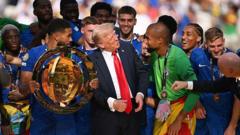
The air inside MetLife Stadium always carries a specific weight, but on this particular July evening, it feels entirely different. It is thick. Pressurized. Eighty thousand voices hum in a register that vibrates less in the ears and more in the center of the chest. Outside the concrete gates, the New Jersey marshlands are cooling under a summer twilight, but inside, under the blinding geometry of the floodlights, a global theater is reaching its absolute pitch.
This is the World Cup final. It is the single most watched sporting event on the planet, a moment where billions of eyes across every time zone converge on a single patch of grass. For ninety minutes, plus whatever agonizing minutes the referee tacks onto the clock, national identities are stripped down to sprinting men and a leather sphere.
But tonight, the drama on the pitch shares its orbit with a different kind of gravitational pull.
In a glass-walled suite high above the midfield line, a man adjusts his tie. Donald Trump is preparing to step into the center of this cathedral. He is not merely attending as a spectator; he is there to hand over the solid gold trophy to the victors. It is a collision of two universes that rarely blend without friction: the uncompromising, fiercely tribal world of global football and the hyper-charged arena of American optics.
To look at the official press releases is to see a simple logistical fact. The host nation’s president presents the prize. That is the tradition. Yet, beneath that sterile paperwork lies a complex reality of human emotion, soft power, and the sheer theater of modern leadership.
The Weight of Gold
Consider what that trophy actually represents. It is eighteen carats of solid gold, depicting two human figures holding up the Earth. It weighs just over thirteen pounds, but its real weight is immeasurable. Men weep for it. Nations plunge into spontaneous carnivals or deep, collective depressions based entirely on who gets to lift it.
When a head of state walks onto that pristine grass to present it, the sporting world slows down. For FIFA, the governing body of soccer, this is the ultimate manifestation of their sport's reach. They have successfully brought the world to America's doorstep. For Trump, a man whose entire public life has been defined by the pursuit of grand stages and decisive victories, this is an unmatched platform.
Imagine standing in the tunnel just moments before the presentation. The turf is chewed up from cleats. The smell of sweat, spilled water, and freshly cut grass hits you instantly. Nearby, the winning team is collapsing in joy, wrapped in flags, while the losers sit paralyzed on the ground, staring at nothing. The stadium speakers are blasting a deafening wall of sound.
Then, the announcement comes over the public address system.
It is a moment where the typical rules of political rallies disappear. A stadium crowd at a World Cup final is not a curated audience of supporters. It is a volatile, unpredictable cross-section of humanity. There are tens of thousands of traveling fans from Europe, South America, or Africa, mixed with American sports enthusiasts. When a political figure steps onto that stage, the sound that greets them is never uniform. It is a wall of cheers competing directly with a chorus of whistles and boos. It is raw, unedited democracy in a sporting bowl.
The Invisible Stakes
Global soccer has long been a mirror for international relations, even if the fans screaming from the rafters prefer to ignore it. The relationship between the United States and the rest of the footballing world has always been slightly complicated. For decades, America was the outsider looking in, treating soccer as a secondary pastime while the rest of the globe treated it as a religion.
Hosting this tournament, alongside Canada and Mexico, was a statement that the dynamic had fundamentally shifted. The infrastructure is American. The massive stadiums belong to the NFL. The money flowing through the broadcasting booths is measured in billions. By stepping onto the podium, the American president is effectively signaling that the United States has not just joined the global game, but is capable of anchoring its grandest night.
But the real human drama belongs to the athletes waiting for that metal to touch their hands.
Think of a player who grew up kicking a deflated ball against a concrete wall in Buenos Aires, London, or Munich. They have spent twenty-five years running until their lungs burned, sacrificing birthdays, enduring surgeries, and carrying the expectations of millions of strangers on their backs. They do not care about the politics of the person holding the trophy. They do not care about the cable news commentary that will follow the event the next morning.
To them, that golden statue is the only thing that matters in the universe. When Trump lifts it to hand it over, it represents the final millisecond of a lifelong journey. The flashbulbs explode in a synchronous white sheet of light, capturing a photograph that will hang in bars, living rooms, and museum halls for the next century.
The Echo After the Whistle
The stadium will eventually empty. The eighty thousand fans will pour out into the parking lots, hunting for their cars or navigating the crowded train platforms back to Manhattan. The bright floodlights will click off one by one, leaving MetLife Stadium in pitch darkness beneath the stars.
The analysts will dissect the match. They will debate the tactical substitutions, the missed penalties, and the controversial yellow cards. On other channels, political pundits will analyze the crowd's reaction to the presentation, looking for signs of shifting tides or cultural statements in the volume of the cheers versus the jeers.
Yet, away from the noise, the true essence of the evening remains untouched. A team of twenty-six players will board a charter flight, their lifetimes of effort validated by a single piece of gold that crossed a stage in New Jersey. The world will begin the four-year wait to do it all over again, reminded once more that nothing brings humanity together—or exposes its deep fractures—quite like the beautiful game.


/894596182-838.2202908273578apartamentocom2quartosavenda55mnocentrosaoleopoldo3.jpg)
