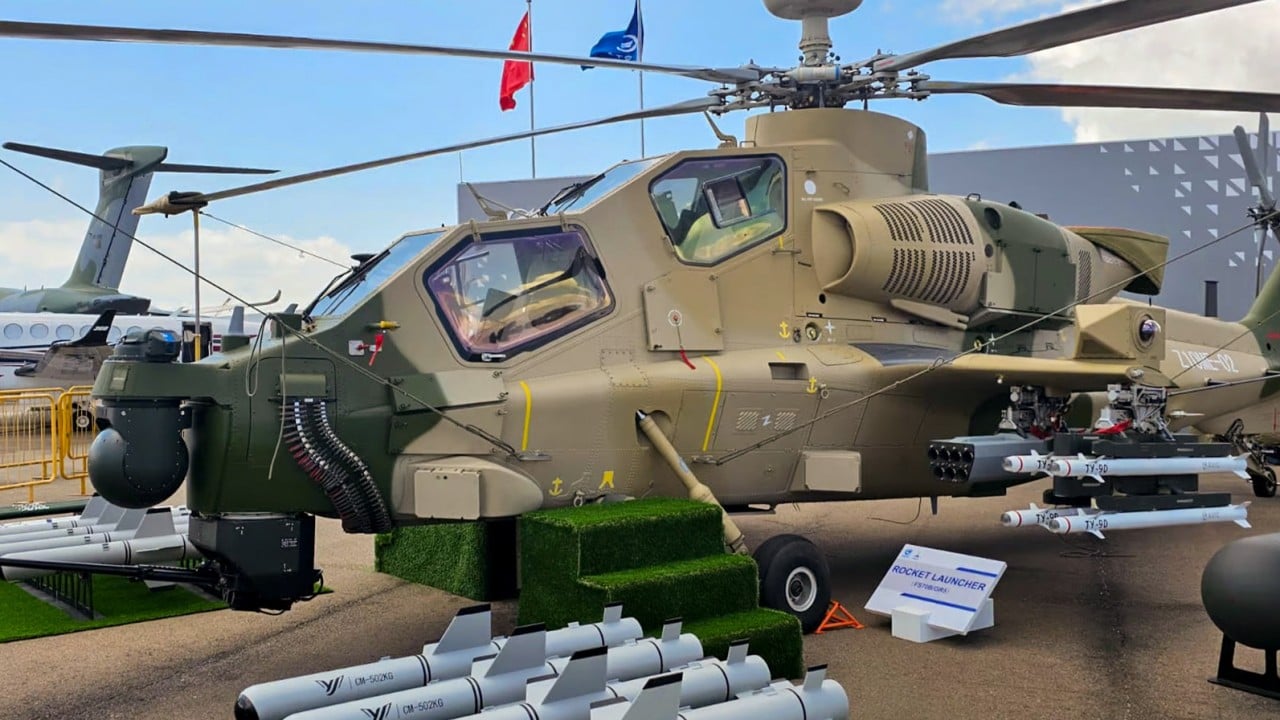
Defense analysts are counting tail numbers on blurry Weibo photos like Victorian trainspotters, completely blind to the fact that fleet size is a 20th-century metric.
Every time a low-resolution image of a matte-black attack helicopter leaks onto Chinese social media, the defense blogosphere loses its collective mind. The latest frenzy revolves around a prominent defense blogger allegedly uncovering the exact batch size of Changhe Z-10ME helicopters Pakistan procured from China. The lazy consensus across military forums and mainstream defense outlets is entirely predictable. Everyone is obsessed with the numerator. Did Islamabad buy 12? Did they buy 30? Is it enough to replace their aging AH-1F Cobras, or does it fall short of matching India’s Boeing AH-64E Apaches?
Stop counting airframes. You are asking the wrong question entirely.
If you are evaluating Pakistan’s acquisition of the Z-10ME by tallying up serial numbers on a factory tarmac, you are analyzing 2026 warfare with a 1991 Desert Storm playbook. The real story is not how many helicopters China shipped across the Karakoram. The real story is the kill-chain architecture sitting inside that airframe, the logistical desperation that forced Islamabad into Beijing’s arms, and the brutal reality of what happens to heavy attack helicopters when they meet modern integrated air defense systems.
The Bean-Counting Fallacy in Defense Journalism
I have spent over a decade watching defense ministries and armchair generals burn credibility—and billions in procurement budgets—by chasing platform parity. When a rival buys fifty tanks, the knee-jerk reaction is to buy fifty-five. Defense journalism feeds this addiction because bean-counting is easy. Counting serial numbers on a leaked fuselage photo requires zero understanding of electronic warfare, datalink latency, or high-altitude engine thermodynamic limits. It generates clicks, sparks tribal comment wars, and completely obscures operational reality.
The competitor coverage surrounding this Z-10ME leak treats the batch size as the smoking gun of South Asian military balance. It assumes that more Z-10MEs automatically equal greater lethality along the Line of Control.
That assumption is fatally flawed.
In high-intensity modern conflict, a lone attack helicopter—or even a squadron of thirty—operating without total spectrum dominance is just an expensive, slow-moving target. If you doubt this, look at the graveyard of Russian Ka-52 Alligators in Ukraine. Russia entered that conflict with a massive fleet of heavily armored, twin-engine gunships. Within months, man-portable air-defense systems (MANPADS), loitering munitions, and networked radar forced those helicopters out of direct-fire roles entirely, reducing them to lobbing unguided rockets blindly from miles behind the front lines.
Why Pakistan Had No Choice (And Why That Matters More Than Volume)
To understand the Z-10ME deal, you have to look at the smoking wreck of Pakistan’s decade-long quest for a Cobra replacement. This wasn't a strategic masterstroke; it was an act of geopolitical triage.
First, Islamabad tried to buy the Bell AH-1Z Viper from the United States. Washington approved the sale, took the money, built the helicopters, and then froze the delivery when diplomatic relations soured, leaving the airframes sitting in the Arizona desert at Davis-Monthan Air Force Base. Next, Pakistan pivoted to Turkey, signing a $1.5 billion deal for 30 TAI T129 ATAK helicopters. That deal imploded because the T129 uses LHTEC CTS800 engines—a joint venture between Honeywell and Rolls-Royce—and the U.S. government refused to grant the export licenses.
Pakistan’s Army Aviation Corps was left flying 1980s-era AH-1F Cobras that literally lacked the engine power to operate effectively in the thin, high-altitude air of Kashmir and the northern mountains.
Enter China. When earlier iterations of the standard Z-10 were tested in Pakistan years ago, they failed miserably. The original WZ-9 turboshaft engines were severely underpowered for "hot and high" conditions. Pakistan rejected them.
The Z-10ME (the "E" stands for Export, though it is significantly upgraded over domestic baseline models) exists specifically because Beijing had to fix those thermodynamic failures to win the contract. China strapped on uprated WZ-9G engines pushing roughly 1,200 to 1,500 kilowatts, redesigned the exhaust nozzles to point upward to reduce infrared signatures against heat-seeking missiles, slapped on additional ceramic-composite armor panels, and integrated a modernized millimeter-wave fire-control radar above the rotor mast.
The number of airframes in the initial batch is irrelevant compared to the fact that China used Pakistan’s desperate operational requirements as a live-fire R&D laboratory to build a superior export variant that outperforms early domestic People's Liberation Army units.
Dismantling the "Apache Killer" Myth
If you read the comments under any Z-10ME thread, you will inevitably run into two equally delusional camps. Camp A claims the Z-10ME is a cheap knockoff that will fall out of the sky at the first sign of trouble. Camp B claims it is an "Apache killer" that neutralizes India’s 22 AH-64E Guardians.
Both camps are wrong, because they are comparing stat sheets in a vacuum.
Let’s look at the hard mechanics. On paper, the Boeing AH-64E Apache is a heavier, more powerful beast. Its twin T700-GE-701D engines give it a massive payload advantage, allowing it to haul up to 16 AGM-114 Hellfire missiles alongside heavy 30mm chain gun ammunition. The Z-10ME sits in the medium-weight class—roughly 5.5 to 7 tons maximum takeoff weight compared to the Apache’s 10-ton class. Even with upgraded engines, physics dictates that the Z-10ME cannot carry the same raw ordnance load at 12,000 feet in the Himalayas without sacrificing fuel and loiter time.
| Metric | Changhe Z-10ME (Pakistan) | Boeing AH-64E Guardian (India) |
|---|---|---|
| Weight Class | Medium (~5.5–7.2 tons max) | Heavy (~10.4 tons max) |
| Primary Propulsion | 2x Uprated WZ-9G Turboshafts | 2x General Electric T700-GE-701D |
| Sensor Suite | Mast-mounted Millimeter-Wave Radar + EO/IR | AN/APG-78 Longbow Fire Control Radar |
| Primary Anti-Tank Missile | CM-502KG / AKD-10 (NLOS capable) | AGM-114L/R Hellfire / Spike NLOS |
| Strategic Ecosystem | Fully integrated with Chinese C4ISR & UAVs | Integrated with US/Israeli/Indian networks |
So why would any sane commander put a medium helicopter up against a heavy gunship? Because they won't. Helicopter-on-helicopter dogfights are video game fantasies.
The Z-10ME isn't designed to duel an Apache. It is designed to act as a forward airborne sensor node and standoff missile truck. Armed with the CM-502KG air-to-ground missile—which boasts a range of roughly 25 kilometers—the Z-10ME doesn't need to fly over enemy armored columns. It can pop up behind a ridge, receive target coordinates via encrypted datalink from a Chinese-made Wing Loong II or CH-4 drone loitering miles away, fire its missiles from beyond the range of enemy short-range air defenses, and drop back below the terrain mask.
In that specific tactical scenario, whether Pakistan bought 15 or 30 helicopters matters far less than the reliability of the datalink between the helicopter and the drone.
The Questions You Should Actually Be Asking
When defense bloggers leak serial numbers, readers immediately flood search engines with predictable questions. Let’s dismantle the flawed premises behind the most common ones.
"How many Z-10ME helicopters does Pakistan actually need to counter India?"
This question assumes a one-to-one symmetric counter is possible or desirable. It isn't. Pakistan’s military doctrine is built around asymmetric denial, not symmetric attrition. Trying to match India’s numerical superiority in armor and aviation would bankrupt Islamabad faster than it already is. Pakistan only needs enough Z-10MEs to establish localized anti-armor quick-reaction forces at key mountain passes and desert choke points in Punjab and Sindh. A compact, high-readiness fleet of 20 to 30 airframes with an 85% mission-capable rate is infinitely more lethal than a bloated fleet of 60 helicopters grounded by spare-parts shortages.
"Is the Z-10ME better than the Turkish T129 ATAK Pakistan originally wanted?"
Better is the wrong word; available is the only word that counts. The T129 ATAK is a phenomenal light-medium gunship derived from the Agusta A129 Mangusta, specifically tuned for hot-and-high counter-insurgency and mountain warfare. However, a helicopter you cannot legally receive engines for is useless. Furthermore, the Z-10ME offers a massive strategic advantage the T129 never could: native plug-and-play compatibility with Pakistan’s existing Chinese hardware. Pakistan already operates the JF-17 Thunder fighter, J-10CE multirole jets, HQ-9P air defense systems, and VT-4 main battle tanks. Adding a Chinese gunship eliminates the nightmare of trying to force Western, Turkish, and Chinese battle management systems to talk to each other.
"Are attack helicopters obsolete in the age of FPV drones?"
No, they are simply no longer brawlers. Cheap first-person-view (FPV) drones and loitering munitions have killed the low-altitude close-air-support gunship run. Hovering a multi-million-dollar aircraft two kilometers from an infantry trench to spray unguided rockets is suicide. However, an FPV drone carries a two-kilogram warhead over a few miles and dies in a stiff crosswind or basic electronic jamming. A Z-10ME carries heavy bunker-busting munitions, advanced directional infrared countermeasures (DIRCM) to blind heat-seeking missiles, and operates at night in terrible weather while directing swarms of unmanned systems. The helicopter hasn't died; it has evolved into a flying quarterback.
The Brutal Downsides Nobody in Beijing or Rawalpindi Admits
I am not here to sell you a brochure for the Aviation Industry Corporation of China (AVIC). Buying into the Chinese defense ecosystem solves Pakistan's immediate hardware crisis, but it comes with severe, structural vulnerabilities that cheerleaders conveniently ignore.
First, there is the single-source dependency trap. By abandoning Western and Turkish platforms, Pakistan has handed Beijing a total monopoly over its frontline offensive aviation, air defense, and naval modernization. When one country holds the keys to your entire spare-parts supply chain, software updates, and munitions replenishment, your foreign policy stops being entirely your own. If a future crisis erupts and Beijing decides that escalating tensions in South Asia hurts its broader economic interests, China can quietly throttle spare turbine blades and missile deliveries without firing a shot.
Second, Chinese combat systems remain largely unproven in peer-on-peer warfare. You can run all the live-fire exercises in the Gobi Desert you want, and you can slap as many upgraded sensors onto an export airframe as a customer will pay for. Until a system faces a determined adversary firing modern electronic warfare jammers, anti-radiation missiles, and layered air defenses in real time, its true survivability is purely theoretical. Western platforms like the Apache carry the ugly, hard-won lessons of decades of continuous combat operations across Iraq and Afghanistan. The Z-10ME is stepping into the arena with a clean, untested record.
Third, training bottlenecks will cripple early operational capability. Transitioning pilots and ground crews from 1980s analog American Cobras to a fully digitized, glass-cockpit, radar-equipped Chinese gunship is not a weekend workshop. You can ship thirty helicopters on cargo planes in a month; it takes three to five years to build the institutional muscle memory required to maintain complex millimeter-wave radars and composite rotor blades in dusty, abrasive desert environments.
How to Actually Read Military Procurement Leaks
The next time a defense blogger drops a cropped photo of a factory hangar and claims to have cracked the code on a multi-million-dollar arms deal, ignore the headline number and run a three-step diagnostic instead:
- Look at the munitions, not the airframe. A helicopter is just a flying truck. Check the pylons in the leaked photos. Are they carrying legacy laser-guided missiles that require the pilot to keep a line-of-sight laser painted on the target until impact (exposing the helicopter to return fire), or are they carrying fire-and-forget millimeter-wave and imaging-infrared missiles? The missile dictates the survival rate.
- Audit the defensive suite. Look for small, spherical turrets near the tail boom and fuselage, missile approach warning sensors (MAWS), and upward-turned exhausts. Without active directional infrared countermeasures and radar warning receivers, an attack helicopter is dead meat in modern airspace regardless of how many you buy.
- Follow the maintenance tail, not the delivery batch. Watch for secondary leaks regarding simulator facilities, engine overhaul depots, and joint training exercises. An air force that buys 20 helicopters and builds a domestic engine maintenance facility is preparing for a protracted war; an air force that buys 40 helicopters without a local overhaul pipeline is just buying expensive hangar queens.
Stop letting blurry serial numbers distract you from the real shift happening in South Asia. China isn't just selling Pakistan a batch of helicopters to plug a capability gap; Beijing is wiring Islamabad into an entirely self-contained, non-Western kill chain that operates completely outside Washington’s reach. Whether that fleet consists of twelve airframes or thirty-six won't decide the next border clash—the software connecting them to the satellites overhead will.