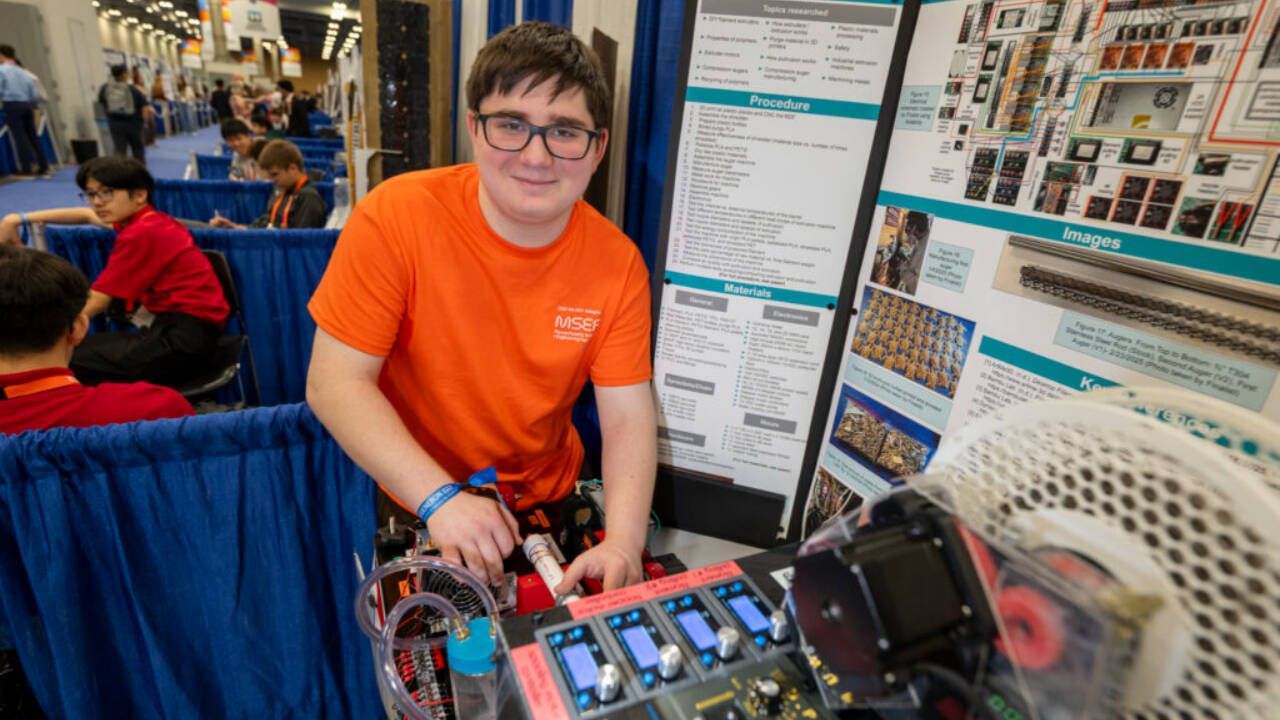
Every single person running a desktop 3D printer owns a graveyard of plastic mistakes. Spaghetti nests, failed calibration prints, and discarded 3D printer waste fill bins across workshops worldwide. Most people sweep it into the trash can without a second thought, figuring it is just the cost of doing business in modern additive manufacturing. Not everyone, though.
A sixteen-year-old student up in Massachusetts looked at that mountain of discarded filament and saw something entirely different. Instead of accepting plastic pollution as just another inevitable headache of home fabrication, this young developer engineered a practical, working solution to upcycle post-print waste. The result wasn't just a cleaner workbench. It netted a seventy-five thousand dollar prize that turned heads across the engineering world. If you found value in this article, you should read: this related article.
You might think garage innovation is mostly luck. You would be wrong. It takes grit, technical obsession, and a deep understanding of materials science.
Let's look at why additive manufacturing has a massive dirty secret that nobody in the influencer community wants to talk about. For another perspective on this event, see the latest update from Engadget.
The Plastic Problem Nobody Talks About
Consumer and industrial 3D printing gets marketed as clean, precise, and futuristic. You press a button on your laptop, watch a nozzle dance across a heated bed, and pull a pristine mechanical part off the plate. It feels digital. It feels weightless.
It is anything but weightless.
Polylactic acid or PLA dominates the desktop space. Manufacturers tout it as biodegradable because it comes from cornstarch or sugarcane. Sounds great on paper. In reality, PLA sitting in a standard municipal landfill takes years or decades to break down unless it goes into a high-heat industrial composting facility. Most cities do not have those facilities.
So your failed benchy models, tangled rolls of ABS, and brittle PETG scraps pile up. They sit in bins. They go straight to local landfills. Multiply that by millions of hobbyists, schools, and rapid prototyping labs around the globe. The volume of discarded thermoplastic scrap is staggering.
Most people ignore it. This Massachusetts student did not.
The Physics of Polymer Degradation
Solving a polymer waste problem requires understanding how plastics behave under thermal stress. When you melt thermoplastic polymers over and over, polymer chains break down slightly. Viscosity changes. Tensile strength drops.
Recycling filament isn't as simple as tossing old plastic chunks into a kitchen blender and pouring them into a hot tube. You need precise thermal control. You need shredding mechanisms that reduce irregular blobs and tangled strings into uniform pellets. You need extrusion rates that match spooling tension so the resulting diameter stays within strict tolerances. A variation of even zero-point-one millimeters means a jammed hotend halfway through a twenty-hour print.
The system developed by this young creator tackled those exact engineering bottlenecks. By combining mechanical shredding with a carefully calibrated desktop extrusion line, the project successfully converted raw printer waste back into reliable, spool-ready filament.
That technical precision is precisely why judges took notice.
Understanding Extrusion Dynamics
When you run recycled plastic through an extruder, you face thermal gradients that virgin pellet manufacturers avoid. Virgin pellets have uniform melt flow indices. Your box of random scrap contains old PLA mixed with slightly burnt PETG residue and moisture absorbed from humid summer air.
If your heating zones aren't precisely managed with PID controllers, the plastic either scorches or refuses to flow smoothly through the nozzle die. The student's winning design incorporated feedback loops that adjusted screw speed based on real-time pressure monitoring inside the barrel. That is university-level engineering built by a teenager in a home workshop.
The Economics of Maker Space Sustainability
Winning seventy-five thousand dollars isn't just about a nice trophy or bragging rights at science fairs. It validates a brutal economic reality. Filament is expensive. Buying virgin rolls of engineering-grade polymers drains budgets quickly, whether you run a school robotics lab or a small commercial print farm.
If you can recycle your own scrap streams at a fraction of the cost, the math changes instantly.
Let's break down the typical waste cycle in a busy workshop. You print a prototype. It fails because of bed adhesion. You scrap it. You print again. That is twenty percent material loss right off the top. Over a year of heavy prototyping, thousands of grams of plastic vanish into garbage bags.
By turning that waste back into usable feedstock, workshops slash operating expenses. More importantly, they stop contributing to local landfill congestion.
The Cost of Inefficiency
Most makers never calculate their true material waste percentage. They buy a spool of filament for twenty-five dollars, use sixty percent of it, and discard the rest due to tangled messes, moisture contamination, or failed prints. That translates to real money flushed down the drain every single month.
When you introduce an efficient recycling loop, your cost per kilogram drops dramatically. You're basically buying your own plastic twice if you don't recycle.
Why Traditional Recycling Fails Plastics
Municipal recycling plants hate 3D printing plastics. Facilities sort materials using optical sensors or sink-float tanks based on recycling codes stamped on packaging. Your random roll of carbon-fiber-infused nylon or wood-filled PLA has no recycling code.
Optical sorters cannot identify custom blended thermoplastics. If those materials slip into standard recycling streams, they contaminate batches of high-density polyethylene or polyethylene terephthalate. Recyclers reject the entire batch.
That means consumer 3D printer waste is virtually unrecyclable through normal municipal channels. Closed-loop, localized recycling is the only viable path forward.
This is where individual makers and small institutions have to take matters into their own hands. Waiting for municipal curbside programs to solve desktop manufacturing waste is a fool's errand.
How You Can Reduce Your Own Printer Waste Today
You don't need a massive grant or an engineering lab to start cleaning up your workflow. Small changes make a massive difference right now.
First, dial in your first layer calibration. Most failed prints happen in the first two minutes because of poor bed leveling or incorrect Z-offset. Fixing that eliminates the vast majority of spaghetti waste before it even forms.
Second, segregate your scrap by polymer type. Mixing PLA with PETG ruins both materials during remelting because their glass transition temperatures and melting points are completely different. Keep separate bins for every single material you run.
Third, look into desktop pelletizers and extruders if you manage a high-volume print farm. While commercial desktop recyclers require an upfront investment, they pay for themselves remarkably fast when you factor in the cost of buying replacement filament every single week.
Managing Moisture in Recycled Filaments
One major mistake people make with recycled plastic is ignoring moisture absorption. PLA and nylon act like sponges in humid environments. When you re-extrude wet plastic, steam bubbles form inside the filament strand.
Those bubbles cause microscopic inconsistencies, popping noises at the hotend, and weak layer adhesion in your final prints. Always run your shredded scrap through a food dehydrator or dedicated filament dryer before feeding it into an extruder.
The Broader Impact on Young Innovation
Stories like this sixteen-year-old's success remind us why practical problem-solving beats theoretical memorization every single time. Schools often focus on standardized testing while ignoring messy, real-world engineering challenges.
When young minds get the freedom to experiment with hardware, electronics, and materials science, real breakthroughs happen. You see teenagers building closed-loop recycling systems that outpace industrial R&D teams working with millions of dollars in budget.
It proves that innovation doesn't require corporate bureaucracy. It requires curiosity, a workbench, and the refusal to accept inefficient systems as permanent.
The maker community thrives on sharing knowledge and building better tools. Taking waste management seriously is the next natural evolution for desktop fabrication.
Stop throwing your scraps away. Start thinking about how every failed print can fuel your next success.