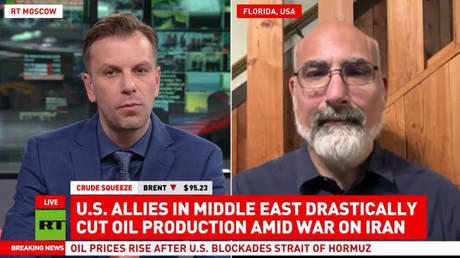
The Strait of Hormuz has long been the world’s most predictable nightmare. A narrow, 21-mile ribbon of water that carries 25 percent of the planet’s seaborne oil, it is a geographic trap that allows Tehran to hold the global economy hostage with a few well-placed sea mines or a swarm of fast-attack boats. For decades, the West treated this vulnerability as an unchangeable fact of nature.
That era of passive acceptance is over. The Trump administration is currently spearheading a radical decoupling of global energy from the Persian Gulf’s most dangerous bottleneck. By aggressively backing a massive expansion of overland pipelines and Red Sea export terminals, the U.S. aims to "rewire" the flow of crude so that it never has to enter the Strait at all. This isn't just a shift in logistics; it is a fundamental demolition of Iran’s primary source of geopolitical leverage.
The Petroline Pivot
The center of this strategy is Saudi Arabia’s East-West Pipeline, known as the Petroline. For years, this 746-mile artery was an underutilized relic of the 1980s. Today, it is being forced into a high-stakes evolution. In March 2024, the pipeline had a capacity of roughly 5 million barrels per day. By mid-2026, following an emergency conversion of parallel natural gas liquids lines, that capacity has been pushed to a staggering 7 million barrels per day.
This massive volume now bypasses Hormuz entirely, traveling from the Eastern Province oil fields directly to the port of Yanbu on the Red Sea. From there, tankers can reach European and African markets without ever seeing the Iranian coast. However, the math of global demand remains a cold mistress. Even at 7 million barrels, the Petroline only accounts for about a third of the volume that typically moves through Hormuz. To truly break the "Hormuz Clock," the infrastructure must be doubled again—a project the White House is now calling Operation Overflow.
Engineering the Permanent Bypass
The "rewiring" extends beyond Saudi borders. The United Arab Emirates has increasingly relied on the Habshan-Fujairah pipeline, which terminates at the Gulf of Oman, safely outside the Strait. But current capacity is still a fraction of what is needed to stabilize prices when tensions spike.
The investigative reality is that this isn't just about building more pipes. It is a total reorganization of Middle Eastern geoeconomics. We are seeing the early stages of a "western-facing" energy corridor that could eventually link Gulf producers to the Mediterranean through a series of overland routes.
- The Saudi-Jordan-Israel Corridor: A proposal to run pipelines directly to the Mediterranean ports of Ashkelon and Haifa.
- The Duqm Expansion: Rapidly scaling Oman’s port of Duqm to serve as the primary deep-water hub for the region’s exports.
- Drone-Centric Defense: Implementing "Ukrainian-style" autonomous defense grids along these hundreds of miles of pipe to prevent the kind of sabotage seen in 2019.
These projects are expensive, and they face immense political hurdles, but the cost of inaction is higher. With Brent crude hovering above $100 a barrel during the current blockade, the economic pain of a closed Strait has become a more potent motivator than regional rivalries.
The Asian Vulnerability
While the U.S. and Europe can pivot to Atlantic-facing supplies, Asia is the Achilles' heel of this plan. Roughly 80 percent of the oil flowing through Hormuz is destined for Asian markets—China, India, Japan, and South Korea. For a tanker leaving Yanbu (on the Red Sea) to reach Shanghai, it must navigate the Bab-el-Mandeb Strait, another high-risk chokepoint currently plagued by instability.
If Hormuz remains blocked, an Asian tanker would have to take the long way around the Cape of Good Hope. This adds approximately 40,000 kilometers to a round trip, driving freight costs into the stratosphere and making "cheap oil" a thing of the past. The Trump administration’s gamble relies on the belief that by securing the Red Sea and the Petroline, they can at least keep the world’s "swing" supply moving, even if the Asian market remains in a state of shock.
Interdicting the Tolls
A significant, often overlooked factor in this conflict is the "illegal toll" system. Reports indicate that before the full blockade took effect, Tehran was charging commercial vessels unofficial passage fees of up to $1 per barrel. This was essentially state-sponsored piracy disguised as "security fees."
The U.S. response has been blunt. The Navy has been authorized to interdict any vessel that has paid these tolls. This move targets the financial incentive for Iran to keep the Strait "semi-open" on its own terms. By forcing a choice between a total blockade and a free-flowing, Western-protected waterway, the U.S. is attempting to strip away the gray-zone tactics that Iran has used to fund its military operations for years.
The High Stakes of Infrastructure
Critics argue that pipelines are just as vulnerable as tankers. A single drone strike on a pumping station can take a million barrels off the market in seconds. This was proven on April 9, 2026, when an attack on the Petroline briefly slashed output by 700,000 barrels.
The difference is repairability. A sunken VLCC (Very Large Crude Carrier) in a narrow shipping lane is a generational catastrophe. A ruptured pipeline is an engineering problem that can be patched in 72 hours. Saudi Aramco proved this by restoring the Petroline to full capacity within three days of the latest strike.
The goal of "rewiring" isn't to create a perfect, invulnerable system. It is to create a redundant one. By diversifying the exit points for the world’s oil, the U.S. is making the Strait of Hormuz less relevant every day. If the current pace of construction continues, the most famous chokepoint in history may soon be nothing more than a local Iranian waterway, while the lifeblood of the global economy flows safely through the desert sands.