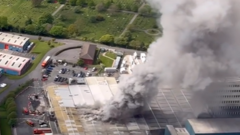
The intersection of private aviation and industrial risk management creates a unique, albeit accidental, layer of redundant oversight for large-scale manufacturing facilities. When Dave Fishwick, the founder of Bank of Dave, identified a fire at the Warburtons bakery in Burnley from his helicopter, he demonstrated a real-world application of high-altitude surveillance that standard ground-level industrial sensors occasionally fail to capture in the early stages of a thermal event. This incident exposes the gap between localized fire suppression systems and the macro-level visibility required to assess the structural integrity of massive industrial footprints.
The Industrial Surveillance Gap
Industrial facilities like the Warburtons bakery operate within a rigid safety framework consisting of Point Detectors (smoke and heat) and Aspirated Smoke Detection (ASD) systems. While these are highly effective for internal containment, they suffer from a "top-down" visibility deficit. A fire that originates or vents through the roof structure may not trigger internal sensors until the thermal bridge is fully compromised.
The detection of this specific fire from an aerial vantage point highlights three critical variables in industrial disaster mitigation:
- Thermal Plume Visibility: Smoke plumes at high altitudes follow atmospheric dispersion models that make them visible to aerial observers long before ground-level sensors or nearby civilians perceive the threat.
- Angle of Incidence: Ground-level observers are limited by the parallax of high perimeter walls. An aerial observer at 1,500 feet possesses a viewing angle that reveals roof-mounted HVAC units and ventilation shafts, which are common failure points in commercial bakeries.
- The Latency of Reporting: In this instance, the pivot from visual identification to emergency services dispatch occurred via a private citizen with high-speed mobility. This bypasses the traditional "cascade" of industrial alarms, which often require human verification before external authorities are notified to prevent false-alarm penalties.
The Cost Function of Industrial Fire Events
To understand the stakes of the Warburtons incident, one must quantify the potential loss of a high-throughput food production facility. The economic impact is not merely the cost of the physical assets—the ovens, the flour silos, and the building—but the disruption of the "Just-In-Time" (JIT) supply chain.
The bakery industry operates on razor-thin margins and high-velocity turnover. A fire-related shutdown triggers a sequence of financial degradations:
- Primary Loss: Destruction of capital-intensive industrial ovens. These are not off-the-shelf items; they have lead times spanning 12 to 18 months for fabrication and installation.
- Secondary Loss: Spoilage of raw ingredients. Flour and yeast require climate-controlled storage. Once power is cut or smoke contamination occurs, the entire inventory is typically classified as a total loss due to health and safety regulations.
- Tertiary Loss: Market share erosion. If Warburtons cannot fulfill its daily delivery slots to major retailers, those shelf spaces are immediately filled by competitors like Hovis or Kingsmill. Regaining that shelf space post-recovery involves significant marketing expenditure and slotting fee renegotiations.
The prompt identification by an external observer effectively shortened the "burn time" of the event. In fire dynamics, the growth of a fire is often modeled as a $t^2$ function, where the energy release rate increases exponentially over time. Every sixty seconds of reduced response time translates to a non-linear reduction in structural damage.
The Paradox of Private Assets in Public Safety
Dave Fishwick’s role in this event is a case study in the "Wealth-Safety Correlation." The utilization of private helicopters for regional travel unintentionally creates a voluntary civil air patrol. While Fishwick's primary objective is transit, the secondary utility is the provision of real-time intelligence to emergency services.
This creates a logic of "Opportunistic Surveillance." The reliability of such a system is statistically low because it relies on the coincidence of a flight path and a disaster event. However, the utility of the data provided during such a coincidence is extremely high. Unlike a fixed CCTV camera, a pilot can provide:
- Directional Vectoring: Informing fire crews of the exact point of entry for the most effective "offensive" fire attack.
- Atmospheric Assessment: Reporting wind direction and speed at altitude, which determines the path of toxic smoke and dictates evacuation zones for the surrounding Burnley area.
- Structural Health Monitoring: Observing roof sag or discoloration that indicates imminent collapse, information that is invisible to fire crews on the ground.
Logistics of the Burnley Response
The Burnley fire required a coordinated response from the Lancashire Fire and Rescue Service (LFRS). The operational challenge in a bakery fire involves the management of high-pressure gas lines and high-density combustible dust (flour).
Flour dust is an explosive hazard. If the fire had reached the silos or the pneumatic transport systems, the event would have transitioned from a structural fire to a volumetric explosion. The aerial report allowed for a rapid assessment of the distance between the visible flames and the high-risk zones (the silos).
LFRS utilized specialized equipment, including an aerial ladder platform (ALP), to mimic the vantage point Fishwick had from his helicopter. This confirms that in industrial firefighting, the "High Ground" is the only position from which to safely direct water monitors into the heart of a large-floor-plate building.
Systematic Limitations of External Detection
While the "Bank of Dave" intervention was successful, relying on external, accidental detection is a symptom of a larger risk management flaw. If a fire is large enough to be spotted from a helicopter, it has already moved past the "incipient" stage.
The limitations of this detection method include:
- Weather Dependency: VFR (Visual Flight Rules) pilots cannot operate in low visibility or heavy rain, precisely the conditions where ground-level smoke might be masked or suppressed by the atmosphere.
- Communication Latency: A pilot must communicate with Air Traffic Control (ATC) or use a mobile device (if at a legal and safe altitude) to relay information to a third party, who then contacts emergency services. This "broken telephone" effect can lead to coordinate errors.
- False Positives: Steam vents and standard industrial exhaust can be mistaken for smoke by untrained observers, potentially diverting emergency resources from actual life-safety incidents.
Structural Recommendations for Industrial Operators
The Warburtons event should serve as a catalyst for a shift in how large-scale manufacturing plants approach external monitoring. The reliance on internal sensors must be augmented with "Exterior-Facing Intelligence."
- Deployment of Long-Range Thermal Imaging: Facilities should install roof-mounted, 360-degree thermal cameras that use AI-driven change detection to identify hotspots before they breach the roofline.
- Integration of Drone Swarms: Large industrial parks in areas like Burnley should invest in "Drone-in-a-Box" solutions. Upon a fire alarm trigger, an automated UAV launches to provide a live 4K feed to both plant managers and the incoming fire service, replicating the aerial advantage provided by Fishwick without the need for a coincidental helicopter flyover.
- Acoustic Sensor Arrays: Implementing sensors that detect the specific sound frequencies of pressurized gas leaks or structural cracking can provide a 120-second lead time over traditional heat sensors.
The strategic play for Warburtons and similar industrial giants is the transition from reactive containment to predictive observation. The fact that a private citizen in a helicopter was the primary sensor for a fire at a multi-million pound facility indicates that the current internal safety loops are insufficient for the scale of the architecture. Future-proofing these assets requires moving the detection perimeter from the ceiling of the factory to the airspace above it.
Operators must prioritize the installation of automated, high-altitude-equivalent monitoring to ensure that the next thermal event is identified by a systematic process rather than the fortunate flight path of a local entrepreneur.