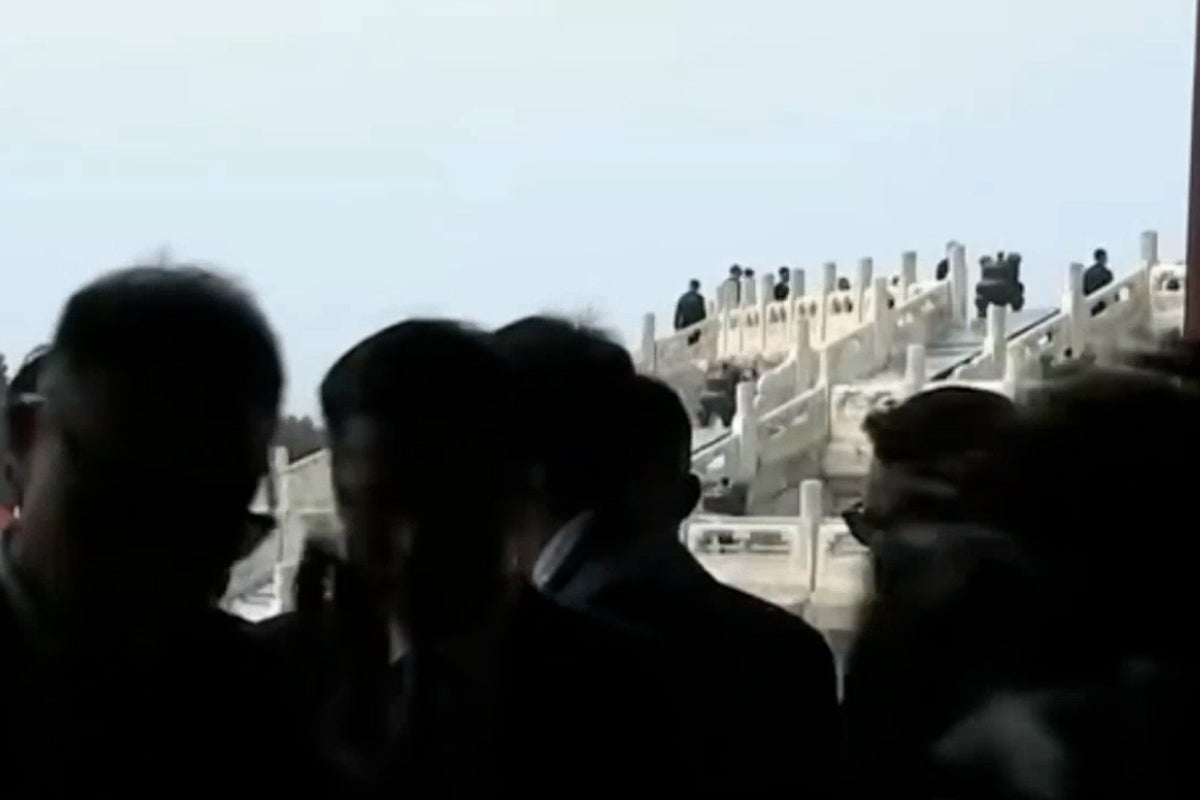
The physical altercation involving a White House staffer and members of the Chinese press corps during the 2019 Hanoi Summit represents a systemic breakdown in crowd flow engineering and inter-departmental security synchronization. While media coverage often focuses on the sensationalism of a staffer being "shaken and bruised," a rigorous analysis reveals that the injury was the inevitable output of a high-pressure environment where the demand for proximity exceeded the physical capacity of the controlled space. The failure was not one of intent, but of spatial logistics and the inability to manage the surge of the "press pool" as a kinetic force.
The Kinematics of Diplomatic Press Pools
The movement of press pools during high-stakes diplomatic summits follows the principles of fluid dynamics. When a high-value target (HVT)—in this case, the President of the United States and the Chairman of the Workers' Party of Korea—moves from one sterile zone to another, the accompanying press corps acts as a pressurized volume forced through a narrow aperture.
The Hanoi incident occurred when the press corps was directed to move into a dining area. The physical bottleneck created a velocity-density trade-off. As the density of the reporters increased in the doorway, their collective velocity dropped, creating a "shove-wave" from the rear. The staffer, positioned as a barrier or a guide at the threshold, became a stationary object in the path of a moving mass with significant momentum.
In physics terms, the force exerted on the staffer can be modeled by the change in momentum ($p$) over time ($t$):
$$F = \frac{\Delta p}{\Delta t}$$
When dozens of reporters, carrying heavy broadcast equipment (cameras, tripods, batteries), accelerate toward a single point of entry, the resulting force ($F$) at the point of impact often exceeds the structural resistance of a single human standing in a fixed position. The "bruising" reported was the physiological manifestation of this mechanical failure in crowd control.
The Three Pillars of Security Failure in Hanoi
To understand why this specific incident occurred, we must categorize the failure into three distinct operational pillars.
1. Structural Permeability
The physical barriers used to segregate the press from the diplomatic principals were insufficient for the volume of the Chinese delegation. In standard Secret Service protocols, "hard" barriers (bolted steel) are used for exclusion, while "soft" barriers (velvet ropes or human lines) are used for direction. In Hanoi, the reliance on human lines—specifically the staffer in question—to regulate the flow of a highly competitive press corps created a single point of failure.
2. Information Asymmetry and Competitive Incentive
Reporters are driven by a high-stakes incentive structure: the first to capture the visual or the quote wins the cycle. When the Chinese press corps perceived a closing window of access, the internal competition within the pool overrode verbal instructions from White House staff. The lack of a synchronized entry protocol—where reporters are released in staggered waves—ensured that the maximum number of people hit the bottleneck simultaneously.
3. Cultural and Protocol Friction
Diplomatic security relies on "perceived authority." In domestic U.S. events, the Secret Service badge or a White House press credential carries a specific weight that dictates behavior. In an international theater, particularly one involving the Chinese state press, these hierarchies are contested. The Chinese reporters operated under their own internal mandates, which prioritized the capture of footage over the localized directives of a foreign press secretary or staffer. This friction creates a non-compliant crowd dynamic that traditional staff-led crowd management cannot handle.
Quantifying the Logistics of the Press Surge
The failure in Hanoi can be mapped through a cost-benefit analysis of the "scrum." For a reporter, the cost of a minor physical altercation is low compared to the benefit of global exclusive footage.
- Mass Factor: A standard ENG (Electronic News Gathering) camera weighs between 15 and 25 pounds. A tripod adds another 10 to 15 pounds.
- Kinetic Energy: A reporter moving at a brisk walk (1.5 m/s) with a total mass of 90 kg (including gear) possesses significant kinetic energy ($E_k = \frac{1}{2}mv^2$).
- Vector Summation: When 20 reporters move in the same direction, their vectors sum. If the staffer is positioned perpendicularly to this vector, they absorb the total energy of the lead wave.
The staffer was essentially acting as a mechanical fuse. In electrical engineering, a fuse is designed to break to protect the rest of the circuit. In this scenario, the staffer "broke" (was knocked down) because the system—the security perimeter—was overloaded.
The Cost Function of Diplomatic Access
The Hanoi summit suffered from an "Access Inflation" problem. Both the U.S. and North Korean delegations wanted maximum visibility, but neither was willing to pay the operational price of a larger, more secure venue that could accommodate the necessary press volume safely.
This creates a bottleneck risk. When the physical space is constrained, the only way to maintain safety is to reduce the "throughput"—meaning fewer reporters. However, reducing the press count has a political cost. In Hanoi, the decision was made to maximize access while minimizing space, which shifted the risk onto the personnel on the ground.
The staffer’s injuries were not a random act of aggression but a predictable byproduct of a high-throughput/low-space configuration.
Tactical Limitations of White House Press Management
Current White House press management lacks a buffer capacity. When a staffer is assigned to "hold the door" against a surge, they have no escalation path other than physical resistance or total retreat.
The limitations of this strategy include:
- Fixed Positioning: Staffers are often told to stand in specific spots, making them easy targets for a crowd surge.
- Lack of Physical Training: Press staffers are communications experts, not tactical crowd controllers. Expecting them to maintain a perimeter against professional camera crews is a mismatch of skill sets.
- Communication Lag: The time between a staffer realizing a surge is happening and the Secret Service intervening is often 5 to 10 seconds—the "critical window" where the trampling occurs.
Rethinking Diplomatic Crowd Management
To prevent the recurrence of the Hanoi incident, the logistical framework for international summits must transition from "instruction-based" management to "infrastructure-based" management.
Implementation of Hard Apertures
Instead of using staffers to gatekeep entry points, summits must utilize physical turnstiles or narrow, reinforced corridors that allow only one person to pass at a time. This mechanically limits the "flow rate" of the press pool, preventing the buildup of a surge-wave.
Predictive Crowd Modeling
Using historical data from previous summits (Singapore, G20, Hanoi), security teams can model "high-risk intervals"—the moments immediately following the conclusion of a photo-op. These models indicate exactly when and where the pressure will peak, allowing for the deployment of physical barriers 60 seconds prior to the surge.
The Role of Neutral Zone Marshals
Relying on a staffer from one of the participating nations creates a conflict of interest that the press may ignore. Using neutral, third-party security marshals (in this case, Vietnamese security) who are trained in crowd suppression techniques provides a more effective psychological and physical deterrent.
The Hanoi incident serves as a data point in the ongoing struggle between diplomatic transparency and operational safety. The "bruised and shaken" staffer was the casualty of a system that prioritized the optics of the event over the physics of the environment. Future planning must account for the fact that a press pool, under the pressure of a global deadline, behaves less like a group of professionals and more like a high-pressure fluid seeking the path of least resistance.
The strategic play for future summits is the elimination of "human gates." Security protocols must mandate that no staff member is ever positioned as a physical barrier in a high-traffic corridor. All flow control must be handled by non-living infrastructure, with personnel moved to "observer" roles five feet back from the flow line. This decoupling of personnel from the friction point is the only way to mitigate the risk of physical injury in high-density diplomatic environments.