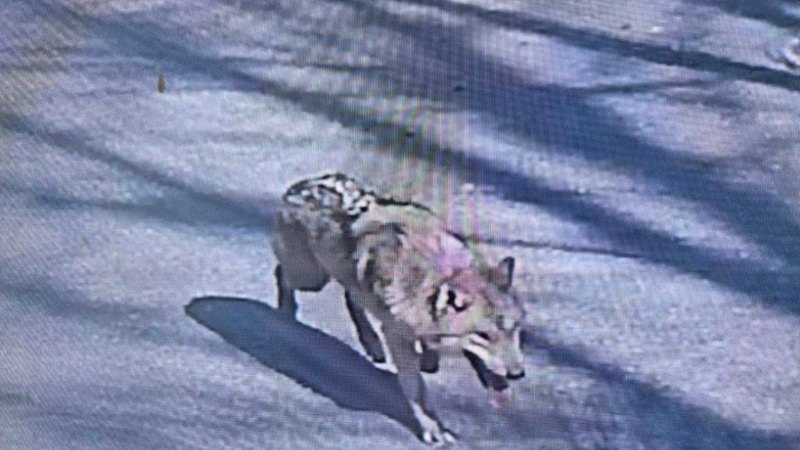
The containment of a translocated apex predator within an urbanized environment represents a high-stakes failure of biological containment and a complex exercise in multi-agency logistics. When a gray wolf (Canis lupus) evades capture for nine days in a densely populated region, the incident ceases to be a simple animal control task and becomes a study in terrain-driven asymmetric advantages. The wolf’s success in remaining elusive was not a product of luck but an optimization of nocturnal movement, thermal shielding, and the exploitation of suburban "green corridors." To understand how a single animal captivated a nation while paralyzing local infrastructure, one must analyze the biological variables and the tactical bottlenecks that define modern wildlife recovery operations.
The Biological Asymmetry of Urban Evasion
A wolf’s survival in a human-dominated landscape depends on its ability to minimize caloric expenditure while maximizing concealment. In this specific nine-day window, the predator utilized a strategy known as "habitat partitioning." By retreating into fragmented woodlots during peak human activity (07:00 to 19:00) and utilizing drainage culverts or railway easements during low-light hours, the animal effectively neutralized the primary advantage of human search teams: visibility.
The core difficulty in these operations stems from the wolf’s sensory suite. While human search efforts rely heavily on visual cues and technology—drones, FLIR (Forward Looking Infrared), and optics—the wolf operates via olfaction and audition. A wolf can detect human presence at distances exceeding one kilometer depending on wind direction. This creates a "dead zone" for search teams; by the time a perimeter is established, the animal has already processed the intrusion and exited the sector.
Constraints of the Urban Canopy
Thermal imaging, often cited as the definitive tool for tracking, faces significant degradation in suburban environments. Hard surfaces like asphalt and concrete act as thermal sinks, retaining heat throughout the night and creating "thermal noise" that masks the heat signature of a 30-to-40-kilogram mammal. Furthermore, the dense undergrowth of unmanaged suburban brush provides a physical barrier that disrupts the line-of-sight required for tranquilizer deployment, which typically requires a clear path of less than 30 meters.
Logistics and the Cost Function of Containment
The nine-day duration of the capture reflects the escalating complexity of the "search area expansion" model. In the first 24 hours, the search radius is manageable. However, if containment fails in the initial phase, the potential search area grows exponentially, following the formula for the area of a circle where the radius is determined by the animal's potential travel distance ($A = \pi r^2$). A wolf can easily cover 30 to 50 kilometers in a single night, meaning that by day three, the search grid becomes statistically impossible to saturate with physical personnel.
The Three Pillars of Tactical Failure
- Information Saturation: Public interest creates a data bottleneck. Law enforcement receives hundreds of "sightings," most of which are false positives (large dogs, coyotes, or shadows). Sifting through this low-signal data consumes man-hours that should be dedicated to active tracking.
- Perimeter Instability: Unlike a wilderness setting, an urban search area cannot be hard-closed. Traffic flow, pedestrian movement, and private property boundaries prevent the establishment of a sterile search zone. The wolf exploits these gaps, moving through backyards and across roads when human activity dips.
- Biological Resilience: The assumption that an escaped animal will quickly succumb to hunger or dehydration in a city is a fallacy. Urban environments are calorie-dense. Trash receptacles, outdoor pet food, and high populations of urban prey (rabbits, squirrels, and deer) provide a steady caloric intake, allowing the predator to maintain high performance indefinitely.
The Chemistry of Capture: Sedation vs. Trapping
The final phase of the operation—the successful capture—involves a precarious balance of pharmacology and ballistic accuracy. The use of a tranquilizer rifle is often the preferred method for public relations, but it is technically the most difficult to execute.
A tranquilizer dart does not provide instantaneous immobilization. Depending on the chemical cocktail used—typically a combination of Medetomidine and Ketamine—the induction period (the time from impact to unconsciousness) can range from five to fifteen minutes. In an urban setting, a wolf can travel several kilometers in ten minutes. If the animal is not tracked perfectly during this "twilight" phase, it may collapse in a hidden location, leading to potential hyperthermia or death before teams can locate it.
Physical Trapping Mechanisms
Soft-catch leg-hold traps and darting from a stationary concealed position are more reliable but require the animal to follow a predictable pattern. The nine-day delay suggests the wolf was in a state of high physiological stress, making its movements erratic and unpredictable. This unpredictability forced the capture team to shift from a proactive "trapping" strategy to a reactive "flushing" strategy, eventually cornering the animal in a location where the terrain finally favored the containment team.
Socio-Technological Impact and Public Hysteria
The "captivation of the nation" mentioned in the source text is a quantifiable variable in wildlife management known as the "charismatic megafauna effect." This psychological phenomenon dictates that public interest—and subsequent political pressure—is disproportionately high for large predators compared to other environmental crises. This pressure often forces management teams to prioritize "non-lethal" outcomes even when those outcomes significantly increase the risk to public safety or the cost of the operation.
This incident exposed a critical vulnerability in urban wildlife policy: the lack of standardized rapid-response protocols for non-native or translocated large predators. Most municipal animal control units are equipped for domestic or small-scale wildlife (raccoons, feral dogs) and lack the specialized ballistics or heavy-duty sedation equipment required for a 100-pound wolf.
Strategic Failure Analysis of Translocation
The root cause of this nine-day crisis was not the wolf’s escape, but the systemic failure of the initial containment or translocation facility. To prevent a recurrence, the following operational adjustments are mandatory for any facility housing high-mobility apex predators:
- Secondary Containment Redundancy: Perimeter fences must be supplemented by buried mesh to prevent "dig-outs" and overhangs to prevent "climb-overs."
- Biometric Tracking Mandates: Any predator scheduled for translocation or temporary housing must be fitted with a dual-redundancy GPS/VHF collar. This transforms a "search" into a "recovery," reducing the duration of the incident from days to hours.
- Rapid Response Tiers: Municipalities must establish clear triggers for when local control is handed over to specialized state or federal wildlife marksmen. Delaying this transition in favor of local optics is the primary driver of extended "on the run" durations.
The capture of the wolf ends the immediate threat but highlights a growing friction point: as urban sprawl encroaches on natural habitats and as "rewilding" or translocation projects increase, the intersection of wild biology and civil infrastructure will create more frequent points of failure. The nine-day window was a warning that the current suburban landscape is not a cage, but a corridor for those evolved to navigate it.
The final strategic move for management agencies is the immediate transition from reactive capture to a comprehensive audit of translocation security protocols. If the failure point was structural, the facility must be decommissioned until it meets the standards of a high-security zoological institution. If the failure was human error, the training modules for handler-animal transitions require a complete overhaul, focusing on the "containment-first" principle where no predator is moved without a secondary barrier in place. Every hour an apex predator spends in an urban environment increases the probability of a lethal encounter; reducing that time requires pre-emptive investment in tracking technology rather than post-escape logistics.