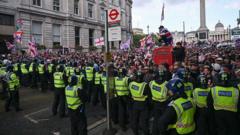
The deployment of 4,000 officers and specialized armored assets by the Metropolitan Police represents a shift from reactive policing to a logic of total saturation. When two ideologically opposed groups occupy the same geographic theater, the objective of law enforcement moves beyond simple "order maintenance" into a complex logistical exercise in spatial segregation and kinetic prevention. The success of such an operation depends not on the number of boots on the ground, but on the precise management of friction points where opposing crowds are most likely to intersect.
The Tri-Modular Policing Framework
Modern urban disorder management is built on three distinct operational modules. Each serves a specific function in neutralizing the risk of mass-participation violence while maintaining the thin veneer of democratic protest rights.
1. Spatial Partitioning and Buffer Zones
The primary risk in dual-protest scenarios is the "merger event," where separate groups coalesce into a single chaotic mass. The Metropolitan Police mitigate this through physical partitioning. This involves more than just steel barriers; it is an exercise in urban engineering. By utilizing the City’s natural bottlenecks and wide thoroughfares, the police create dead-zones—buffer regions several hundred meters wide—that prevent visual and physical contact between opposing factions.
2. Rapid Intervention and Kinetic Deterrence
The inclusion of armored vehicles is not merely for officer protection; it serves as a psychological and physical anchor. In a crowd-control context, these vehicles act as mobile, impenetrable barricades that can be repositioned faster than a human line. They provide the "heavy" element of the force-multiplication strategy, allowing a smaller number of officers to hold a wider perimeter.
3. Intelligence-Led Target Extraction
Large-scale deployments utilize "spotter" teams and high-resolution surveillance to identify high-risk individuals within a crowd. Rather than engaging the entire mass—which risks a general riot—the strategy focuses on "surgical extractions." This involves small, highly trained units moving into the crowd to remove agitators before their influence triggers a wider escalatory cycle.
The Cost Function of Mass Deployment
The decision to mobilize 4,000 officers carries a significant operational deficit elsewhere in the capital. This is the "Security Opportunity Cost." Every officer stationed on a protest line is an officer removed from local borough policing, domestic response, or investigative duties.
The Metropolitan Police utilize a graded mobilization scale. At the 4,000-officer mark, the force is effectively operating at a Level 1 mobilization. This triggers specific logistical requirements:
- Mutual Aid: Drawing officers from surrounding regional forces to fill gaps.
- Extended Shifts: Moving from 8-hour to 12-hour patterns, which leads to a steep decline in decision-making quality after the first 48 hours of an operation.
- Financial Burn Rate: Between overtime pay, logistical transport, and specialized equipment maintenance, a deployment of this scale can cost the taxpayer millions of pounds per 24-hour cycle.
The efficacy of this spending is measured by a "Zero-Event" metric. In this framework, the police only "win" if nothing happens. If the day ends with zero serious injuries and minimal arrests, the 4,000-officer deployment is considered a success, despite the immense financial and operational strain it places on the wider force.
The Mechanics of Crowd Friction
Violence in protests is rarely a spontaneous collective decision. It is the result of specific environmental and psychological triggers. The Metropolitan Police strategy aims to remove these triggers through a "De-escalation by Presence" model.
The presence of a massive, disciplined police line creates a "high-cost" environment for potential rioters. When the perceived cost of an illegal action (immediate arrest, physical containment) outweighs the perceived benefit (shouting at an opponent or damaging property), the majority of the crowd remains passive. However, this creates a secondary risk: the "Kettling Paradox." If a crowd feels too restricted, the psychological pressure can lead to a desperate surge against the police lines.
Effective commanders avoid this by ensuring "Pressure Release Valves"—pre-planned exit routes that allow protesters to leave the area but not to move toward their opponents. The logic is simple: keep the crowd moving, keep them separated, and never allow them to settle into a fixed, defensive position.
Armored Assets and the Logistics of Force
The use of armored vehicles signals a transition from "Peel's Principles" of policing by consent toward a paramilitary containment model. These vehicles are essential for:
- Route Clearance: Removing debris or abandoned vehicles that could be used as improvised barricades.
- High-Intensity Protection: Providing a safe haven for officers if the protest degrades into a projectile-rich environment (bricks, bottles, or incendiaries).
- Command and Control: Acting as forward communications hubs that are immune to the chaos of the street level.
The deployment of these assets is a calculated risk. While they provide essential utility, they also serve as a visual stimulant for more radical elements of a protest. The Metropolitan Police balance this by keeping heavy assets in "reserve positions"—visible enough to act as a deterrent, but not so close as to be viewed as an immediate provocation.
The Bottleneck of Digital Coordination
A critical factor that the Metropolitan Police must now manage is the "Digital Feedback Loop." Protesters use encrypted messaging apps to coordinate movements in real-time, often bypassing static police lines. To counter this, the Met employs Tactical Communications Interception and open-source intelligence monitoring.
This creates a cat-and-mouse game of urban navigation. As police move to block a bridge, protesters receive a notification to redirect to a different crossing. The 4,000 officers are therefore not just a wall, but a fluid network that must react to digital shifts in real-time. The bottleneck here is communication latency; if the central command center cannot relay new orders to the frontline within minutes, the physical deployment becomes obsolete.
Strategic Forecast for Urban Management
As the frequency of high-intensity dual protests increases, the current model of mass-manpower deployment faces a sustainability crisis. The Metropolitan Police cannot indefinitely subsidize the protection of ideological clashes at the expense of general public safety.
The move toward "Technological Containment" is the inevitable next step. This involves:
- Enhanced Perimeter Automation: Using modular, rapidly deployable fencing systems that require fewer officers to guard.
- AI-Driven Analytics: Utilizing real-time video feeds to predict crowd surges before they happen by analyzing density shifts and movement vectors.
- The Normalization of Hard Assets: Armored vehicles and specialized riot units becoming a standard feature of the London cityscape during weekends.
The ultimate strategy for the Metropolitan Police is the transition from "Managing the Crowd" to "Engineering the Environment." By making the physical space of London inhospitable to large-scale friction—through street design, surveillance, and overwhelming force presence—they aim to make the logistical cost of protesting higher than the groups are willing to pay.
The current deployment is a test of this attrition model. If the 4,000-officer surge prevents a riot today, it sets the new baseline for every future protest of this nature. The "new normal" is not peaceful coexistence, but a heavily policed, state-mandated separation that prioritizes the continuity of the City over the volatile expressions of its citizens.
The strategic play here is clear: leverage massive upfront force to demoralize potential agitators, ensuring that the "battle" is won in the minds of the participants before they ever reach the police line. Failure to maintain this dominance results in a breakdown of the urban fabric that takes years, and billions more in funding, to repair.