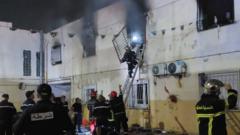
An electrical short circuit in a neonatal care facility in El Oued, Algeria, caused a catastrophic fire that killed eight infants. The tragedy highlights a systemic crisis in regional infrastructure, where regulatory failures and delayed emergency responses routinely turn preventable technical faults into fatal disasters. While initial official reports pointed exclusively to a faulty anti-mosquito device, a deeper examination of the incident reveals a chronic lack of preventative maintenance, substandard construction materials, and a severe deficit in localized emergency medical resources.
The fire broke out in the early morning hours at the Mother and Child Hospital in El Oued, a city located in northeastern Algeria near the Tunisian border. Within minutes, dense, toxic smoke filled the wing.
Emergency response teams managed to rescue eleven infants, three mothers, and nine staff members. For eight newborns, however, the rescue came too late. They died from smoke inhalation and severe burns.
The immediate public reaction was a mix of grief and profound anger. This was not an isolated act of God. It was the predictable outcome of an administrative system that treats safety compliance as a secondary concern.
Fire Safety Failures in Public Infrastructure
The official investigation quickly targeted a small, wall-mounted plug-in mosquito killer. Investigators concluded that the device overheated, sparked, and ignited nearby synthetic bedding materials.
Focusing solely on the device misses the broader engineering failure. A single malfunctioning appliance should not result in the total failure of a hospital wing's safety ecosystem. Modern healthcare facilities rely on redundant defense layers to isolate and suppress localized fires before they breach patient rooms.
In the El Oued facility, those layers did not exist. The building lacked automated smoke-detection systems tied to localized alarms. Without early detection, the fire smoldered undetected until the room became completely engulfed.
Furthermore, the materials used in the interior outfitting of the ward contributed directly to the speed of the disaster. Budget-grade plastics and synthetic wall paneling common in fast-tracked public construction release highly toxic hydrogen cyanide and carbon monoxide gases when burned. In a neonatal ward, where patients cannot move and possess highly vulnerable respiratory systems, these gases prove fatal long before radiant heat becomes an issue.
The electrical grid architecture itself presents a continuous hazard. Regional facilities in Algeria frequently suffer from violent voltage fluctuations. Without commercial-grade surge protection and heavy-duty circuit breakers, sensitive medical equipment and standard appliances face constant risk of thermal overload. The Oued Souf facility lacked these system-wide protections, leaving individual wall outlets vulnerable to extreme spikes in current.
The Regional Healthcare Divide
The disaster in El Oued exposes the stark disparity between Algeria’s northern coastal medical hubs and its marginalized southern and interior regions. Healthcare funding flows disproportionately to the capital, leaving peripheral provinces with understaffed, poorly maintained outposts.
Medical staff in these regional clinics work under grueling conditions. They cope with routine supply shortages and outdated infrastructure.
"We are operating with equipment that should have been decommissioned a decade ago," notes a regional healthcare administrator who spoke on the condition of anonymity. "When a machine breaks down, we don't get a replacement. We get a patch job."
This lack of investment extends to specialized training. Staff members receive minimal instruction on emergency evacuation protocols for non-ambulatory patients. When the fire broke out, nurses and orderlies had to navigate pitch-black, smoke-filled corridors without emergency lighting or specialized transport incubators. They carried infants out by hand through a single exit route, as secondary emergency exits were either locked or blocked by surplus medical clutter.
The response time of the Civil Protection units further complicated rescue efforts. The fire station’s proximity to the hospital should have guaranteed a three-minute response window. Delays in communication and difficulties navigating poorly planned local access roads extended that timeline, giving the toxic smoke more time to fill the ward.
Accountability and Institutional Reform
Following the public outcry, the government terminated the hospital director and suspended several local health officials. The Algerian judiciary initiated a formal criminal inquiry into administrative negligence.
These dismissals follow a familiar political pattern observed after previous infrastructure disasters in the region. Firing mid-level bureaucrats provides immediate political insulation for top officials, but it does nothing to correct the underlying structural issues. True accountability requires a complete overhaul of how public buildings are certified and inspected.
Algeria possesses strict building codes on paper. The gap lies entirely in enforcement. Independent safety audits are virtually non-existent in public sector projects, replaced instead by internal bureaucratic sign-offs that gloss over non-compliant wiring, missing fire doors, and absent suppression systems.
Fixing this broken loop requires moving inspection duties entirely outside the Ministry of Health's purview. An independent, third-party regulatory body must hold the authority to shut down non-compliant facilities immediately, regardless of political pressure or local administrative inconvenience.
Material Upgrades and Future Risk Mitigation
Preventing the next institutional fire requires an immediate shift away from cosmetic political fixes toward hard physical engineering upgrades. The most critical intervention involves the mandatory installation of localized fire suppression systems.
| Safety Component | Standard Current Status | Required Minimum Standard |
|---|---|---|
| Smoke Detection | Manual reporting or absent alarms | Photoelectric sensors linked to central dispatch |
| Wiring Standards | Unprotected PVC conduit | Low-smoke, zero-halogen (LSZH) fire-rated cabling |
| Surge Protection | Individual power strips | Facility-wide industrial transient voltage surge suppressors |
| Emergency Exits | Often blocked or locked for security | Panic-bar hardware with dedicated battery backup alarms |
Upgrading the physical plant of these hospitals is expensive. Yet, the cost of retrofitting these wards with fire-rated drywall and modern breaker panels is negligible when measured against the legal liabilities and human toll of a single catastrophic failure.
The reliance on cheap procurement contracts must end. Governments must mandate that all materials used in medical environments meet strict flame-retardant and low-toxicity international benchmarks.
The tragedy in El Oued cannot be undone by bureaucratic shuffle or symbolic firing. It stands as a grim reminder that without rigorous engineering oversight, independent regulatory enforcement, and a fundamental realignment of regional healthcare funding, public buildings remain structural traps waiting for a single spark.


