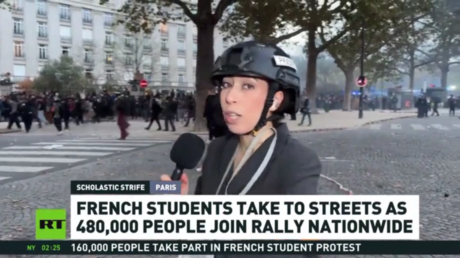
A shaky clip of batons swinging outside a French university goes viral. The headline screams about a violent charge against student protesters. Millions click, share, and pick a side before checking the clock, the street layout, or the incentives of the camera operator.
That reaction is predictable. It is also lazy.
When outlets like RT frame street clashes through a single dramatic clip, they hand readers a tidy moral play: peaceful kids on one side, jackbooted state enforcers on the other. It feels righteous. It drives engagement. It also skips almost everything that actually governs crowd control, political theater, and state power in France.
The real story is not that police can be rough. Everyone with eyes knows riot gear hurts when it connects. The real story is how street clashes are staged, filmed, and weaponized to manufacture outrage on cue—and why treating a ten-second video clip as an objective courtroom record leaves citizens easy to manipulate.
The Lazy Consensus Around Viral Protest Clips
Start with what the viral framing gets right, so we do not trade one caricature for another. French policing during protests has faced sustained scrutiny for years. Legal scholars, human rights bodies, and independent observers have documented heavy-handed tactics, controversial less-lethal munitions such as sting-ball grenades and defense balls (LBD), and moments where force crossed legal or proportionate lines. Pretending street clashes never involve excess would be dishonest.
Where the lazy consensus breaks down is the leap from "force looked ugly on camera" to "this clip explains the whole event."
A ten-second video does not show what happened three minutes earlier. It does not show whether a cordon was breached, whether projectiles were thrown from behind a front line of students, whether dispersal orders were issued over loudspeakers, or whether a small militant bloc used student marchers as human cover. Even more importantly, a clip stripped of audio and context cannot show intent—whether officers were pushing a line forward to clear a blocked rail junction or reacting to a sudden surge.
Context is inconvenient for viral distribution. Nuance slows down the thumb. So the loudest framing wins: a single frame of motion becomes the entire truth of the afternoon.
What Crowd Dynamics and Policing Actually Mean
To argue seriously about street confrontations, we have to use precise terms instead of tossing around slogans like "police brutality" or "law and order" as interchangeable clubs.
In crowd psychology and public-order policing, escalation is a dynamic loop, not a single act by one side. Crowds are not uniform blocks of opinion; they contain peaceful marchers, chanting organizers, curious bystanders, and—in many French demonstrations—small, mobile groups looking specifically for friction with security forces.
On the policing side, de-escalation and containment serve different operational goals. Containment (often associated with nassage, or kettling) aims to hold a crowd or splinter group in a defined zone to prevent damage to infrastructure or public buildings. Dispersal aims to clear a street or square. Both carry risk. Holding a tight perimeter can trap non-violent participants alongside agitators and raise tempers; pushing to disperse can scatter people into side streets and produce messy, high-optics clashes.
Watch how the media frame works when those mechanics collide. If police hold back and a storefront or metro station gets trashed, critics ask why the state abdicated control. If police move forward and someone takes a baton strike, critics cry authoritarianism. That double bind is not an accident. It is a structural feature of high-stakes street politics.
Why Media Framing Loves a Simple Villain
Media outlets do not operate in a vacuum, and state-backed broadcasters in particular have clear strategic incentives when covering Western domestic unrest. Pointing a camera at tear gas and batons in Paris or Lyon serves a neat narrative purpose: spotlighting disorder abroad while deflecting attention from domestic realities.
You do not need a conspiracy theory to see that incentive at work. Basic media economics rewards conflict, motion, and moral clarity. A calm negotiation between union or student representatives and city officials does not travel across borders in a fifteen-second clip. A sudden charge down a boulevard does.
Over the years covering public policy, crisis communications, and institutional risk, I have watched organizations blow millions of dollars misreading viral flashpoints because they treated emotional volume as strategic reality. Boards panic over a single clip. Executives issue reactive statements based on incomplete facts. Politicians rush to microphones to condemn or defend before the basic timeline is established.
The pattern repeats every time. Emotion arrives first. Verification arrives late, if it arrives at all.
A Thought Experiment in Framing
Imagine a scenario where a student protest blocks a major transit hub in a European city. For forty minutes, chants ring out while a small cluster at the front rattles metal barriers and hurls bottles at a line of riot officers. A bystander films from the third row with a phone zoomed tightly onto the front line. Thirty seconds before police advance, the bystander lowers the phone to adjust their bag; thirty seconds later, they raise it just as officers step forward with batons raised and a student stumbles backward.
Now cut that footage down to twelve seconds. Strip out the background noise. Post it with an all-caps caption about an unprovoked assault on students.
Ask yourself: what did the camera capture, and what did it crop out? It captured real physical force. It cropped out the prelude, the spatial geometry, the crowd's internal divisions, and the operational choices made on both sides. Anyone judging the entire afternoon from those twelve seconds is looking through a keyhole and claiming to see the whole building.
The Wrong Question Everyone Keeps Asking
Most arguments sparked by a clip like this center on a binary question: Were the police wrong, or were the protesters wrong?
That question is a trap. It forces you into a partisan trench before you have examined how the system works. Both sides can make mistakes. Both sides can act in bad faith. Both sides can be shaped by incentives that reward confrontation over resolution.
A sharper question is this: Who benefits from turning every street clash into an instant, unexamined outrage cycle, and what happens to democratic accountability when we fall for it?
When every incident is treated as total good versus total evil, real accountability gets buried under noise. Genuine misconduct by officers—when it happens—gets lumped together with routine, lawful crowd management, making serious reform harder to win and easier to dismiss as partisan posturing. Conversely, legitimate grievances raised by students—whether over tuition, housing costs, campus conditions, or broader economic pressure—get drowned out by spectacle.
Where This Contrarian View Can Go Wrong
Being contrarian has a well-known hazard: contrarianism for its own sake is just another kind of laziness.
If you push skepticism too far, you can slide into reflexive cynicism—waving away real abuses with a smug "both sides do it" or treating every video as staged propaganda. That is just as dishonest as swallowing a sensational headline whole. Power is asymmetric. A uniformed officer backed by state authority and protective gear does not stand on equal footing with an unarmed student in a hoodie. Pretending those positions are symmetrical is bad analysis.
There is also a practical cost to demanding full context before reacting. In fast-moving public events, waiting weeks for official inquiries or courtroom findings can mean looking slow while real harm unfolds on the ground. Healthy skepticism does not mean indifference. It means holding two thoughts at once: taking potential force seriously while refusing to let a single edited clip dictate your entire judgment.
How to Read the Next Clash Without Getting Played
If you want to understand what is actually happening the next time a protest clip floods your feed, change how you process the first five minutes.
- Look for the edges of the frame. Ask what is happening to the left, right, and behind the camera. A tight shot hides crowd size, street layout, and what the front row is doing.
- Separate the clip from the claim. Treat the video as evidence of a moment, not proof of the entire sequence of events or the political motive behind it.
- Check the source's incentive. Ask why a specific outlet or account is pushing this clip right now, what emotion it wants you to feel, and what facts it leaves out.
- Demand institutional follow-through, not just viral heat. Real accountability lives in oversight bodies, transparent chain-of-command rules, body-worn or wide-angle footage, and clear rules of engagement—not in angry comment threads.
Viral clips are built to make you react fast and argue loud. Real understanding starts the moment you refuse to dance to someone else's edit.