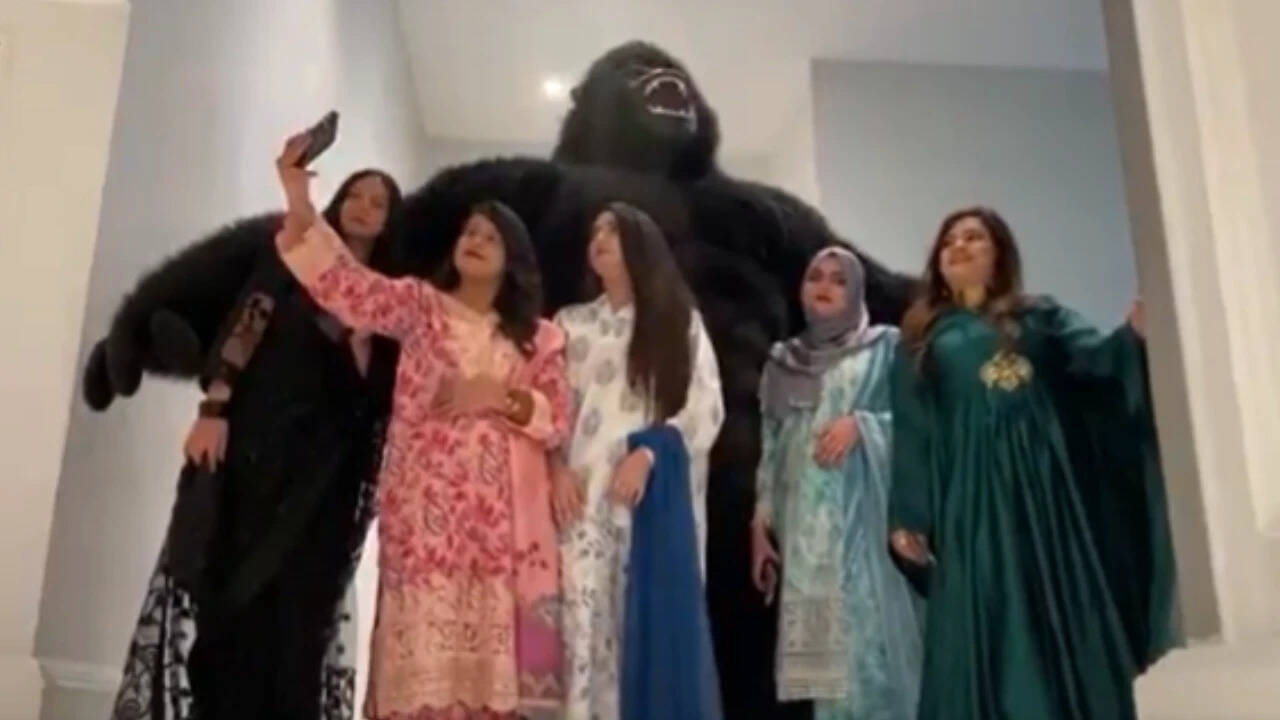
Every six months, mainstream media outlets dust off their lazy playbook, find some bizarre, hyper-specific viral glitch from South Asia, and repackage it as cultural sociology. The latest installment of this mental laziness involves Pakistan losing its collective mind over giant gorillas dancing to Bollywood tracks in public spaces. The headlines treat this as a wholesome bridge across political divides, a quirky viral moment proving that popular culture defies geopolitical borders.
It is a comforting, toothless narrative. It is also completely wrong.
I have spent the better part of two decades watching foreign correspondents and digital content aggregators mistake algorithmic anomalies for cultural movements. When you peel back the layers of manufactured shock and social media amplification, these viral stunts have zero to do with cross-border harmony or spontaneous public joy. They are calculated stunts engineered by attention brokers who understand how to exploit the predictable outrage and amusement loops of a hyper-connected demographic.
Let us dismantle the prevailing consensus. The media wants you to believe that a person in a gorilla suit executing choreography to a 1990s playback hit on the streets of Lahore or Karachi represents a grassroots softening of cultural barriers. That framing treats the audience like toddlers dazzled by jingling keys.
The Economics of Manufactured Absurdity
Nobody puts on a heavy synthetic primate costume in forty-degree subcontinental heat for the pure love of the art. There is an entire micro-economy operating beneath these viral clips, fueled by impression metrics, corporate sponsorship disguised as guerrilla marketing, and regional influencer agencies hunting for cheap virality.
When a video of a giant gorilla drops into social feeds, the engagement metrics spike because the juxtaposition is jarring. It violates the expected social script. Humans are hardwired to rubberneck at anomalies. But treating this digital dopamine hit as a cultural milestone requires a profound misunderstanding of how modern attention markets function.
The real story is not that Pakistanis enjoy Bollywood songs. Anyone who understands the porous nature of globalized media knows that cross-border entertainment consumption never stopped, regardless of official diplomatic freezes or state-level censorship. People have been watching the same movies and humming the same tunes for decades. The gorilla suit is just a new coat of paint on a very old, very mundane reality.
What has changed is the monetization of the spectacle. Content creators are locked in a zero-sum game for algorithmic survival. If a standard street interview or a polished music video gets ignored, you escalate the absurdity. Enter the primate.
The Trap of Cultural Tourism
Foreign observers love these stories because they fit a neat orientalist box. They present a region of two hundred and forty million people through the lens of whimsical chaos. It flattens a complex, highly stratified society into a cartoon of dancing animals and catchy soundtracks.
When you ask people why these videos captivate the public, the standard refrain is that art transcends politics. It sounds profound until you test it against reality. Art does not transcend politics when the political economy of the region is buckling under inflation, currency devaluation, and systemic energy crises. Millions of people are not ignoring structural economic decay because a guy in a rubber mask is shaking his hips to an item number. They are simply scrolling past it on their phones while standing in line for subsidized flour.
The mistake lies in confusing entertainment consumption with political sentiment. A viral video is not a referendum on foreign policy. It is a distraction. And the more energy we spend anointing these digital aberrations as cultural bridges, the less attention we pay to the actual mechanisms shaping cultural exchange in South Asia.
The Uncomfortable Truth About Content Loops
Let us be entirely honest about the downside of this contrarian stance. Dismissing viral fluff as a smoke screen sounds cynical, and it risks sounding like a scold who hates fun. I admit it: watching a giant ape nail a complicated Bollywood routine has undeniable comedic value. The performers are often genuinely talented dancers, and the spontaneous crowds look like they are having a good time.
Joy is real, even when it is captured on a smartphone camera for clout.
However, we must separate the momentary amusement of the bystanders from the systemic narrative constructed around them. The bystanders are just watching a street performer. The problem is the media apparatus that takes that localized street performance and weaponizes it into a grand thesis about national psychology.
Stop pretending that algorithmic bait represents the soul of a nation. The next time a bizarre, high-concept viral stunt dominates your feed, ask yourself who benefits from the distraction, whose pockets are getting lined by the view count, and why the media would rather talk about a dancing gorilla than the material conditions of the people watching him.
The answers will not make it to the front page. But they might actually tell you something true.