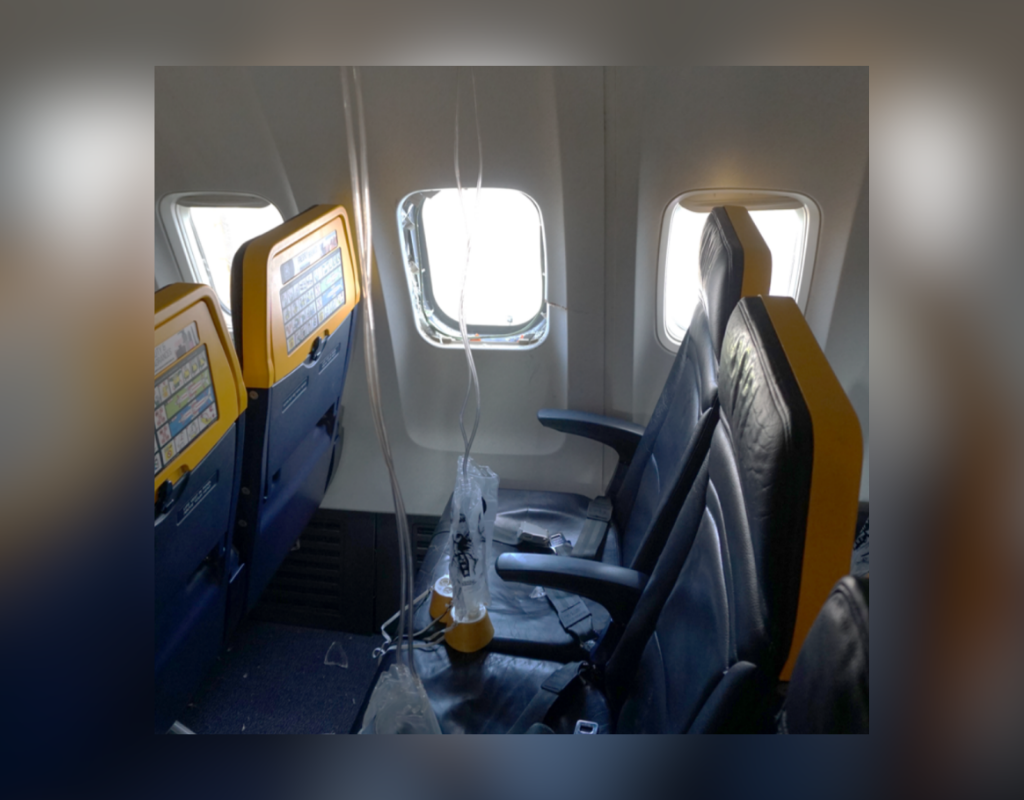
Commercial aviation has a fetish for catastrophic narratives. Every time a turbine blade lets go or a piece of cowling departs into the slipstream, the media machinery instantly pivots to Hollywood physics. People want a dramatic sequence of events: an explosion, a sudden vacuum, and a passenger violently yanked through a fuselage breach like a piece of garbage thrown out of a car window. It makes for compelling television. It also fundamentally misunderstands how modern aircraft structures, engine containment rings, and high-bypass turbofans behave when metallurgy meets bad luck.
I have spent decades watching safety boards pick through compressor debris and listening to armchair aerodynamicists explain decompression using rules learned from action movies. The lazy consensus after any high-profile engine disintegration is that our planes are flying pressure cookers waiting to pop, and that a single broken window means the structural integrity of the entire tube is about to unravel. Meanwhile, you can find related events here: Why The Panic Over Midair Cabin Decompressions Is Completely Misunderstood.
That theory is wrong. It ignores the engineering redundancy built into every single square inch of a commercial transport category aircraft.
The Myth of the Instantaneous Void
When people hear about an engine fragment striking a window or a fuselage skin panel, their brains immediately conjure up the physics of a puncture in a balloon. They picture a sudden, explosive evacuation of air that turns the cabin into a vacuum cleaner. To see the full picture, we recommend the excellent report by The Points Guy.
Let us clear up the mechanics. A modern airliner cabin is pressurized, yes, but the differential pressure at cruising altitude is typically around eight to nine pounds per square inch. It is significant, but it is not a sci-fi airlock breach. When a high-energy transient event occurs—such as a contained or uncontained engine failure throwing high-velocity shrapnel—the immediate threat is kinetic, not pneumatic.
The kinetic energy of a flying blade fragment can punch a hole through a composite fairing or crack an outer window pane. What it does not do is instantly vaporize the structural load paths of the airframe. Fuselages are not single sheets of thin metal relying on hope; they are skin-stringer-frame networks designed to arrest crack propagation instantly. If a window pane cracks or fails, the cabin does experience a localized pressure drop and a fierce rush of cold air, but the notion that a human body is going to be effortlessly sucked through a standard passenger window opening by ambient differential pressure alone is a mechanical fairy tale.
To pull a mass through an aperture under standard cruising differential pressure requires an area-to-volume dynamic that a standard passenger window simply does not provide unless the entire window frame and surrounding structural stringers have been completely sheared away by massive blunt force. A stray turbine fragment is sharp, fast, and destructive, but it is a surgical knife compared to the structural demolition required to create an open portal for ejection.
Why Engine Containment is a Double-Edged Sword
We praise engine manufacturers for containment rings. We treat them like invincible steel belts wrapped around spinning titanium fans.
I have seen millions of dollars spent on containment testing, and I have also seen what happens when fatigue outsmarts a test bench. The industry consensus is that containment rings keep everything inside the nacelle. Most of the time, they do. Modern high-bypass turbofans are marvels of containment engineering; thick Kevlar wraps and heavy steel armor belt the core to ensure that broken fan blades stay trapped inside the housing.
The dirty secret nobody in the marketing department wants to talk about is that containment sometimes creates localized hyper-velocity shrapnel redirection. When a blade breaks at takeoff thrust or high-altitude cruise, it possesses enough kinetic energy to power a small artillery shell. If the containment system forces that energy to deflect rather than absorb cleanly, fragments can punch out through the sides of the cowl at weird vectors.
This is why engine fragments occasionally reach the fuselage skin or the leading edge of the wing. It is not because the engine designers were careless. It is because physics imposes hard limits on how much weight you can hang under a wing. Every pound of steel added to a containment ring is a pound of revenue-generating cargo or fuel you cannot carry. Aviation safety is an exercise in brutal economic and physical compromise. The fact that engine breakups rarely result in structural compromise is a testament to the safety margins, not a guarantee that engines are indestructible.
The Real Vulnerability Is Not the Metal
If you want to worry about safety, stop obsessing over whether an engine blade can dent a window frame. The metal is predictable. Metallurgy is a science of crystal lattices, grain structures, and fatigue limits. We know exactly how aluminum-lithium alloys and carbon composites respond to cyclic loading.
The unpredictable variable is the human element in maintenance and inspection scheduling.
I have watched operators squeeze every permissible hour out of a component lifecycle because replacing a high-pressure compressor stage ahead of schedule hurts quarterly earnings. The regulatory frameworks set by agencies like the Federal Aviation Administration and the European Union Aviation Safety Agency are rigorous, but they are reactive. They are written in blood and inspection reports.
When an engine throws fragments through a casing, the root cause is almost never a sudden manufacturing defect that slipped past quality control. It is almost always a missed signature on a borescope inspection, an undiscovered micro-fissure that grew under thousands of thermal cycles, or a maintenance procedure where a torque value was missed by a fraction of a foot-pound.
Focusing public anxiety on the sensational image of a broken window distracts from the mundane, unglamorous reality of hangar operations. The safety of your flight was decided months earlier by an overworked mechanic working a midnight shift in a drafty hangar, not by the pilot fighting the controls after a bang overhead.
Stop Looking at the Symptoms
When media outlets sensationalize an engine failure by hyping up passenger danger, they train the traveling public to fear the wrong things. They teach people to look at the windows and wonder if the rivets will hold.
The rivets will hold. The airframe engineering standards enforced across the major manufacturers are exceptionally conservative. A commercial jetliner is designed to fly with structural damage that would terrify a layman, precisely because engineers assume things will occasionally break.
The next time an engine sheds a blade and the internet fills with panicked speculation about sudden decompression and flying passengers, remember the actual mechanics at play. The turbine is a controlled bomb operating at the edge of material limits. Occasionally, it reminds us of that fact by throwing pieces through the skin.
That is not a systemic failure of flight. It is the cost of moving hundreds of tons of metal across continents at five hundred miles per hour using controlled explosions. Accept the risk, respect the engineering, and stop letting Hollywood write your risk assessment matrix.