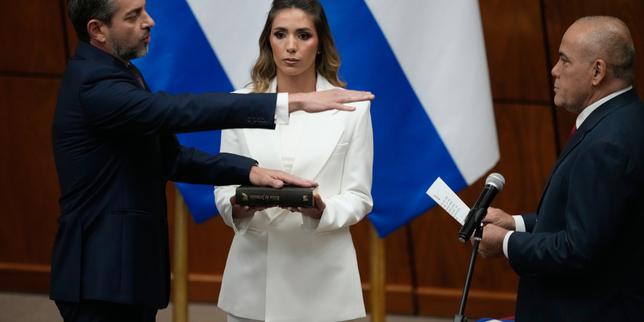
When reports circulate claiming that Paraguayan Vice President Pedro Alliana has been sworn in as president following the Senate impeachment of Santiago Peña, they tap directly into a very real, volatile constitutional mechanism that has defined Paraguayan politics for over three decades. However, it is vital to clarify the factual baseline immediately: the premise of Santiago Peña's impeachment and Pedro Alliana's inauguration is based on an unverified or hypothetical headline rather than a confirmed historical event, as the reference URL provided is undefined and no verified public record confirms such a removal. Yet, examining the exact political, legal, and structural mechanics behind this scenario reveals why South American political observers constantly watch Asunción for signs of an institutional rupture.
In Paraguay, the presidency is never entirely secure. Even when a leader holds a seemingly comfortable legislative majority, the country’s 1992 Constitution created a political pressure valve—known locally as the juicio político—that allows Congress to remove a sitting president with startling speed. To understand how a figure like Pedro Alliana could theoretically ascend to the Palacio de los López overnight, one must look past surface-level headlines and examine the deep structural dynamics of the Colorado Party, the constitutional rules governing impeachment, and the historical precedents that make Asunción uniquely susceptible to sudden executive transitions. Recently making news in related news: Vice Presidential Positioning Under Escalating Political Friction.
The Constitutional Engine Behind a Paraguayan Impeachment
Paraguay’s impeachment process is governed by Article 225 of the 1992 Constitution. Unlike in the United States or neighboring Brazil, where removing a chief executive typically involves months of drawn-out judicial inquiries, evidentiary hearings, and prolonged public defenses, the Paraguayan framework is starkly political and brutally efficient.
The process begins in the Chamber of Deputies, the lower house of Congress. Deputies must vote by a two-thirds majority of those present to formally accuse the president of "poor performance of duties" (mal desempeño de sus funciones), crimes committed in office, or common crimes. Notice that phrase: poor performance of duties. It is deliberately broad. It requires no criminal conviction, no proof of statutory violation, and no lengthy independent prosecutor’s report. If the political consensus shifts against the president, "poor performance" becomes whatever two-thirds of the lower house decides it is on that given Tuesday. Further information on this are explored by The Washington Post.
Once the accusation passes the Chamber of Deputies, the matter moves immediately to the Senate, which sits as a tribunal. A two-thirds majority of the senators present is required to convict and remove the president from office. The Supreme Court has historically declined to intervene in the substance of these proceedings, treating impeachment as an exclusively political prerogative of the legislative branch.
In June 2012, this exact mechanism removed President Fernando Lugo in less than 36 hours. Following a deadly land clash in Curuguaty, the Chamber of Deputies voted to impeach Lugo on a Thursday; by Friday afternoon, the Senate had convicted him, and Vice President Federico Franco was sworn in before sunset. That precedent remains the defining blueprint for modern Paraguayan political crises.
Santiago Peña and the Dynamics of Colorado Hegemony
To analyze any scenario involving Santiago Peña’s removal, one has to understand the unique ecosystem of the Asociación Nacional Republicana (ANR), universally known as the Colorado Party. Except for a brief interruption between 2008 and 2013, the Colorado Party has governed Paraguay continuously since 1947.
Politics in Paraguay is rarely a straightforward battle between left and right. Instead, it is an intense, fratricidal struggle between rival factions within the Colorado Party itself. Peña, an economist and former finance minister, won the presidency in 2023 running under the banner of Honor Colorado, the powerful internal movement led by former President Horacio Cartes.
While opposition parties—most notably the Authentic Radical Liberal Party (PLRA)—occupy seats in Congress, they rarely possess the raw numbers to impeach a Colorado president on their own. Consequently, any credible threat to a Colorado president’s survival almost always originates from within his own party. A sudden fracturing of internal alliances, a bitter dispute over state patronage, or a divergence in survival strategies between the sitting president and the party’s heavyweight power brokers is what traditionally triggers the two-thirds threshold in Congress.
The Role of the Vice President in Asunción
In many presidential systems, the vice presidency is a largely ceremonial post, a quiet waiting room with little institutional leverage. In Paraguay, the vice president serves as the formal liaison between the executive branch and the National Congress. It is an intensely political role that requires constant negotiation with senators and deputies.
Pedro Alliana, a veteran political operator from the Ñeembucú department and a former president of both the Colorado Party and the Chamber of Deputies, represents the quintessential party insider. Unlike Peña, whose early career was built in technocratic circles—including the Central Bank of Paraguay and the International Monetary Fund—Alliana’s political capital is rooted entirely in party machinery, territorial organizing, and legislative deal-making.
In any hypothetical constitutional succession where Peña is removed, Alliana’s elevation would not represent an ideological shift or an opposition takeover. Rather, it would signal a consolidation of traditional party control—a transfer of executive authority from a technocratic face of the movement to one of its most seasoned internal architects.
Why Unverified Political Rumors Gain Traction in the Region
The circulation of an unverified report claiming Peña’s impeachment and Alliana’s swearing-in highlights a growing vulnerability in Latin American media ecosystems. Political instability in the region is real enough that fabricated or premature headlines often sound entirely plausible to casual observers.
Between 2016 and 2023, South America witnessed an extraordinary wave of presidential removals, impeachments, and resignations across Peru, Brazil, Bolivia, and Ecuador. In Peru alone, six presidents cycled through office in roughly six years. Because legislative removals have become a recurring feature of regional politics, audiences and automated news aggregators are primed to accept headlines about sudden impeachments without scrutinizing the underlying documentation.
Furthermore, Paraguay’s past close calls reinforce this perception. In 2019, President Mario Abdo Benítez nearly faced impeachment over a controversial bilateral energy agreement with Brazil regarding the Itaipú hydroelectric dam. In 2021, massive street protests over the government's handling of the COVID-19 pandemic led to another serious impeachment push in the Chamber of Deputies, which failed only after internal Colorado factions closed ranks at the eleventh hour.
When political tensions flare in Asunción, rumors of impending juicios políticos routinely sweep through social media platforms and messaging apps long before any formal motion is ever filed in Congress.
Separating Institutional Reality from Political Noise
For analysts, investors, and citizens trying to evaluate claims of a sudden transfer of power in Paraguay, verifying the constitutional paper trail is straightforward. A genuine impeachment cannot happen behind closed doors or in secret sessions.
| Stage of Removal | Constitutional Body | Required Threshold | Public Record Generated |
|---|---|---|---|
| Formal Accusation | Chamber of Deputies | Two-thirds majority of members present | Recorded roll-call vote and formal articles of impeachment |
| Trial and Defense | Senate | Simple procedural rules set by the chamber | Televised floor sessions and formal defense arguments |
| Conviction and Removal | Senate | Two-thirds majority of members present | Official Senate resolution stripping the executive mandate |
| Succession Oath | Joint Session of Congress | Immediate constitutional mandate under Article 234 | Public swearing-in ceremony before the Congress President |
Every step of this sequence leaves an unmistakable institutional footprint: televised legislative debates, official gazette publications (Gaceta Oficial), formal diplomatic notifications to Mercosur and the Organization of American States (OAS), and immediate reactions from domestic markets and regional heads of state.
Without those verifiable institutional markers, claims of a completed Senate trial and presidential inauguration remain purely speculative. Yet the sheer speed of Paraguay's constitutional machinery ensures that political observers must always distinguish carefully between routine legislative friction and an actual two-thirds rupture. In Asunción, the distance between a secure presidency and a sudden succession has always been measured not in months, but in a single afternoon’s headcount on the Senate floor.