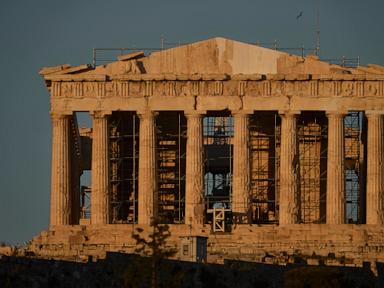
Athens is stripping away centuries of grime from the Acropolis, but the scaffolding hides a bitter ideological war. For the first time in more than two centuries, visitors are seeing the pristine white Pentelic marble of the Parthenon, freed from the black crust of industrial pollution and the disfiguring interventions of past eras. This aesthetic transformation is not just a routine maintenance project. It represents a aggressive geopolitical statement and a high-stakes gamble with architectural history. Greece is racing to present a flawless, unified monument to the world, scrubbing away the complicated layers of its own past to bolster its claim as the rightful guardian of Western civilization's ultimate symbol.
Behind the tourism press releases lies a complex engineering and philosophical operation. The current restoration program, managed by the Committee for the Conservation of the Acropolis Monuments, has been quietly running since 1975. The recent milestone—the removal of massive scaffolding from the northern facade—unveiled a pristine look that the monument has not possessed since before the Ottoman occupation and the subsequent removal of its sculptures by Lord Elgin in the early 19th century.
The Hidden Damage of Past Rescues
To understand why this facelift is taking place, one must understand how previous generations nearly destroyed the structure under the guise of saving it.
During the late 19th and early 20th centuries, chief engineer Nikolaos Balanos led a massive reconstruction effort. Balanos wanted to reassemble the collapsed walls and columns using original fragments strewn across the site. He used iron clamps and beams to hold the ancient stones together.
He made a catastrophic mistake.
Balanos used ordinary industrial iron. He neglected to coat the metal in a protective layer of lead, a technique the ancient Greeks knew and practiced. When moisture inevitably penetrated the porous marble, the internal iron clamps began to rust. As iron oxidizes, it expands to several times its original volume.
The expanding metal acted like slow-motion dynamite inside the ancient columns. It cracked the irreplaceable Pentelic marble from the inside out, creating structural instability that threatened to bring the entire monument down.
Modern teams have spent decades systematically undoing Balanos's work. Conservators must carefully dismantle the columns, extract the corroded iron, and replace it with titanium. Titanium does not rust. It matches the thermal expansion properties of marble perfectly, ensuring that the structural integrity of the temple will endure for centuries without causing internal trauma to the stone.
The Erasure of History
The physical restoration is only half the battle. The aesthetic choices made by the Greek government raise troubling questions about historical authenticity.
The Parthenon was never just a classical Greek temple. Over its 2,500-year lifespan, it served as a Byzantine church, a Catholic cathedral, and an Ottoman mosque complete with a minaret. In 1687, a Venetian mortar shell struck the building, which was being used as a gunpowder magazine by the Ottomans, causing a massive explosion that blew out the center of the structure.
The current restoration strategy favors a specific slice of time. It prioritizes the Periclean golden age of the 5th century BC above all else.
By removing the later accretions, the soot from Ottoman-era fires, and the physical traces of medieval modifications, the project risks turning a living historical artifact into a sanitized, idealized monument. The bright, cleaned marble presents a fiction. It suggests that the temple jumped directly from antiquity to the modern era, skipping the messy centuries of occupation, conflict, and transformation that define the reality of Greek history.
This selective memory serves a distinct political purpose. Greece has been locked in a bitter, decades-long dispute with the British Museum over the return of the Parthenon Marbles. The British Museum has long argued that Greece lacked the facilities and the stability to properly care for these priceless artifacts.
By executing a world-class, technologically advanced restoration of the Acropolis, Athens is systematically dismantling every British excuse. The pristine white marble of the Parthenon stands as a silent, powerful demand for the return of its missing pieces. It shows the world that Greece is ready to receive its heritage.
The Problem of Synthetic Stone
Purists object to the visual composition of the restored temple. Because many original blocks were destroyed in the 1687 explosion or lost to time, modern engineers cannot simply piece the puzzle back together. They must insert new stone to stabilize the structure.
This new stone comes from the exact same quarries on Mount Penteli that the ancient Greeks used. When first cut, this new marble is blindingly white. It creates a stark, checkered contrast against the weathered, golden-brown hue of the original ancient blocks.
Over time, the new marble will oxidize and develop the same golden patina as the old stone. This process takes decades. Visitors today are left looking at a hybrid monument—part ancient ruin, part modern reconstruction. Critics argue that this heavy intervention blurs the line between historical preservation and historical recreation, turning the Acropolis into an architectural theme park designed for Instagram feeds rather than historical contemplation.
The technological sophistication used to achieve this look is undeniable. Conservators use laser technology to vaporize the black crust of air pollution without damaging the underlying mineral structure of the marble. A specialized laser system emits pulses at two different wavelengths simultaneously, safely cleaning the surface without causing the stone to discolor or flake.
The result is a monument that looks cleaner than it has in centuries. Whether that cleanliness represents a triumph of science or a loss of historical depth remains a subject of intense debate among those who look past the surface.
The work on the Acropolis continues, shifting from the Parthenon to the surrounding structures like the Propylaea and the Erechtheion. The scaffolding will move, the lasers will hum, and the white marble will continue to emerge from the darkness of time. The true test of the project will not be found in the praise of tourists, but in how future generations view this deliberate reshaping of the past.