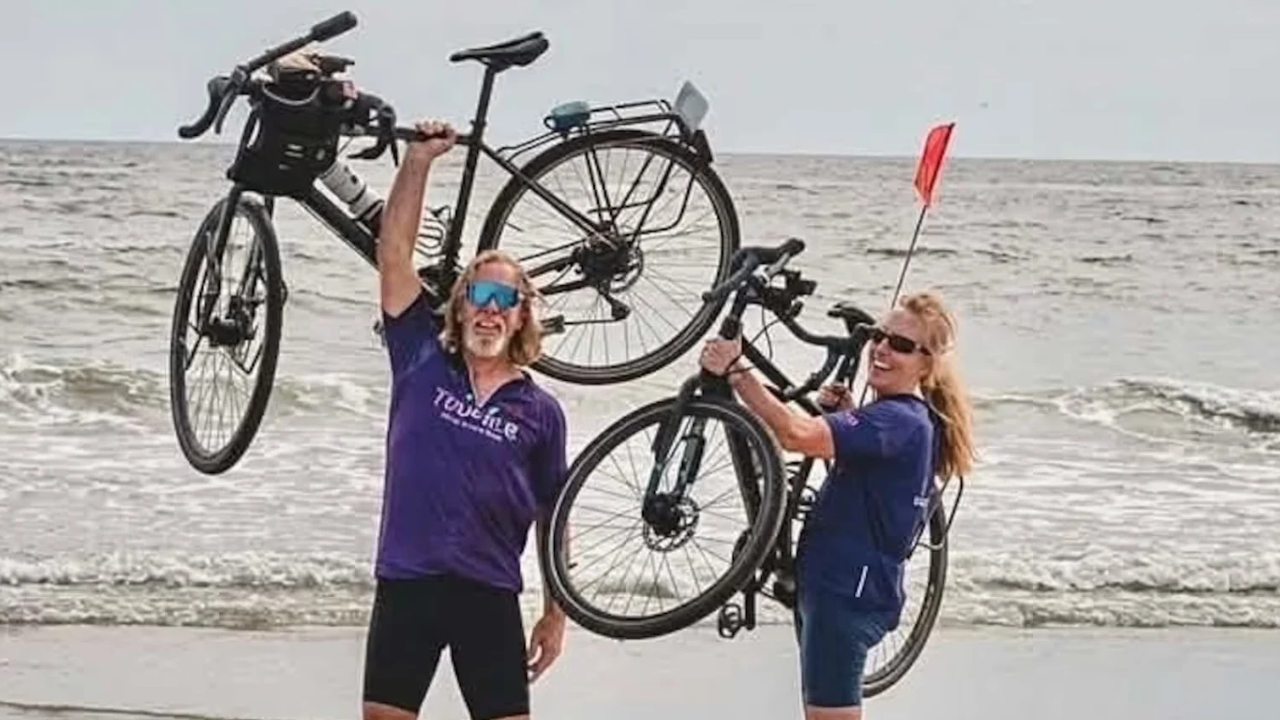
Endurance sports often attract individuals seeking personal validation. Cyclists chase personal records, Strava crowns, and grueling elevations simply to prove something to themselves. Yet, every so often, the raw physical commitment of long distance cycling pivots toward a collective purpose. Across eighty-seven grueling days, a Utah couple transformed three thousand six hundred thirty-four miles of relentless asphalt into a mobile engine for social impact, raising approximately twenty-three thousand dollars for charity.
The feat demands examining more than just raw mileage. Anyone with a titanium frame, endurance nutrition, and a tolerant employer can map out a cross country route. Surviving the psychological erosion, mechanical failures, and physical toll of consecutive months on a bicycle tells a completely different story.
The Logistics of Long Distance Altruism
Setting out to pedal thousands of miles requires treating logistics like a military operation. Weight is the enemy. Every extra gram translates to watts wasted over mountain passes. When you add fundraising goals to an unsupported or semi supported tour, the operational friction multiplies.
Charity rides frequently underestimate the administrative burden. Cyclists often assume that hitting the road is the hard part, while gathering donations happens organically. In reality, modern fundraising relies on sustained digital marketing, constant social media updates, and relentless outreach. A pair moving across state lines at fifteen miles per hour must balance physical recovery with digital storytelling. If the audience forgets you are out there, the funding stream dries up.
Consider the physical reality of covering those distances. Averaging over forty miles every single day for nearly three months requires consuming thousands of calories daily just to maintain basic body weight. Tendonitis, saddle sores, and heat exhaustion act as constant companions. The mental grit needed to pack up camp in the rain, clip into pedals with swollen feet, and face a headwind across open plains cannot be overstated.
Moving Beyond the Kilometer Count
Journalists often default to glorifying big numbers. We love totals. Three thousand six hundred thirty-four miles sounds impressive. Twenty-three thousand dollars looks good on a press release. But numbers alone obscure the human mechanism driving these endeavors.
Why do everyday citizens trade comfort for chronic saddle discomfort? The modern landscape of charitable giving is saturated. Nonprofits compete for shrinking attention spans against corporate campaigns and global disasters. Grassroots initiatives cut through this noise by offering radical transparency. When donors watch two real people struggle up a mountain pass via daily video updates, trust builds organically.
This transparency shifts the psychological barrier of giving. People stop donating to a faceless institutional fund and start investing in a shared human journey. The sweat equity invested by the riders serves as collateral. Donors feel that by contributing twenty or fifty dollars, they are fueling the next fifty miles of the journey.
The Reality Check on Endurance Fundraising
While the Utah pair's journey highlights the best of community spirit, sustainable philanthropy requires looking at the structural limitations of adventure fundraising. Relying on physical feats to fund vital services is inherently inefficient. It depends entirely on personal charisma, social media algorithms, and weather conditions.
If a rider gets injured on day twenty, the momentum halts. If a major news cycle swamps social feeds, the daily donation links go cold. True systemic support for charitable causes requires predictable, recurring revenue streams rather than high risk physical stunts.
Even so, dismissing these efforts as mere stunts misses the point entirely. Endurance rides serve as powerful catalysts. They capture attention in a world numb to traditional advertising. They inspire local communities to show up with roadside water bottles, home cooked meals, and unexpected contributions.
The Road Ahead for Grassroots Campaigns
As endurance touring evolves, the blueprint established by long distance charity cyclists continues to shift. Technology allows riders to broadcast their struggles in real time, turning isolated stretches of highway into interactive community forums.
The twenty-three thousand dollars raised by the Utah cyclists will not solve systemic societal challenges on its own. Money rarely does. Instead, it provides immediate relief, fuels local programs, and proves that individual action still matters.
The pedals keep turning long after the finish line fades. The true value lies not in the final tally on a fundraising page, but in the stubborn refusal to accept that one person cannot shift the needle.