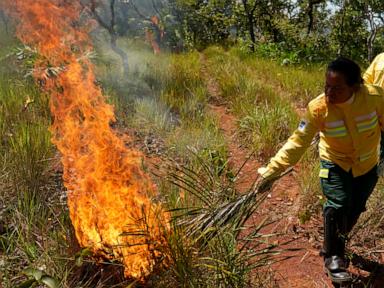
The air in the Brazilian Cerrado does not just smell of smoke; it tastes of iron.
When the dry season peaks, the grass underfoot turns into tinder, so brittle it crackles like breaking glass. For decades, the official response to this vulnerability was absolute prohibition. Fire was the enemy. If a plume of smoke rose over the vast, scrubby savanna, trucks raced out to smother it. Helicopters dropped water. Laws were passed, fines were issued, and the message from government agencies was clear: zero tolerance.
It failed.
By treating fire as an absolute evil, the authorities inadvertently created a monster. Without small, regular burns to clear away dead vegetation, the fuel built up. Year after year, the dry grass thickened. When a spark finally caught—whether from a lightning strike or a careless spark—the resulting wildfires were not just large; they were apocalyptic. They incinerated everything, baking the soil and killing animals that had survived in this ecosystem for millennia.
The mistake was simple. We forgot that some landscapes need to burn. More importantly, we forgot that the people who lived there already knew exactly how to handle the flame.
The Rhythm of the Scorch
To understand the Cerrado, you have to look past the dense Amazon rainforest that grabs all the headlines. The Cerrado is a massive tropical savanna, covering more than twenty percent of Brazil. It is an ancient, twisted landscape of stunted trees with thick, corky bark and roots that plunge dozens of meters into the earth to find water. It is a place built to survive fire. In fact, it requires it.
For generations, the Indigenous peoples of the Cerrado, such as the Xavante and the Krahô, operated on a completely different frequency than modern firefighters. They did not view fire as a disaster to be avoided, but as a tool to be managed.
Consider a traditional hunter setting out in the early dry season. He does not strike a match in August, when the winds are howling and the heat is oppressive. He strikes it months earlier, in May or June. The air is still cool. The dew is heavy in the mornings. When he drops a spark into a patch of dense scrub, the fire moves slowly, lazily, licking away the dead undergrowth but leaving the deep-rooted trees untouched.
This is not destruction. It is maintenance.
By burning the savanna in a patchwork pattern, Indigenous communities create natural firebreaks. A wildfire roaring across the plains in September will suddenly hit one of these pre-burned patches and die out, starved of fuel. The landscape becomes a mosaic of different stages of growth. Some areas are freshly blackened, others are bursting with new green shoots, and some are dense and mature. This variety is exactly what keeps the ecosystem alive.
The Cost of the Blanket Ban
When bureaucratic conservation strategies overrode this ancient wisdom, the consequences were devastating. Bureaucrats sitting in distant offices looked at satellite imagery, saw fire, and panicked. They criminalized the very practices that kept the savanna stable.
During the height of the zero-tolerance era, Indigenous rangers were forced to watch the land choke on its own growth. The gray, dead biomass piled up. Wildlife patterns shifted. Animals like the giant anteater and the maned wolf struggled to find food because the dense, unburnt brush blocked their paths and choked out the nutritious new grass they relied on.
Then came the inevitable infernos.
When a wildfire breaks out in an area that has been artificially protected from fire for a decade, the heat is unimaginable. The flames climb into the canopy, killing trees that would normally survive a low-intensity surface fire. The seeds buried in the soil, which require a gentle heat to crack open and germinate, are instead cooked and destroyed. The ground turns to ash, and when the rains finally return, the topsoil washes away into the rivers.
It became a vicious cycle. More suppression led to bigger fires, which led to more panic, which led to stricter bans. The policy was working perfectly on paper, and failing completely on the ground.
A Shift in the Wind
The turning point did not come from a breakthrough in a laboratory or a new piece of firefighting technology. It came from a painful realization: the old ways were right.
In recent years, Brazil’s environmental agencies began to quietly reverse course. They started collaborating with Indigenous communities instead of criminalizing them. This new approach, known as Integrated Fire Management, essentially hands the matches back to the people who know how to use them.
Rangers now sit down with tribal elders to map out the territory. They look at the wind patterns, the moisture levels, and the historical movement of animals. They plan the burns together, using traditional knowledge to decide exactly when and where to introduce fire to the landscape.
The results of this collaboration are visible from space. In areas where managed burns are practiced, the total acreage destroyed by late-season catastrophic wildfires has dropped dramatically. The fires that do occur are smaller, cooler, and easier to control. The mosaic has returned.
But the shift is about more than just ecological statistics. It is about a fundamental change in how we relate to the natural world. Modern environmentalism often treats nature as a museum piece—something to be fenced off, protected, and left entirely alone. The story of the Cerrado proves that humans are not always an infection on the landscape; sometimes, we are a vital part of its metabolism.
The Lessons of the Ash
Walking through a patch of Cerrado a few weeks after a managed burn is a strange experience. The ground is black, and a thin skin of soot covers everything. It looks dead.
But if you look closer, right at the base of the blackened tree trunks, you see bright, neon-green shoots pushing through the ash. The fire has cracked open the seeds, released nutrients into the soil, and cleared away the canopy so sunlight can reach the ground. Within months, this area will be a lush, vibrant meadow, filled with flowers and buzzing with insects.
The people who live here do not fear the smoke. They watch the horizon, reading the color of the plume to know whether it is a destructive runaway blaze or a friendly, low-level burn clearing the path for new life.
We are entering an era where the old methods of control are no longer working. The climate is shifting, the summers are getting hotter, and the forests are drier than ever before. Trying to fight every single flame with sheer force is a losing battle. The only way forward is to learn when to step back, when to listen, and when to let the ground burn.