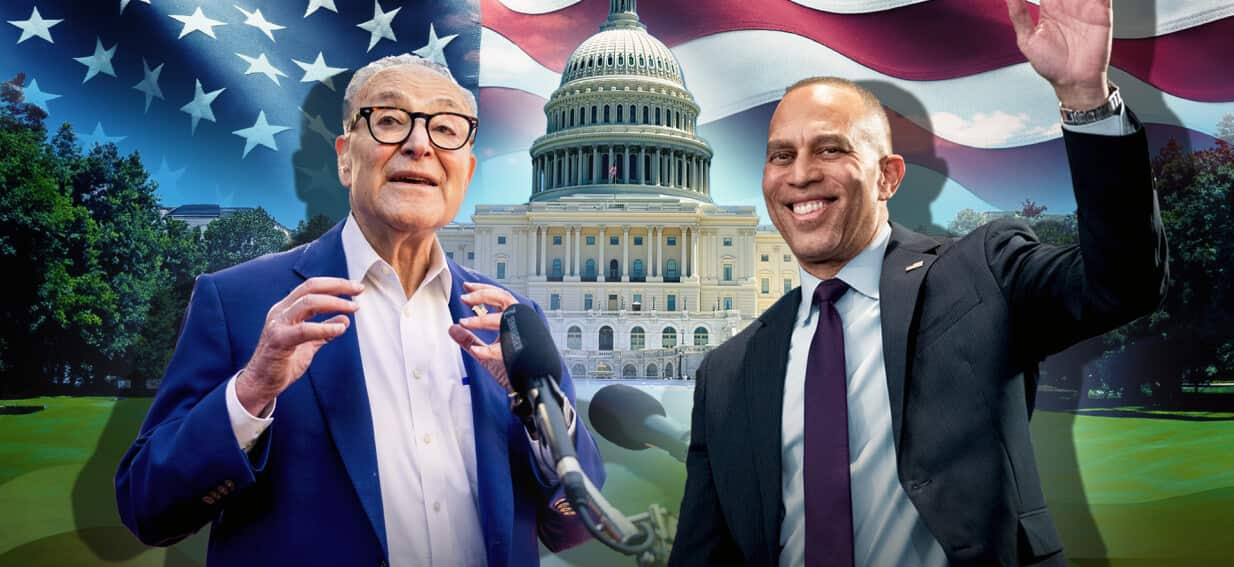
Two men from Brooklyn hold the keys to the Democratic Party's entire legislative playbook in Washington. If you only catch glimpses of them on the evening news, Chuck Schumer and Hakeem Jeffries look like standard-issue politicians reading talking points off a teleprompter. That surface-level read misses everything that actually makes them effective.
Most voters assume they are just ideological clones from the same New York borough. They aren't. While Chuck Schumer and Hakeem Jeffries share a home zip code—literally living blocks apart in Prospect Heights and Crown Heights—their paths to Capitol Hill, their rhetorical styles, and the way they wrangle their respective chambers couldn't be more different. Understanding how this Brooklyn duo operates is the only way to make sense of how Congress actually functions right now.
The Brooklyn Power Duo Running Washington
Let's clear up the biggest misconception first. People hear "New York Democrats" and immediately picture either Wall Street moderates or fire-breathing progressives. Schumer and Jeffries don't fit neatly into either box, which is precisely why they survived the brutal internal politics of the Democratic caucus to reach the top.
Chuck Schumer is the Senate Minority Leader, though he spent years as Majority Leader before the chamber flipped. Born in Midwood, Brooklyn, in 1950, he is the son of an exterminator and a homemaker. He went to Harvard, skipped practicing law entirely, and won a seat in the New York State Assembly at just 23 years old. He hasn't held a job outside of elected office since 1975.
Hakeem Jeffries leads the House Democrats as Minority Leader, having taken the gavel from Nancy Pelosi in 2023. Born in 1970 and raised in Crown Heights, Jeffries took a completely different route. He went to Binghamton University, earned a master's in public policy from Georgetown, and got his law degree from NYU. Before running for office, he worked as a corporate litigator at Paul, Weiss, Rifkind, Wharton & Garrison—one of the most prestigious law firms in the country—and clerked for a federal judge.
Think about that contrast for a second. Schumer is a purebred political animal who has spent half a century memorizing county-by-county election returns. Jeffries is a trained courtroom litigator who approaches legislative strategy like he's building an airtight brief for a federal appellate panel.
Why Geographic Proximity Matters More Than You Think
It isn't a coincidence that the two highest-ranking Democrats in Congress represent overlapping parts of Brooklyn. New York City politics is a contact sport. If you can survive a Brooklyn Democratic primary, you can survive anything Washington throws at you.
In the past, the Senate and House Democratic leaders often came from wildly different regions—think Harry Reid of Nevada paired with Nancy Pelosi of San Francisco. They had different donor bases, different regional priorities, and sometimes different instincts on how hard to push a message. Schumer and Jeffries don't have that friction. They ride the same Acela train back to Penn Station. They deal with the exact same local press corps, the same state party machine, and the same constituent complaints about subway fares and congestion pricing.
When they need to align their messaging on a Sunday morning talk show or a high-stakes budget standoff, they don't need a team of aides to translate their regional dialects. They speak the exact same political language.
Inside Chuck Schumer's Legislative Playbook
If you've ever watched Schumer work a room, you know his reputation isn't exaggerated. There's an old joke in Washington that the most dangerous place in the capital is between Chuck Schumer and a television camera. He holds press conferences every single Sunday in New York, often about hyper-local issues like dangerous lithium-ion batteries in e-bikes or safety regulations for regional airlines, just to keep his name in the Monday morning papers.
Critics call him a spotlight hog. They're missing the point.
Schumer uses media ubiquity as a pressure valve. By constantly keeping issues in the press, he forces reluctant senators—both Democrats and Republicans—to take a public stand before they're ready. When he served as Senate Majority Leader from 2021 to 2025, he operated with the razor-thin margin of a 50-50 Senate, relying on Vice President Kamala Harris to break ties. Political pundits predicted total gridlock. Instead, Schumer muscled through the Bipartisan Infrastructure Law, the CHIPS and Science Act, and the Inflation Reduction Act.
How did he pull that off without losing Joe Manchin or Kyrsten Sinema every other week? He stopped acting like an ideologue and started acting like a horse trader.
Schumer keeps a battered flip phone in his pocket and works the phones relentlessly. He memorizes what every individual senator needs to win re-election back home. When he needed votes for the CHIPS Act, he didn't pitch it as a grand philosophical victory. He pitched it as thousands of manufacturing jobs in Ohio, Arizona, and Texas. He gave senators the exact local deliverables they needed to run campaign ads, and in return, he got their votes.
The Flip Phone Strategy and Caucus Management
Managing the Senate is like herding cats that all think they should be president. Every single one of the 100 senators has the power to grind the chamber to a halt using arcane procedural rules. Schumer's real talent isn't giving soaring speeches on the Senate floor—honestly, his floor speeches are usually pretty dry, delivered with his reading glasses perched right on the tip of his nose.
His talent is patience and math. He counts votes better than almost anyone in modern Senate history. He rarely brings a bill to the floor unless he already knows the exact outcome, and he's willing to sit on legislation for months while quietly cutting side deals behind closed doors. Even in the minority, he uses procedural delays and unanimous consent holds to force the GOP majority to burn precious floor time on routine nominations.
How Hakeem Jeffries Controls a Fractured House
Walk across the Capitol rotunda to the House of Representatives, and the vibe shifts completely. The House has 435 members. The rules are stricter, the tempers are hotter, and the ideological divides are wider. When Nancy Pelosi stepped down after two decades at the helm, everyone wondered if the House Democratic caucus would immediately fracture into civil war between the progressive "Squad" and the moderate Frontline Democrats from swing districts.
It didn't happen. Not even close.
Hakeem Jeffries took over in January 2023 and immediately pulled off something remarkable: near-total party discipline. During the chaotic 15-ballot speaker fight that kicked off the 118th Congress, Republicans tore themselves apart on live television while all 212 Democrats voted in lockstep for Jeffries on every single ballot. He repeated that exact feat during debt ceiling negotiations and government shutdown showdowns, often delivering more Democratic votes to pass essential funding bills than the Republican Speaker could muster from his own side.
Jeffries doesn't rule through fear the way Pelosi sometimes did. He rules through methodical listening and unmistakable discipline.
The Hip-Hop Cadence and Calculated Discipline
Watch Jeffries speak on the House floor, and you'll notice a distinct rhythm. He pauses. He repeats key phrases. He uses alliteration and rhythmic cadences that openly pull from his love of 1990s Brooklyn hip-hop—he famously quoted Biggie Smalls during Donald Trump's first impeachment trial, dropping "if you don't know, now you know" into the Congressional Record.
Some conservative commentators mock his delivery as overly rehearsed or theatrical. Again, they're missing the strategy. Jeffries is a former litigator speaking directly to the C-SPAN cameras to create clean, shareable 30-second clips for social media. Every word is deliberate. He rarely goes off-script, and he almost never gets baited into messy public spats with members of his own party.
Behind closed doors, he runs his caucus like a tight ship. Before any major vote, Jeffries holds exhaustive listening sessions where progressives and moderates can vent their frustrations privately. He absorbs the heat in the room so nobody feels the need to air their dirty laundry on cable news. Once a consensus is reached, he expects everyone to hold the line. And because he spent years serving as Chairman of the House Democratic Caucus before becoming leader, he already built personal relationships with nearly every member.
Where Their Styles Clash and Complement Each Other
Putting Schumer and Jeffries side by side reveals a fascinating generational and tactical split within the Democratic Party.
Schumer is 75 years old and represents the classic retail-politics era of the 1970s and 80s. He wants to shake every hand, attend every county fair in upstate New York, and cut deals in smoky backrooms. He is comfortable with messy compromises if it means getting 60% of what he wants signed into law.
Jeffries is 55 and represents the modern, hyper-mediated era of politics. He is fiercely protective of his time, laser-focused on message discipline, and deeply attuned to how younger voters and Black voters—the bedrock of the Democratic base—consume political information. Where Schumer is impulsive and chatty with reporters in the Capitol hallways, Jeffries is guarded, precise, and unshakeable.
Yet those differences make them an unusually effective tag team.
When Republicans try to wedge the House and Senate Democrats apart during budget negotiations, they usually fail because Schumer and Jeffries coordinate their red lines early. During the 2023 debt ceiling crisis, for example, the two leaders met constantly to ensure House Democrats wouldn't cave to steep spending cuts that Senate Democrats had already rejected. Schumer handled the grueling backchannel negotiations with the White House and Senate leadership, while Jeffries kept 200-plus House members from breaking ranks under intense media pressure.
The Generational Torch Passing
There is an unspoken reality hanging over both men's careers right now. Jeffries represents the new generation of Democratic leadership that finally took the reins in the House after years of complaints that octogenarians were holding onto power too long. Schumer, meanwhile, remains the old guard in the Senate.
Progressive activists occasionally target Schumer, arguing he's too cautious on judicial reforms or foreign policy, and too cozy with Wall Street donors in Manhattan. Jeffries faces pressure from the exact same flank—some progressive groups have criticized his strong pro-Israel stance and his willingness to work with centrist Super PACs during primary seasons. Both men have developed thick skin. They understand that keeping a big-tent party together means pissing off the loudest voices on the fringes at least once a week.
Why Their Leadership Matters for the Future of Congress
If you want to know where American legislation is headed over the next few years, stop watching the loudest backbenchers on social media and pay attention to what Schumer and Jeffries actually put on the schedule.
Right now, Congress operates on razor-thin margins where a handful of defections in either chamber can kill a bill instantly. In that environment, legislative power doesn't belong to the politicians with the sharpest tweets. It belongs to the leaders who can count votes, absorb political blame, and keep unruly coalitions pointed in the same direction.
Schumer brings institutional memory. He knows every procedural trick in the Senate rulebook and knows how to extract maximum leverage even when his party doesn't hold the majority. Jeffries brings ironclad unity. He has proven he can hold House Democrats together even when the chamber descends into total chaos around him.
How to Track What They Are Actually Doing
If you want to cut through the cable news noise and see how Schumer and Jeffries are moving the needle on issues you care about, skip the pundit panels and look at the primary sources:
- Watch the "Dear Colleague" letters: Jeffries regularly sends detailed memos to House Democrats outlining the party's exact strategy before major floor votes. News outlets like Punchbowl News and Politico publish these almost immediately, and they reveal way more than any press conference.
- Follow the Senate cloture calendar: Don't get distracted by grandstanding bills that have zero chance of passing. Watch what Schumer actually files cloture on via Congress.gov—that tells you which judicial nominees and must-pass funding bills are genuinely moving.
- Pay attention to leadership PAC spending: Track where Schumer's Impact PAC and Jeffries's Team Blue PAC send money during election cycles via OpenSecrets. Leaders always put their cash behind the specific vulnerable incumbents they need to protect to hold or win back the majority.
You don't have to agree with their politics to recognize the sheer mechanical skill it takes to run two fractured chambers from a single zip code in Brooklyn. While the rest of Washington argues for clicks, Schumer and Jeffries are busy counting the votes that actually decide what becomes law.


