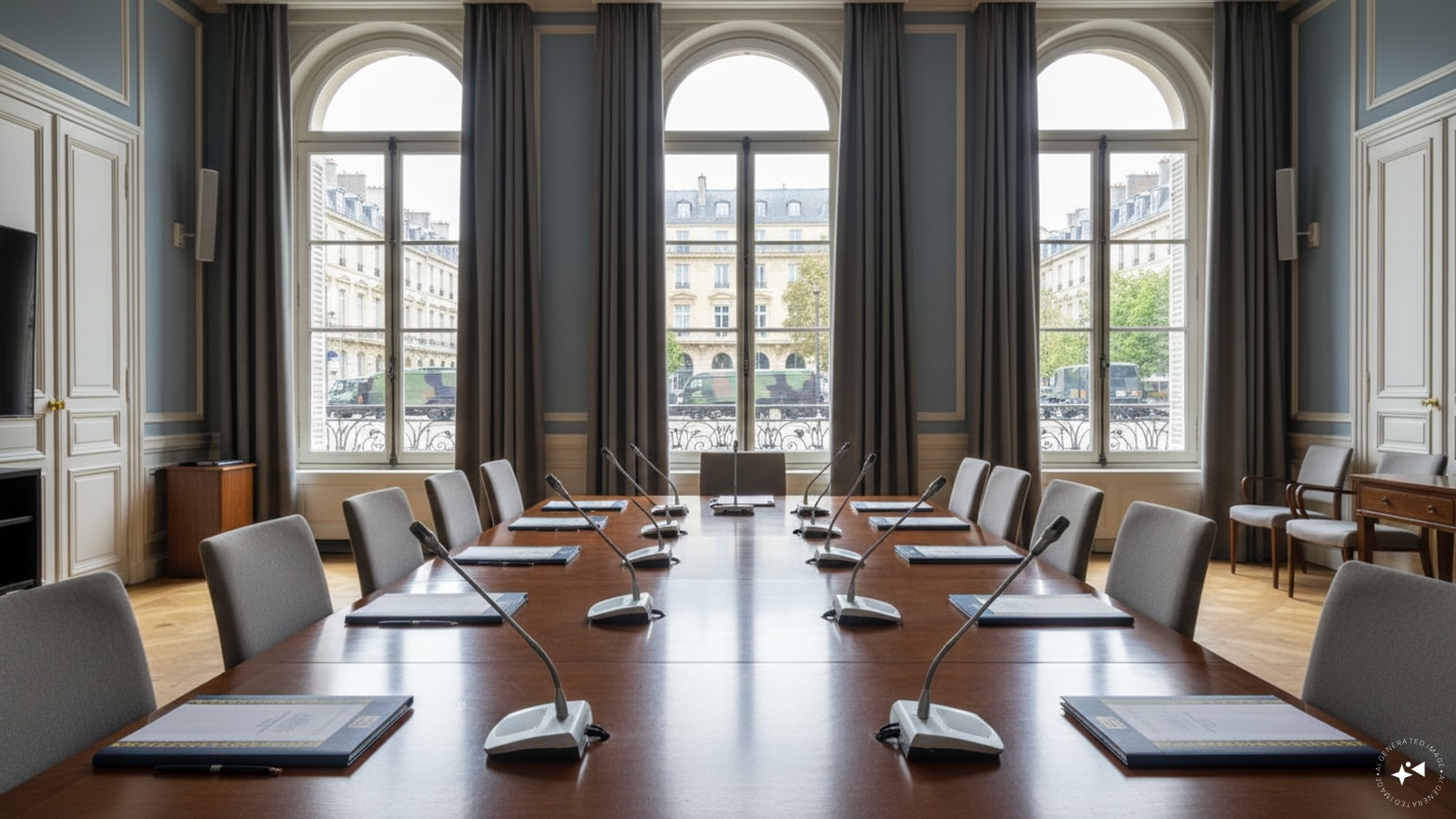
When France, Germany, Italy, Poland, and the United Kingdom put pen to paper in Paris on October 26, 2026, most headlines treated their joint statement like a bold new awakening. It wasn't. Europe’s top five defence powers calling Russia the biggest threat wasn't a sudden realization—it was an overdue admission that the old security playbook is dead, and that promises alone won't stop drones over German cities or sabotage in the Baltic Sea.
If you read the surface-level coverage of the European Group of Five (E5) summit, you might think Europe has everything under control. You'd be wrong. Behind the handshakes at the French Armed Forces Ministry in Balard, defense chiefs spent hours wrestling with an uncomfortable reality. They agree on the danger, sure. What they haven't solved is how to turn slow-moving European factories and unspent billions into actual deterrence before Washington pulls back further.
The Paris E5 Summit Was About Panic Not Just Solidarity
Let's look at who actually sat around that table in Paris. French Armed Forces Minister Catherine Vautrin hosted German Defence Minister Boris Pistorius, Italian Defence Minister Guido Crosetto, British Defence Secretary Wes Streeting, and Polish State Secretary for National Defence Paweł Zalewski. EU High Representative Kaja Kallas, European Commissioner for Defence and Space Andrius Kubilius, and NATO Deputy Secretary General Radmila Shekerinska joined them.
Their official line was clear. In their joint communiqué, the five biggest military spenders in Europe labeled Russia "the most acute and long-term threat to Euro-Atlantic security and stability".
Sounds decisive, right? Look closer at what happened during the press conference. For all the stern language about Moscow, the E5 ministers left Paris without announcing a single major new weapons package for Kyiv. That gap between rhetoric and fresh hardware is the real story most outlets missed.
Crosetto said the quiet part out loud during the talks. For decades, European governments poured money into pensions and education while letting their militaries atrophy. Now they're scrambling to catch up, and even the continent's wealthiest nations—Germany, Britain, and France—realize they can't survive this alone.
Why Russia’s Hybrid War Changed the Calculation
For years, European leaders treated the war in Ukraine like a contained regional conflict. That illusion shattered in 2026. When Europe’s top five defence powers call Russia the biggest threat today, they aren't just talking about tank columns in Donbas. They're talking about attacks happening inside EU and NATO borders every single week.
Consider what Pistorius brought up in Paris. Unidentified drones spotted flying over Leipzig. Civilian shipping targeted in the Black Sea. Undersea cables at risk. Moscow isn't trying to defeat NATO in a conventional tank battle tomorrow—it knows it would lose. Instead, the Kremlin is running a relentless shadow campaign designed to exhaust European voters, paralyze decision-making, and crack political unity from within.
Pistorius laid out three specific objectives behind Vladimir Putin's hybrid strategy:
- Stopping European governments from making fast, unified security decisions.
- Eroding public trust in democratic institutions and the rule of law.
- Breaking the cohesion between EU and NATO allies before a real crisis hits.
Honestly, this is where Russia holds an asymmetric advantage. Launching cheap drones near German logistics hubs or running sanctions-busting "shadow fleet" tankers costs Moscow very little. Defending every power substation, rail line, and fiber-optic cable across Western Europe costs billions.
The Shadow Fleet Problem Nobody Has Solved
In their October 26 statement, the E5 ministers specifically pledged to crack down on Russia’s shadow fleet. These are aging, poorly insured oil tankers operating outside Western maritime rules to keep Kremlin war revenues flowing.
Saying you'll tackle the shadow fleet in accordance with international law is easy. Actually boarding or seizing vessels in international waters without triggering an escalation—or an environmental disaster from a rusted-out hull—is a legal and naval nightmare. Until London, Paris, and Berlin start enforcing strict naval inspections and port bans with teeth, Moscow will keep funding its war machine right past European coastlines.
The Elephant in the Room Is Washington
You can't understand the E5 format without talking about the United States. Why do France, Germany, Italy, Poland, and the UK even need an informal "Group of Five" outside normal NATO and EU channels? Because formal consensus among 32 NATO members or 27 EU states moves too slowly when Washington's long-term commitment to Europe looks shaky.
Every European defense ministry is planning around the reality of a reduced American military footprint on the continent. During the Paris discussions, officials openly referenced the need for a coordinated transition—what some diplomats call "NATO 3.0"—as the US shifts its focus elsewhere.
German Chancellor Friedrich Merz warned just days before the summit that Europe must strengthen its own defenses and cut its dependency on American security guarantees. Yet look at the E5 statement itself: it still calls the United States an "indispensable Ally" whose continued engagement is essential.
That contradiction defines European defense right now. Europe wants strategic autonomy in theory, but it doesn't have the heavy airlift, satellite intelligence, or missile defense stockpiles to replace the Pentagon today. So ministers talk tough about European leadership while praying Washington doesn't pull troops out faster than Europe can replace them.
Billions Sit Unspent While Factories Crawl
Here's the biggest misconception in European security coverage: people assume higher defense budgets automatically equal stronger armies. They don't.
At the Paris meeting, EU Defence Commissioner Andrius Kubilius pointed out a glaring failure. Roughly €21 billion from a first round of European funding was still sitting unspent. Meanwhile, Vautrin stood at the podium begging European industry to "produce more, produce faster".
Why does money sit idle while Ukrainian cities take nightly missile barrages? Because European defense procurement is fragmented across national borders.
France wants contracts going to French firms. Germany protects its own industrial champions. Italy and Britain push their joint ventures. Poland, tired of waiting for Western European assembly lines to warm up, has spent years buying tanks and artillery from South Korea and the United States instead.
Even Kubilius's push to fund joint projects with Ukraine—like the Freya anti-ballistic missile effort—runs into the same bottleneck. Signing a memorandum in Paris takes an afternoon. Building new propellant plants, training specialized welders, and standardizing ammunition across five different military bureaucracies takes years.
What Each E5 Power Actually Brings to the Table
People often lump the E5 together as equals, but their strategic priorities clash constantly.
Poland lives on the frontline and treats Russian aggression as an existential survival issue. Warsaw is pushing hardest for massive conventional forces and immediate European burden-sharing.
The United Kingdom, represented in Paris by new Defence Secretary Wes Streeting, brings nuclear deterrence, naval reach, and unmatched intelligence ties with Washington. Streeting emphasized that Russian casualties have reached levels no Western democracy would ever tolerate, arguing that sustained economic pressure will eventually break Moscow's stamina.
France holds the EU's only nuclear arsenal and pushes relentlessly for European industrial sovereignty—though critics in Warsaw and Berlin often suspect Paris uses "buy European" rules to subsidize French defense contractors.
Germany has the financial muscle and industrial base to anchor Europe's conventional defense, and Pistorius has been unusually blunt about Putin having zero interest in real peace talks. Still, Berlin struggles with decades of bureaucratic inertia inside its procurement system.
Italy brings major naval assets in the Mediterranean and defense manufacturing via Leonardo, yet Crosetto has repeatedly warned that European publics still haven't mentally accepted the trade-offs of a wartime economy.
What Needs to Happen Next If Europe Wants Real Deterrence
Calling Russia the top threat is step one. Making Moscow believe Europe will actually fight and outproduce it is something else entirely. If you're watching how this plays out over the coming months, ignore the diplomatic communiqués and track four concrete benchmarks instead:
- Multi-year procurement contracts. Defense companies won't build new missile factories based on warm speeches in Paris. Watch whether E5 governments actually sign binding, 10-year bulk orders that allow manufacturers to expand assembly lines.
- Air defense deliveries before deep winter. Both Kallas and NATO's Shekerinska warned that Ukraine’s energy grid faces relentless bombardment. Whether Patriot, SAMP/T, and IRIS-T interceptors actually arrive in Ukraine—not just get promised—will test E5 credibility immediately.
- Aggressive enforcement against shadow tankers. Look for Baltic and North Sea navies to start detaining uninsured Russian-linked vessels over environmental and safety violations rather than just issuing diplomatic protests.
- Clearing the €21 billion backlog. Until Brussels and E5 capitals unlock the unspent defense funds flagged by Kubilius and channel them directly into Ukrainian and European joint production, Russia will keep betting that it can outlast Western willpower.
Europe’s five biggest military spenders finally share the same diagnosis. Now they have to prove they're willing to swallow the medicine before Moscow tests NATO's red lines directly.