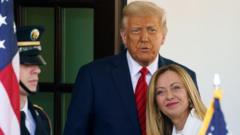
Political alliances are fickle things, but nobody expected the high-profile relationship between Italian Prime Minister Giorgia Meloni and US President Donald Trump to implode this spectacularly. For a long time, Meloni was widely seen as the ultimate Trump whisperer in Europe. She was the only European Union head of state to show up at his second inauguration in January 2026. They shared the same nationalist rhetoric, the same conservative values, and a mutual disdain for globalist bureaucracy.
Then came the June 2026 G7 summit in Evian-les-Bains, France.
Within days, a relationship built on public praise dissolved into a bitter, hyper-visible war of words on social media. Trump claimed Meloni literally begged him for a photo-op out of pity. Meloni fired back with a blazing video stating that neither she nor Italy ever begs, slamming Trump for being soft on the real enemies of the West while bullying his actual allies.
If you think this massive Meloni and Trump fallout is just a childish high school spat over a camera angle, you are missing the real story. This is a collision of hard geopolitical realities. It reveals the fundamental flaw of international populism. It turns out that when two fiercely nationalistic leaders put their own country first, they eventually end up running directly into each other.
The Myth of Eternal Right Wing Solidarity
Pundits love to group right-wing leaders into a single monolithic club. They assumed Meloni and Trump would remain inseparable because they both preach about border security and traditional values. That was a lazy assumption.
The reality of 2026 has blown that theory to pieces.
Meloni is a transatlantic institutionalist at heart. She wants to lead Europe from within, using her relationship with Washington as a tool to gain leverage over Brussels. Trump operates on raw transactional power. He does not care about alliances or diplomatic niceties. He cares about absolute compliance.
The cracks started showing early in the year. In January, Trump threatened European nations with a 10% tariff if they opposed his aggressive, wildly unpopular plans regarding Greenland. Meloni did not sit quietly. She publicly called his tariff threats a mistake and made it clear that Italy would never support forced territorial moves. She tried to play the role of the mature mediator, believing her personal rapport with Trump would save the day. It did not. Trump does not want a mediator. He wants an echo chamber.
The Real Breaking Point Was the Iran War
You cannot understand this diplomatic collapse without looking at what happened in the Middle East. When the US and Israel went to war against Iran earlier this year, Washington expected total obedience from its NATO allies. Trump wanted full access to European infrastructure to execute his military campaign.
Meloni drew a hard line. Italy is a massive logistics hub for the US military, especially with airbases in Sicily. But the war sent European energy prices through the roof. It disrupted the economy. It was deeply unpopular with the Italian public.
When Washington requested permission to use Italian runways for offensive bombing runs, Meloni said no. She insisted that any offensive use of Italian bases required explicit approval from the parliament in Rome.
Trump took this refusal as a personal betrayal. He values loyalty above all else. To him, Italy was freeloading under the protection of American defense spending while refusing to step up when the shooting started. The strategic distance Meloni kept from the unpopular military campaign created a deep resentment in the White House that was bound to boil over.
Defending the Vatican Over the White House
The friction turned deeply personal when Trump picked a fight with the Pope.
Pope Leo XIV has been an outspoken critic of the US military actions in Iran, regularly calling for an immediate ceasefire. Trump responded in typical fashion during a media interview, blasting the American-born pontiff as weak on crime and terrible for foreign policy.
For an Italian conservative leader, this was impossible to ignore. Meloni represents a political base deeply rooted in Catholic tradition. She could not let an American president insult the Pope without losing her own domestic credibility. She broke her diplomatic silence and called Trump's attacks on the spiritual leader completely unacceptable.
Trump fired back through the press, stating he was shocked by Meloni and claiming she lacked courage. The stage was set for a massive blowup. The warm ties that had been cultivated at Mar-a-Lago and the White House were completely dead by the time the leaders packed their bags for France.
The G7 Photo Dispute Revealed the Pettiness
Everything blew up after an interview with Italy's La7 television network. Trump told the broadcaster that Meloni had repeatedly begged him for a photo during the summit because her domestic popularity was cratering. He claimed he only agreed because he felt sorry for her.
The insult was designed to humiliate her on her home turf. It backfired.
Meloni dropped all diplomatic decorum. She posted an extraordinary video response on Instagram looking directly into the camera. She called Trump's story completely fabricated. The Italian government rallied behind her, with Foreign Minister Antonio Tajani instantly canceling a high-profile trip to the United States to protest the offensive remarks.
Trump doubled down on Truth Social, mocking her poll numbers and writing that she wanted to be friends again just to get her ratings up. Meloni shot back again, telling him to worry about his own collapsing poll numbers and pointing out that being his friend had actually damaged her politically.
Moving Beyond the Fallout
The diplomatic damage is done. The Italian diplomatic machine is currently working frantically behind the scenes to prevent Trump from slapping retaliatory tariffs on Italian exports. Meloni has stated she does not want to keep fueling the dispute, but the underlying systemic issues cannot be wished away.
If you are an international business leader, a policy analyst, or just someone tracking global stability, you need to accept that the old rules of transatlantic diplomacy are gone. Do not rely on personal relationships between heads of state. They can vanish over a single social media post.
European leaders are realizing they cannot rely on Washington to protect their economic interests. Italy is already looking to diversify its diplomatic and trade alliances within Europe to insulate itself from sudden American policy shifts.
The best move right now for European nations is to strengthen regional supply chains and secure independent energy corridors. Relying on a volatile Washington ally has proven to be a massive political liability. Keep your eyes on the upcoming NATO summit in Turkey. The body language and official statements there will tell you exactly how deep this fracture really runs.