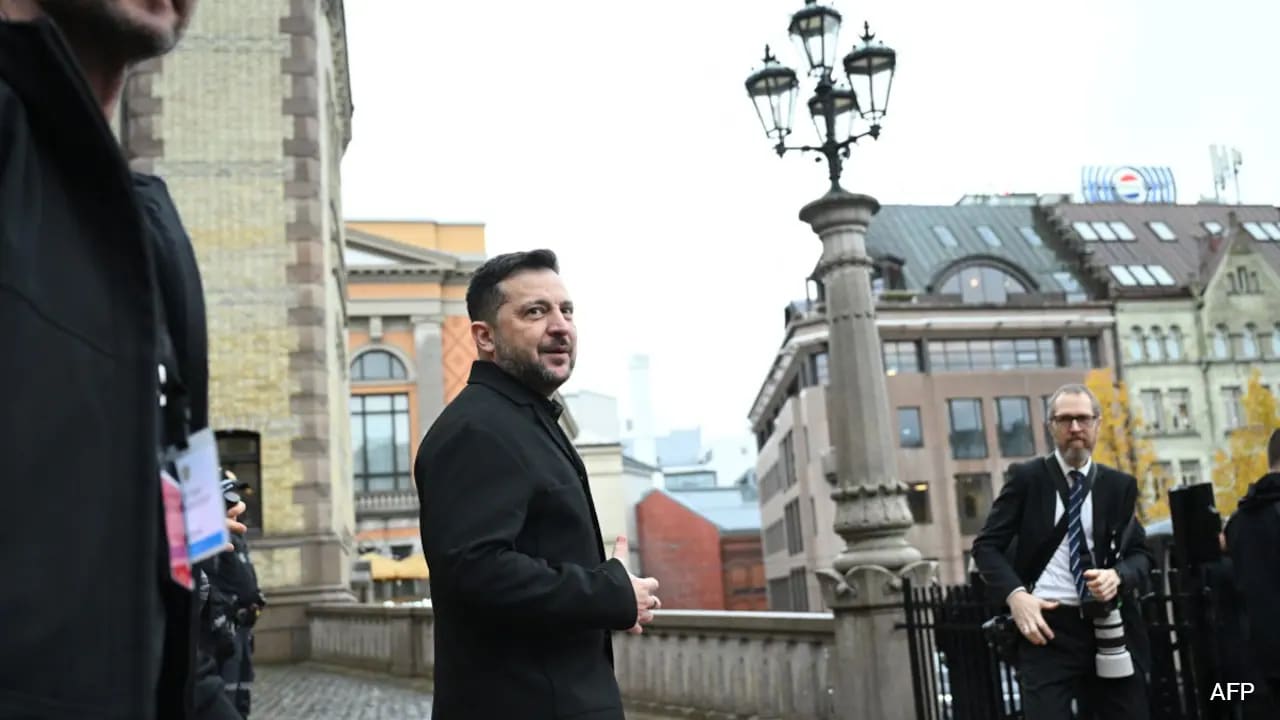
Diplomacy rarely looks like the dramatic handshake photos you see on cable news. When Ukrainian President Volodymyr Zelensky confirms that new talks on peace prospects are underway with the United States and the European Union, most casual observers immediately jump to one of two extremes. Either they think a ceasefire will be signed by Tuesday, or they dismiss the whole thing as empty political theater.
Both reactions miss the point entirely.
According to official statements from Kyiv and European diplomatic channels, these consultations are less about drawing immediate lines on a map and more about locking in long-term security guarantees and synchronized diplomatic pressure. If you've ever watched high-stakes international negotiations unfold in real time, you know the real work happens months before anyone sits down at a formal summit table. Right now, Washington, Brussels, and Kyiv are trying to get on the exact same page before Moscow can exploit any daylight between them.
Why These US and EU Peace Consultations Are Happening Right Now
Timing in geopolitics isn't an accident. Zelensky's push to coordinate peace prospects directly with American and European counterparts comes at a moment when war fatigue, shifting election cycles, and economic pressures are testing Western unity.
You can't separate diplomatic talks from what's happening on the ground and inside Western capitals. Kyiv knows that if Washington and Brussels aren't aligned on what an acceptable settlement looks like, Ukraine gets squeezed in the middle. That's why Zelensky has consistently emphasized his Peace Formula, insisting that any framework for ending the war must rest on international law, the United Nations Charter, and concrete deterrence mechanisms rather than temporary freezes that just give Russia time to rearm.
Honestly, the biggest misconception people have about these talks is assuming Russia is sitting at the table right now. They aren't. These are allied alignment sessions. Before you negotiate with an adversary, you have to make sure your own coalition agrees on the non-negotiables.
Getting Washington and Brussels on the Same Page
Anyone who follows transatlantic policy knows that the US and the EU don't always move at the same speed. Washington holds the heaviest military leverage and financial weight, while European nations deal directly with the immediate geographic fallout, energy shifts, and refugee flows on their borders.
During these bilateral and trilateral discussions, Ukrainian officials have focused heavily on three specific tracks:
- Security guarantees that actually have teeth. Kyiv learned the hard way after the 1994 Budapest Memorandum that vague assurances don't stop tanks. Current talks with the US and EU center on bilateral security agreements, air defense commitments, and long-term defense industrial cooperation.
- Global diplomatic outreach. Ukraine and its Western partners are actively courting nations outside the traditional NATO and EU orbit—countries in Latin America, Asia, and Africa—so that any future peace framework carries broad international legitimacy rather than looking like a purely Western blueprint.
- Economic recovery and frozen assets. Peace prospects mean very little if a country is left economically hollowed out. Discussions with EU leaders consistently tie diplomatic frameworks to the use of immobilized Russian sovereign assets and long-term reconstruction funding.
The Reality Behind Zelensky's Peace Formula vs Frozen Conflicts
Let's be clear about what Kyiv is trying to avoid. A "frozen conflict" sounds peaceful on paper if you live thousands of miles away, yet in practice it just means periodic artillery exchanges, stalled foreign investment, and a permanent countdown to the next invasion.
Ukrainian officials have repeatedly pointed to the Minsk agreements of 2014 and 2015 as proof of why half-baked ceasefires fail. Those deals paused full-scale escalation temporarily, only to set the stage for the broader invasion years later. When Zelensky talks about new peace prospects with US and EU representatives, he is specifically trying to prevent Western partners from pressuring Kyiv into another Minsk-style compromise.
What Critics and Skeptics Argue
It wouldn't be honest to pretend everyone in Washington or Europe views this strategy the same way. Foreign policy analysts and political leaders across the West are genuinely divided on how far diplomacy can go without direct Russian participation.
Some realist thinkers and policy commentators argue that holding peace talks without Moscow is like staging a play without half the cast. From their perspective, any durable settlement eventually requires direct negotiations over territorial realities, neutrality statuses, or sanctions relief. They worry that setting maximalist preconditions makes it harder to find an off-ramp before attrition takes an even heavier toll on Ukraine's population and infrastructure.
On the flip side, supporters of Kyiv's approach—including many Baltic and Eastern European officials—argue that offering concessions upfront only rewards aggression and signals to other global powers that borders can be redrawn by force. They contend that until the Kremlin believes it cannot win on the battlefield, Moscow has zero incentive to negotiate in good faith.
Both arguments carry real weight. That tension is precisely why these consultations between Zelensky, US officials, and EU leaders are so intense right now.
How Diplomatic Leverage Actually Works in Modern Conflicts
If you want to understand whether these talks will produce real results, stop watching the press conferences and start tracking the leverage points. Diplomacy doesn't happen in a vacuum; it reflects the balance of power outside the room.
Right now, three major variables dictate how much room Zelensky and his Western partners have to maneuver:
- Sustained military and air defense supply. You cannot negotiate from a position of strength while your energy grid is being systematically targeted. Every time Kyiv enters peace discussions with the US and EU, talks about diplomatic frameworks are paired directly with requests for air defense interceptors and long-range capabilities.
- Sanctions enforcement and economic pressure. Western diplomats spend enormous energy trying to close loopholes that allow sanctioned technology and oil revenues to keep flowing into Russia. Without sustained economic pressure, diplomatic proposals lack bite.
- Domestic political stability in allied nations. Elections, budget battles, and shifting public priorities in both the United States and European member states directly shape how bold Western leaders can be when backing Kyiv's peace conditions.
I've watched countless diplomatic initiatives stall out simply because observers mistook preliminary framework meetings for final peace treaties. When diplomatic readouts mention "productive discussions on peace prospects," they are talking about drafting the rules of the road—deciding who hosts future summits, which working groups handle nuclear safety or prisoner exchanges, and what security commitments stay intact after the fighting stops.
Practical Ways to Track Whether These Talks Are Making Real Progress
If you want to cut through the noise of breaking news alerts and partisan spin whenever Zelensky, US officials, or EU leaders announce a new round of peace consultations, pay attention to concrete indicators rather than dramatic headlines.
First, look for joint communiqués with specific working group assignments. When diplomats are serious, they assign named envoys to narrow technical tracks like energy security, maritime corridors, or humanitarian prisoner swaps. Vague statements about "shared values" mean nothing moved forward.
Second, watch non-Western diplomatic participation. Check whether major Global South nations—such as Brazil, India, Saudi Arabia, or South Africa—send high-level representatives to follow-up meetings hosted by Ukraine and its European partners. Broad international buy-in is the clearest sign that Kyiv's diplomatic framework is gaining real traction.
Third, track long-term defense and reconstruction commitments. Peace prospects become credible only when paired with multi-year funding mechanisms and binding bilateral security treaties ratified by parliaments in Washington and European capitals. Follow those concrete policy shifts, and you'll always know whether a diplomatic breakthrough is genuinely taking shape long before the cameras start rolling.