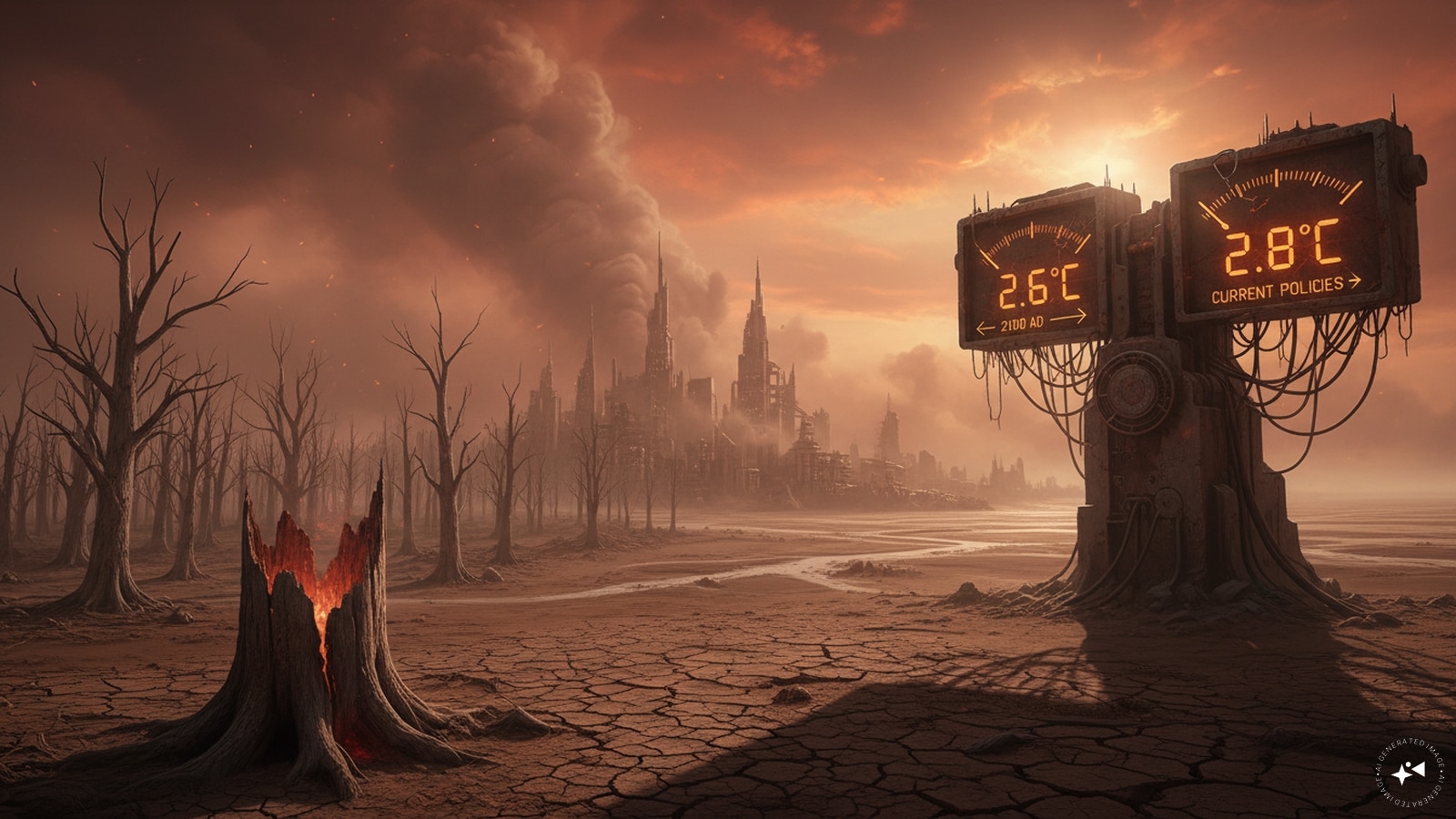
A headline saying global warming could hit 2.8°C by 2100 sounds like a slow-motion disaster movie. Most readers skim the number, sigh, and move on. That's a mistake.
Here is the real story behind projections around a 2.8°C rise by 2100. It isn't a single guaranteed date stamped on a calendar, nor is it a neat 2.8-degree bump evenly spread across the planet. Instead, current climate assessments from the United Nations Environment Programme and the Intergovernmental Panel on Climate Change point to a wide gap between where global policy stands today and the 1.5°C or well-below-2°C targets set in the Paris Agreement. Depending on whether governments stick to current policies, deliver conditional pledges, or slam on the brakes with deep emissions cuts, projected end-of-century warming spans a broad range—with trajectories near 2.6°C to 2.9°C sitting squarely in the danger zone if current policies don't tighten fast.
If you're wondering why a couple of degrees matters so much when the weather outside can swing by 15 degrees between morning and afternoon, you're asking the exact right question. Daily weather bounces around. Global average temperature is the baseline that sets the odds for heatwaves, droughts, heavy downpours, and ice melt across the entire planet.
Why Global Warming Projections Around 2.8°C Feel Abstract Until You Zoom In
People tend to treat climate numbers like sports scores. Either we win and stay under 1.5°C, or we lose and hit 2.8°C. Reality is much messier.
First, a global average hides wild regional extremes. Land warms roughly twice as fast as the global average because oceans absorb huge amounts of heat and slow down surface temperature jumps. High northern latitudes warm even faster than that. A 2.8°C global average doesn't mean every town gets 2.8°C warmer. It means some regions see far steeper heat spikes, while shifting wind and rain belts leave some areas flooded and others parched.
Second, temperature pathways depend heavily on what happens over the next ten to fifteen years. Carbon dioxide lingers in the atmosphere for centuries. Methane hits harder over shorter stretches but clears out faster. When scientists model a path toward roughly 2.8°C by 2100, they're looking at what happens if current policies continue with only modest updates, rather than full implementation of ambitious net-zero promises that still lack binding rules or financing.
I've spent years reading climate policy briefs, municipal adaptation plans, and energy market reports, and one pattern jumps out every time. People argue endlessly about long-range 2100 numbers while ignoring near-term grid bottlenecks, permitting delays, and methane leaks happening right now. Long-term models are essential guardrails, yet near-term execution decides which branch of the chart we actually travel down.
Key Takeaways From Recent UN Climate Assessments
Instead of treating a 2.8°C figure as a standalone prophecy, it helps to look at the core patterns running through recent UN climate and emissions gap work.
- Current policies still outpace promised cuts. Even when governments announce bold net-zero targets for 2050 or later, near-term policies often trail behind. The gap between pledges on paper and real-world laws is where extra warming accumulates.
- Every fraction of a degree compounds risk. Moving from 1.5°C to 2°C—and higher still toward 2.8°C—sharply raises the frequency and intensity of extreme heat, heavy rainfall, and agricultural stress. Risk doesn't creep up in a straight line; thresholds and compounding impacts hit harder as baselines shift.
- Methane offers faster near-term relief. Cutting methane from fossil fuel operations, agriculture, and waste won't solve long-term carbon buildup on its own, but reducing short-lived pollutants can slow the pace of warming over the coming decades.
- Adaptation cannot replace emissions cuts. Sea walls, drought-tolerant crops, and early-warning systems save lives and money. Still, there are physical and financial limits to adaptation if warming climbs past 2°C toward 2.8°C.
- Clean energy growth is real, yet uneven. Solar, wind, and battery deployment have expanded rapidly in many markets, bringing costs down dramatically. Even so, fossil fuels still supply the bulk of global primary energy, and grid upgrades plus storage lag behind generation growth in several regions.
- Developing economies face steep climate and finance pressure. Countries that contributed the least to historical emissions often face severe heat, water, and food shocks while paying higher borrowing costs to build resilient infrastructure.
- Land use and forests cut both ways. Deforestation releases stored carbon, while reforestation and better soil management can help—though forests themselves face greater wildfire, drought, and pest stress as temperatures rise.
- Tipping elements raise tail risks. Ice sheets, permafrost, and major ocean or ecosystem systems carry non-linear risks. Higher temperatures increase the chance of crossing thresholds that are slow or practically impossible to reverse on human timescales.
- Near-term action still shapes the 2100 outcome. A trajectory pointing near 2.8°C isn't locked in stone today. Rapid deployment of clean power, efficiency, electrification, and methane controls can pull projections downward over the coming election and investment cycles.
- Delay shifts costs onto households and budgets. Waiting to act doesn't make the transition free. Extreme weather damages infrastructure and supply chains while delaying cheaper, cleaner systems.
Look at how that temperature curve climbs after the mid-twentieth century. You can see why climate scientists focus so heavily on the slope of recent decades rather than treating warming as a distant, hypothetical trend.
Common Misconceptions That Trip People Up
When headlines talk about 2.8°C by 2100, a few stubborn myths usually follow right behind. Let's clear them up honestly.
Myth 1. If we're already past 1.2°C or 1.5°C, trying doesn't matter anymore
That's flat-out wrong. There is no "game over" switch at 1.5°C where suddenly every extra tenth of a degree becomes harmless. Every tenth of a degree we avoid matters for heatwaves, crop yields, coral reefs, and extreme storms. Holding warming to 2.2°C or 2.4°C is vastly better than hitting 2.8°C or 3.0°C, and staying under 2.0°C is better still.
Myth 2. "Net zero" means zero emissions today
Not even close. Net zero means balancing remaining greenhouse gas emissions that are tough to eliminate—like certain industrial or agricultural emissions—with an equivalent amount of carbon removal. More importantly, a net-zero pledge set for 2050 or 2060 only helps if interim targets for 2030 and 2035 actually cut emissions sharply right now.
Myth 3. Solar and wind alone will magically fix everything
Solar panels and wind turbines have been remarkable success stories, especially where costs dropped and rollout sped up. Still, electricity is only part of the energy picture. Heavy industry, freight, aviation, heating, cooling, and land use also matter. Plus, without transmission lines, grid storage, and smart demand management, clean power can get bottlenecked before it ever reaches homes or factories.
You can see from the setup in that image how modern energy systems pair generation with storage and grid infrastructure. Without that pairing, intermittency becomes a real headache on cloudy or calm days.
What This Means for Everyday Decisions and Planning
So what do you actually do with this information if you're not a climate negotiator? You don't need to panic, and you don't need to pretend nothing is changing.
For homeowners and renters, practical steps pay off regardless of politics. Better insulation, air sealing, efficient heating and cooling (like heat pumps where climate-appropriate), and shading or ventilation cut monthly bills while making homes more comfortable during extreme heat or cold snaps. If you live in an area prone to flooding, wildfire smoke, or heavy storms, checking local hazard maps and insurance terms early saves nasty surprises later.
For business operators, investors, and local leaders, the smart move is stress-testing assumptions. Heat waves hit outdoor workers, logistics, and power demand simultaneously. Supply chains that rely on single-region agricultural harvests or vulnerable transport corridors face rising disruption risks. Looking at data from the International Energy Agency and local meteorological agencies helps ground decisions in physical and economic reality rather than wishful thinking.
Honestly, the biggest trap is treating climate change as either a hopeless doom loop or a side hobby for environmentalists. It's a physical engineering, economic, and public health challenge all rolled into one.
Practical Next Steps You Can Take This Week
If you want to move from reading headlines to taking clear, grounded action, start small and practical.
- Check your local climate and hazard exposure. Look up historical heat, flood, drought, or storm patterns for your specific city or region so you're planning for local realities, not generic headlines.
- Audit your biggest energy and waste leaks. Track where your household or business spends the most on electricity, heating, cooling, and transport, and pick one high-return fix—like programmable thermostats, draught-proofing, or cutting idle energy use.
- Read primary reports rather than outrage summaries. When you see a bold temperature claim in a headline, trace it back to the underlying UN, IPCC, or scientific agency summary to see the scenario assumptions behind the number.
- Support practical local infrastructure and resilience. Pay attention to local grid upgrades, transit options, urban tree canopy, flood drainage, and building codes—those day-to-day choices shape resilience far more than distant speeches.