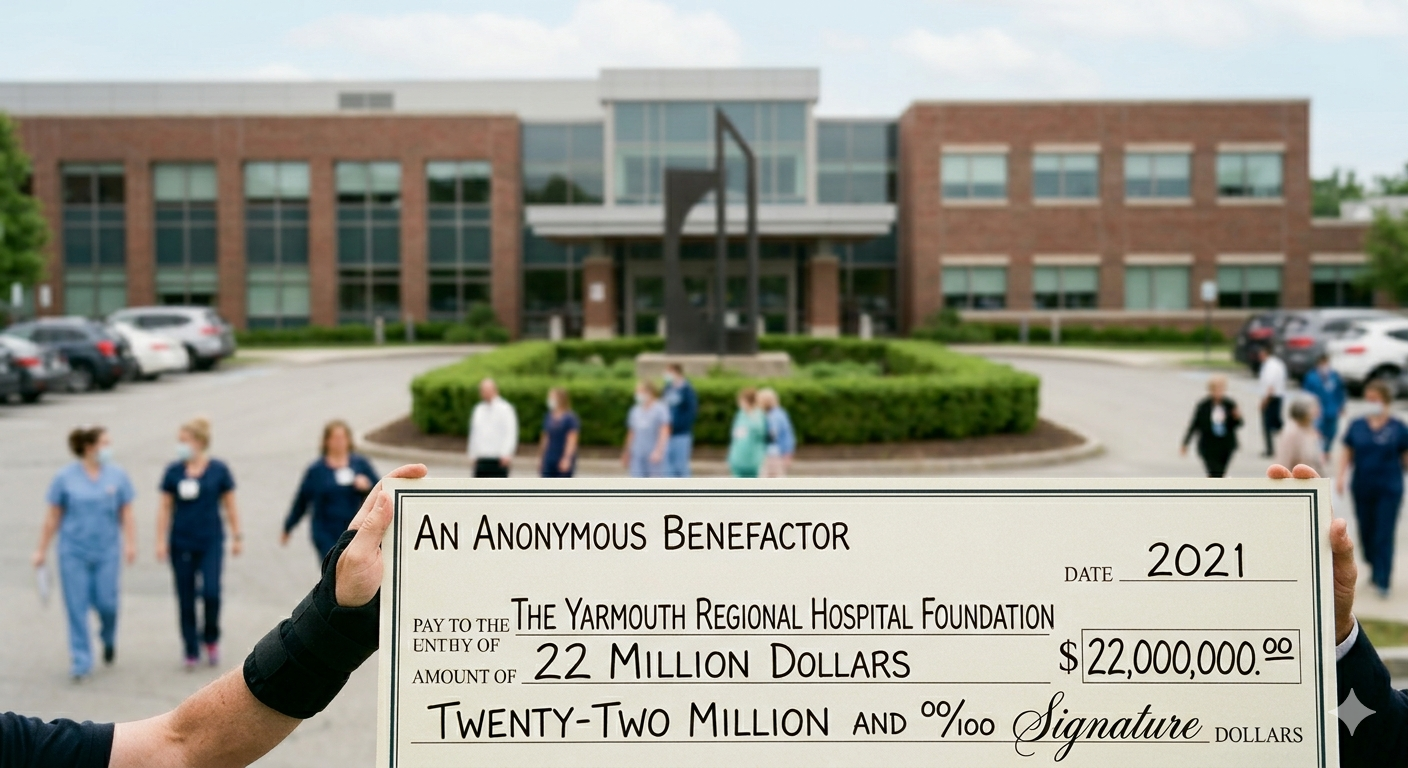
A secret donor drops $22 million into the lap of a tiny, rural hospital in Ontario. The media swoons. Local officials cry tears of joy. The general public views it as a miracle—a "gift of a lifetime" that secures the facility's future.
They are all wrong.
In reality, these massive, unsolicited windfalls are a systemic poison. They don't fix healthcare; they mask the rot of a failing funding model and create a dangerous dependency that actually weakens the long-term survival of the institution. This isn’t a feel-good story about a mystery benefactor. It is a case study in why the current "beg-and-borrow" model of community health is broken beyond repair.
The Endowment Trap
Everyone assumes that $22 million is a net gain. It isn't. When a small-town hospital receives a sum that exceeds its entire annual operating budget, it triggers a phenomenon known as "fiscal crowding out."
I have seen boards of directors at medium-sized non-profits completely lose their edge the moment a massive check clears. The urgency to innovate disappears. The drive to optimize operations vanishes. Why bother tightening the belt or finding efficiencies when you have a twenty-million-dollar safety net?
But the real danger lies with the government. In the Canadian single-payer system, the Ministry of Health watches these balances. While they won't explicitly "steal" the money, they will deprioritize that hospital for capital grants. Why would the province fund a new MRI machine for Hospital A when Hospital B just got a secret $22 million check? The "gift" effectively relieves the state of its responsibility, shifting the burden of public infrastructure onto the whims of private individuals.
The Operating Cost Nightmare
Here is the math that the feel-good articles never bother to calculate.
Donors love "stuff." They want their name—or their anonymity—attached to a shiny new wing, a high-tech surgical robot, or a state-of-the-art diagnostic suite. But in healthcare, the capital cost is the tip of the iceberg.
Imagine a scenario where this $22 million buys a brand-new specialty center.
- Maintenance: 5-8% of the capital cost annually.
- Staffing: Specialized technicians and nurses who are already in short supply.
- Utilities and Insurance: Massive overhead spikes.
The "gift" is often just a down payment on a debt the hospital can’t afford to service. Within five years, the interest earned on that $22 million (if they were smart enough to invest it) is swallowed whole by the increased cost of simply keeping the lights on in the new facilities the donor demanded. If the donor didn't provide an accompanying endowment for operations—which they rarely do—they haven't given a gift. They've given a burden.
The Anonymity Myth
The media loves the "Secret Santa" angle. It’s romantic. It’s selfless.
It is also a governance nightmare.
Accountability is the bedrock of public health. When a massive portion of a hospital's strategy is dictated by the wishes of a ghost, the community loses its voice. Usually, "anonymous" donors aren't truly anonymous to the board or the CEO. They have preferences. They have "suggestions" about which departments should get the most attention.
When $22 million comes from one source, that source becomes the most important person in the room—even if they aren't in the room. This leads to "donor-centric" medicine rather than "patient-centric" medicine. If the secret donor wants a world-class oncology unit but the community actually needs better geriatric home care and mental health support, the money goes to the oncology unit every single time.
The Illusion of Sustainability
People ask: "How can more money be a bad thing?"
It’s a bad thing because it creates a "lumpy" revenue cycle. A healthy hospital should rely on a broad base of predictable, recurring community support and stable government transfers. Relying on "black swan" events—one-time massive gifts—is like a family trying to fund their retirement by winning the lottery once every decade.
It kills the "culture of giving" in the local area. When the town hears that a secret donor gave $22 million, the local business owner who used to give $5,000 a year stops writing checks. The gala attendance drops. The $20 monthly donors figure their money isn't needed anymore.
By the time the $22 million is spent or tied up in depreciating assets, the grassroots donor base has withered away. The hospital is left larger, more expensive to run, and more alone than ever.
Breaking the Cycle of Charity-Based Care
We need to stop celebrating these gifts as "miracles" and start seeing them as "symptoms."
A functioning healthcare system should not require the intervention of a mysterious multi-millionaire to survive. When we cheer for these donations, we are essentially admitting that we have failed to build a sustainable public infrastructure. We are moving toward a neo-feudalist model where the quality of your local ER depends on whether a billionaire happens to live in your postal code.
The solution isn't to ban the money. It's to fundamentally change how it's handled.
- Mandatory Operating Endowments: No capital gift should be accepted without an accompanying 30% "tail" for long-term operations.
- Regional Pooling: Instead of $22 million going to one tiny hospital, it should be pooled into a regional health trust to ensure equity across the entire network.
- Transparency Over Mystery: Anonymity should end at the $1 million mark. If you are influencing public health infrastructure on this scale, the public has a right to know who you are and what your interests are.
The "mystery donor" didn't save that hospital. They just gave it a bigger shovel to dig a deeper hole. Stop waiting for a savior and start demanding a system that doesn't need one.
Next time you see a headline about a "secret gift," don't applaud. Ask to see the five-year pro forma for the increased utility bills.
The most expensive thing a hospital can receive is "free" money.