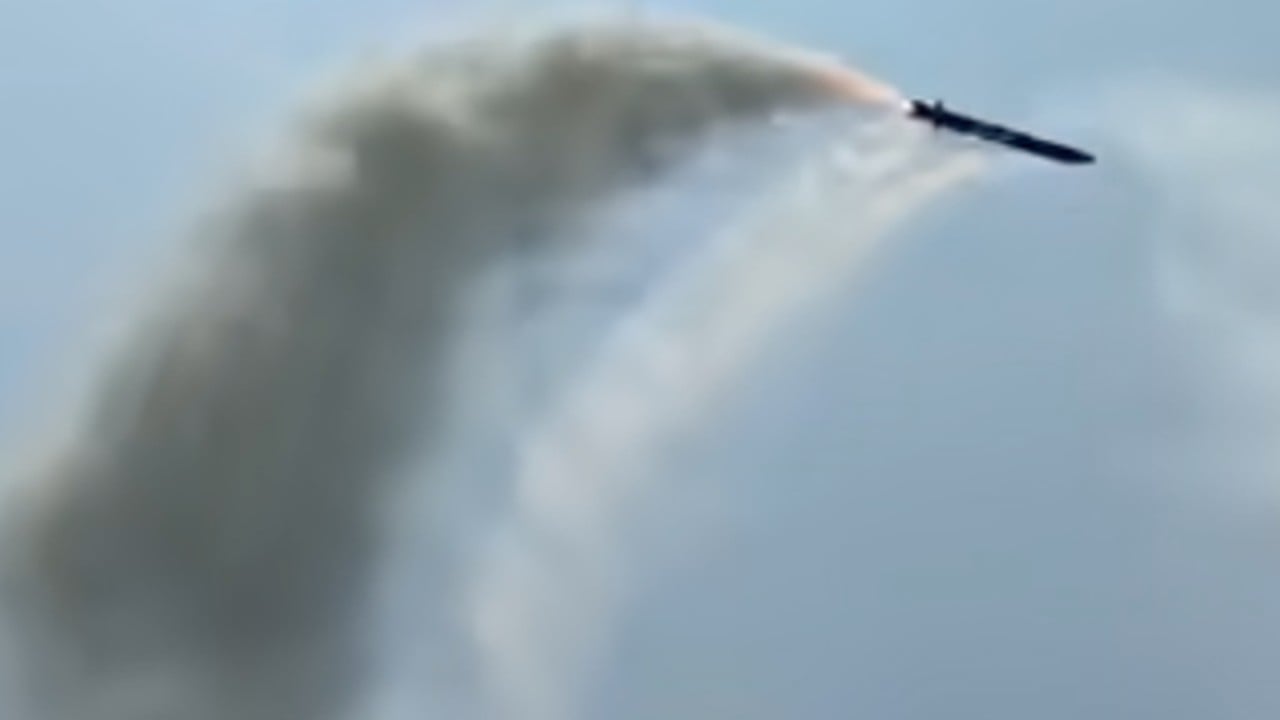
Naval strike warfare is fundamentally an exercise in reducing reaction time and degrading sensor performance. When state media released footage of a People's Liberation Army Navy surface combatant launching a variant of the YJ-18A anti-ship cruise missile coated in a matte black finish, the defense analysis community focused on the wrong variable. Pigmentation is a cosmetic property; surface electromagnetic impedance and radar cross-section attenuation are material sciences.
This technical assessment deconstructs the structural parameters of the reported sea trial, evaluating how low-observable coatings interact with dual-regime propulsion systems to alter modern naval interception calculus.
The Dual-Regime Flight Profile and Interception Windows
To understand the operational significance of the YJ-18A test, one must evaluate its kinematic profile. The weapon operates on a hybridized propulsion architecture split into two distinct physical phases:
- Subsonic Cruise Phase: Powered by a sustainer turbofan or turbojet engine, the missile travels at approximately Mach 0.8. This phase prioritizes fuel efficiency, maximizing range up to an estimated 540 kilometers while utilizing low-altitude sea-skimming profiles to exploit the radar horizon of defending warships.
- Supersonic Terminal Sprint Phase: Upon closing within approximately 20 to 40 kilometers of the target, the sustainer system jettisons, and a high-thrust solid rocket motor ignites, accelerating the airframe to between Mach 2.5 and Mach 3.0.
In a conventional engagement, an Aegis-equipped combat system tracking a subsonic inbound threat has an extended intercept window. Operators can assign multiple tiers of defense, including standard missile variants and Close-In Weapon Systems.
However, compressing the reaction time by introducing a high-speed terminal sprint reduces the defensive engagement timeline from minutes to seconds. The addition of radar-absorbing materials alters this dynamic not by changing speed, but by shrinking the detection range.
Material Mechanics of Radar-Absorbing Surfaces
Standard anti-ship missiles typically utilize high-visibility factory paint schemes, such as light gray or white, optimized for thermal regulation under solar radiation during long storage and deck-handling cycles. These finishes reflect high-frequency radar bands utilized by shipboard fire-control systems.
The appearance of a specialized dark, radar-absorbing coating on a vertical launch system variant indicates an operational shift toward minimizing the radar cross-section (RCS) during vulnerable transition windows.
[VLS Launch] ---> [Vector Maneuvering] ---> [Low-Altitude Sea-Skimming] ---> [Supersonic Terminal Dash]
      |                     |                          |                               |
  (Hot Gas Expulsion)  (Immediate Pitch-Over)     (Radar Horizon Exploitation)      (Mach 3 Kinetic Sprint)
Radar-absorbing materials function by converting incident electromagnetic energy into thermal energy through magnetic hysteresis and dielectric loss mechanisms. Carbon-based composites, ferrite particles, or specialized polymer matrices embedded in the outer skin attenuate incoming X-band and S-band radar emissions from enemy search and fire-control arrays.
Even a marginal reduction in RCS exponentially decreases the maximum detection range against active seeker tracking, according to the radar range equation, where detection distance scales inversely with the fourth power of the cross-sectional area.
Tactical Mechanics of Vector Post-Launch Maneuvering
Footage of the recent trial highlighted an immediate post-launch vector maneuver. When a missile clears the vertical launch system (VLS) canister of a Type 052D destroyer or Type 055 cruiser, it occupies a high-altitude ballistic apex where it is fully exposed to regional surveillance radar.
- Vector Reorientation: The immediate application of thrust vectoring forces the missile downward into a sea-skimming trajectory before standard aerodynamic control surfaces become fully effective at low speeds.
- Clutter Intersecting: By descending rapidly to wave-top altitudes, the missile merges its radar return with surface clutter—the ambient electromagnetic noise generated by ocean waves.
- Visual and Thermal Mitigation: While dark finishes primarily target radio frequency emissions, they concurrently disrupt visual acquisition in low-light sea environments where deep water approaches slate or black shades, complicating optical and infrared tracking systems during the boost phase.
Systemic Limitations and Engineering Trade-Offs
No low-observable aerodynamic application exists without compromises. Implementing specialized coatings introduces strict maintenance and environmental constraints.
Thermal loading presents the primary engineering hurdle. During the terminal supersonic dash at Mach 3, aerodynamic friction generates skin temperatures capable of degrading standard organic radar-absorbing paints. If the coating ablates unevenly or blisters under frictional heating, the RCS spikes dynamically, rendering the stealth characteristics unstable during the critical final seconds of flight.
Furthermore, dark pigmentation increases solar heat absorption while parked in VLS cells under direct sunlight, requiring active temperature management within the shipboard launch infrastructure to prevent propellant degradation or premature thermal warping of composite control surfaces.
Operational Integration within Regional Deterrence Frameworks
The systematic fielding of low-observable, dual-regime armaments addresses the core vulnerability of anti-access and area-denial constructs: defending networks against multilayered maritime missile defense architectures.
By fusing a high-altitude VLS deployment mechanism, vector-controlled descent profiles, radar-attenuating surface treatments, and a supersonic terminal velocity, modern naval strike engineering seeks to saturate the decision-making cycles of automated combat management systems.
The strategic utility lies not in any single attribute, but in the compression of multiple defensive variables simultaneously—forcing defending platforms to counter a threat that is harder to detect, faster to close, and structurally optimized to penetrate terminal point defenses.


