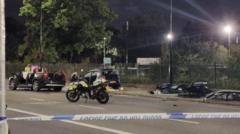
High-speed urban intervention operations introduce profound kinetic risks that frequently clash with statutory safety mandates. When law enforcement units operate vehicles at velocities drastically exceeding urban thresholds, the margin for human cognitive error collapses. The legal proceedings surrounding the October 2024 collision on Eltham Road in south-east London—involving Metropolitan Police vehicles and resulting in the deaths of 38-year-old Mariam Ahmed and her unborn child—bring these operational tensions into sharp focus. Examining cases of this magnitude requires moving beyond episodic reporting to evaluate the underlying mechanics of pursuit dynamics, driver exemption frameworks, and institutional risk management protocols.
The Kinetic Thresholds of Urban Interventions
Kinetic energy scales quadratically with velocity ($E_k = \frac{1}{2}mv^2$). This mathematical reality dictates that doubling a vehicle's speed quadruples its destructive potential upon impact. In dense urban environments characterized by complex intersections, mixed modal traffic, and pedestrian density, operating at velocities approaching 80 miles per hour introduces environmental variables that exceed standard human reaction and braking capabilities.
The operational profile of tactical units often relies on rapid deployment capabilities. However, urban infrastructure is engineered for nominal flow rates and average speeds significantly lower than emergency response thresholds. When a heavy enforcement vehicle travels on the incorrect side of a thoroughfare at high velocity, the visual acquisition time for civilian motorists attempting to execute routine maneuvers—such as a stationary or signaling right turn—is compressed from seconds to milliseconds.
The cognitive load on the emergency driver is equally severe. Navigating opposing lanes requires constant evaluation of peripheral hazards, oncoming traffic, and unexpected pedestrian movements. Under high-stress operational conditions, tunnel vision narrows the driver's visual field, degrading situational awareness. The intersection of high speed and urban complexity creates an operational hazard profile where minor deviations in trajectory yield catastrophic outcomes.
Statutory Exemptions and the Doctrine of Proportionality
Under United Kingdom traffic legislation, specifically the Road Traffic Act, police drivers responding to emergency circumstances may claim statutory exemptions from certain speed limits and traffic sign regulations. However, these exemptions are not absolute. They are legally conditioned upon a strict requirement for care and competence. The exemption excuses non-compliance with statutory speed limits, but it does not absolve the driver or the employing agency from the overarching common-law duty of care.
The core legal question in prosecutions involving emergency drivers centers on whether the manner of driving fell below the standard expected of a competent and careful driver under identical circumstances. This evaluation requires a multi-variable assessment:
- Urgency of the Objective: The gravity of the incident prompting the emergency response versus the immediate risk introduced to the public.
- Environmental Conditions: Traffic density, weather, road surface friction, and visibility at the time of transit.
- Maneuver Execution: The specific choice of speed, positioning on the roadway, and the use of audible and visual warning systems.
- Risk Mitigation: The active employment of slowing techniques or stopping at blind junctions regardless of exemption status.
Prosecutors and defense counsels evaluate these variables through forensic reconstruction, telemetry data, and dashcam footage. The central tension lies in establishing where legitimate tactical urgency transitions into reckless disregard for civilian safety. When charges of causing death by dangerous driving are brought against an officer—such as the case involving PC Chris Johnson—the court must determine if a sober, competent driver in the defendant's position would have recognized the manifest danger of the speed and positioning chosen.
Institutional Accountability and Tactical Oversight
The operational chain of command extends beyond the individual behind the wheel. Modern law enforcement agencies maintain internal policies governing pursuits, tactical driving, and response criteria. These guidelines are designed to balance the necessity of apprehending suspects or rendering urgent assistance against the inherent risk to public safety.
When an incident results in a fatality, investigations typically examine two distinct layers of accountability: individual criminal culpability and institutional supervision. The Independent Office for Police Conduct (IOPC) evaluates whether supervisory decisions, training regimens, or policy enforcement contributed to the operational choices made on the road.
Tactical units, such as the Metropolitan Police Taskforce, are frequently deployed for high-urgency operations. The operational culture within specialized units can sometimes foster an environment where pushing performance envelopes becomes normalized. Systemic oversight requires telemetry monitoring, mandatory post-incident reviews, and regular re-certification to ensure that individual operational habits remain aligned with legal boundaries and institutional safety thresholds.
When multiple vehicles are involved in a coordinated response—such as an overtaking maneuver where one vehicle precedes another—the complexity multiplies. The lead vehicle's actions directly alter the traffic flow and create downstream reactions from civilian drivers who may interpret the passage of one emergency vehicle without anticipating a second. The allocation of criminal charges to multiple officers reflects an investigative focus on the collective dynamics of the convoy rather than isolated driving errors.
Systemic Vulnerabilities in Emergency Response Protocols
Analyzing the systemic vulnerabilities inherent in high-speed urban policing reveals persistent structural challenges that technology and policy must address.
The Decision-to-Speed Feedback Loop
Emergency dispatch systems frequently incentivize rapid arrival times to maximize response metrics. This institutional pressure can inadvertently encourage drivers to adopt excessive velocities in environments where infrastructure cannot support safe high-speed transit. Mitigating this risk requires decoupling operational evaluation from raw speed metrics, emphasizing tactical risk assessment over sheer velocity.
Civilian Predictability Deficits
Civilian drivers are conditioned to expect predictable traffic flows. When an emergency vehicle operates contrary to standard expectations—such as traveling against the flow of traffic at high speed—civilian reaction models fail. Standard indicators, such as a driver initiating a turn after checking traditional sightlines, become hazards because the closing speed of the oncoming emergency vehicle negates standard braking and reaction times. Training frameworks must account not only for the driver's skill but for the high probability of civilian cognitive misinterpretation.
Telemetry and Data Transparency
Historically, reconstructing high-speed collisions relied heavily on eyewitness testimony and limited skid-mark analysis. Modern vehicular black boxes and high-definition telemetry provide microsecond-by-microsecond data regarding throttle position, braking input, steering angles, and exact velocity profiles. Integrating real-time telemetry streaming into command centers could introduce automated velocity caps or warning triggers when tactical driving enters high-risk zones, shifting reliance from retrospective legal prosecution to prospective operational intervention.
Re-Engineering Urban Tactical Operations
Addressing the systemic risks associated with emergency transit requires a fundamental overhaul of how agencies manage high-speed deployment. The traditional model relies heavily on post-hoc judicial review after fatalities occur, creating an adversarial relationship between accountability bodies and operational units.
A preventative framework requires strict operational parameters tied to empirical risk indices. If urban density, road configuration, and traffic volume cross specific threshold metrics, high-speed exemptions should automatically require mandatory deceleration protocols at intersections and blind corners. Furthermore, supervision must shift from passive monitoring to active intervention, where control rooms can curtail high-speed operations when the immediate threat profile no longer justifies the collateral risk to the public.
Revising training syllabi to emphasize cognitive load management during high-stress pursuits will help mitigate the tunnel vision that characterizes many critical incidents. Officers must be drilled in the tactical necessity of calculated deceleration, recognizing that arriving slightly later preserves the very public order they are sworn to protect. The legal proceedings moving toward trial highlight the urgent requirement for structural reform across metropolitan enforcement operations, ensuring that the pursuit of justice does not inadvertently jeopardize civilian life.