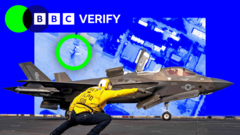
A satellite blinks 300 miles above the desert. Down below, nothing moves but the dust. To the untrained eye, the image transmitted back to a glowing monitor in Washington is a study in beige and grey—a collection of flat roofs, perimeter walls, and the sharp lines of asphalt roads cutting through the wilderness.
Then comes the flash.
When the smoke clears, the next satellite pass captures a different reality. The sharp lines are jagged now. The flat roofs have collapsed inward like deflated cardboard boxes. Black scorch marks radiate outward from what used to be a reinforced concrete bunker.
Public military briefings usually reduce these moments to sterile numbers. They talk about "successful engagements," "neutralized assets," and "mitigated threats." But behind the sterile language of geopolitical conflict lies a massive, quiet reality that has fundamentally altered the landscape of the Middle East over the last few years.
More than 50 Iranian-linked military bases have been damaged or destroyed by American airstrikes since the current wave of regional conflict ignited.
Fifty.
Think about that number for a moment. It is not just a statistic on a Pentagon press release. It represents a massive, coordinated campaign of precision violence carried out from the air, recorded by cameras in space, and felt by thousands of people on the ground. To understand what this actually means, you have to look past the political speeches and dive into the mechanics of modern warfare, where a conflict is fought simultaneously with high-explosive ordnance and high-resolution pixels.
The View from the Sky
Consider the routine of an imagery analyst. Let’s call her Sarah. She sits in a windowless room, miles away from any actual danger, drinking lukewarm coffee. Her job is to look at the world through a digital straw.
For months, Sarah watches a specific coordinate in eastern Syria. She sees the daily rhythm of the base. She notes when the supply trucks arrive, usually under the cover of twilight. She counts the new security checkpoints that spring up along the perimeter. She watches the construction of a new berm, a dirt wall designed to protect a hidden ammunition depot from blast fragments.
She learns the personality of the base through its architecture. This is not a standard national army outpost. It belongs to a militia funded, trained, and equipped by Iran’s Islamic Revolutionary Guard Corps. The structures are modular, built quickly, and designed to blend into the surrounding civilian infrastructure.
Then, the order comes down.
A few days later, Sarah pulls up the fresh imagery. The berm she watched being built over three weeks is gone, pulverized into a crater. The ammunition depot is a hollow shell, its roof peeled back like a tin can.
This sequence has played out at least 50 times across Iraq, Syria, and Yemen. The sheer scale of the destruction is difficult to comprehend without looking at the cumulative map. It is a trail of broken concrete stretching across thousands of miles, marking a shadow war that has finally burst into the open.
The Anatomy of a Strike
Why 50 bases? And why now?
The escalation did not happen in a vacuum. Every strike is a counterweight in a deadly game of physics and politics. When militia groups launch drone attacks or fire rockets at American outposts in the region, the response is calculated to hurt without triggering a total regional war.
But a calculated response still involves immense power.
When a B-1B Lancer bomber or an F-15E Strike Eagle releases its payload, it isn’t dropping the dumb gravity bombs of the twentieth century. It is releasing weapons guided by GPS and laser tracking systems. These munitions are designed to hit a specific room inside a specific building.
The targets are chosen with meticulous care:
- Command and Control Centers: The nerve centers where militia leaders plan drone routes and coordinate rocket attacks.
- Logistics Hubs: Warehouses storing Iranian-supplied components, from guidance kits for ballistic missiles to cheap, deadly loitering munitions.
- Training Camps: Isolated facilities where local fighters are taught how to operate advanced weaponry.
When these sites are hit, the secondary explosions often do more damage than the initial bomb. A warehouse packed with solid-rocket fuel or drone batteries doesn't just burn. It erupts. The resulting fires can rage for hours, cooking off ammunition and tearing through nearby structures until entire complexes are rendered completely useless.
The Human Ripple
It is easy to get lost in the technology of destruction. We look at before-and-after photos and marvel at the accuracy of a missile that can fly through a ventilation shaft. But every single one of those 50 bases sat near a community.
Imagine living in a village just outside an airfield in western Iraq. You know who occupies the base down the road. You see the armed men at the checkpoints. You know they aren’t locals. You also know that their presence makes your home a target.
You go to sleep wondering if tonight is the night the sky tears open.
When the strikes happen, the ground shakes for miles. Windows shatter in civilian homes. The night sky turns a brilliant, terrifying orange. For the people living in these zones, the geopolitical chess match between Washington and Tehran isn't an abstract debate on a cable news network. It is a physical force that rattles their dishes, frightens their children, and reminds them daily of their own vulnerability.
Even for the fighters inside those bases, the reality is stark. The satellite images show the structural damage, but they don't show the chaos that follows. They don't show the frantic search for survivors in the rubble, the sirens wailing into the desert night, or the sudden realization that their secure positions are completely transparent to an enemy watching from orbit.
The Endless Inventory
The most unsettling realization of this campaign is its apparent lack of a final chapter.
You might think that destroying 50 military installations would break the back of any fighting force. In a conventional war, that kind of loss would force a retreat or a surrender. But this is not a conventional war.
The supply lines running from Iran through Iraq and into Syria are resilient. They are built on decades of experience in smuggling, bypassing sanctions, and operating in the shadows. When a warehouse is destroyed, another one is rented or built a few miles away. When a command post is flattened, the officers move into a residential apartment building or an underground bunker.
The satellite images prove that the United States can hit whatever it wants, whenever it wants. But they also reveal a deeper, more frustrating truth: the targets keep reappearing. It is an endless inventory of destruction. One side builds, the other side watches, the bombs fall, and the cycle resets.
Beyond the Smoldering Concrete
What remains when the smoke clears from fifty separate battlefields?
We are left with a landscape scarred by precision warfare and a regional architecture that is constantly being dismantled and rebuilt. The satellite photos tell a story of undeniable technological dominance. They show that secrecy is an illusion in the modern age, and that distance no longer offers protection.
But as the analysts in Washington catalog the latest round of damage, counting the destroyed vehicles and mapping the crater diameters, the fundamental question remains unanswered. The bombs can destroy the concrete, the steel, and the stockpiled weapons. They can turn 50 bases into dust.
They cannot, however, erase the geography, the ideology, or the grievances that built those bases in the first place.
A lone bulldozer moves across the scarred desert floor in the fading evening light, clearing away the jagged remains of a collapsed roof, preparing the ground to build all over again.


