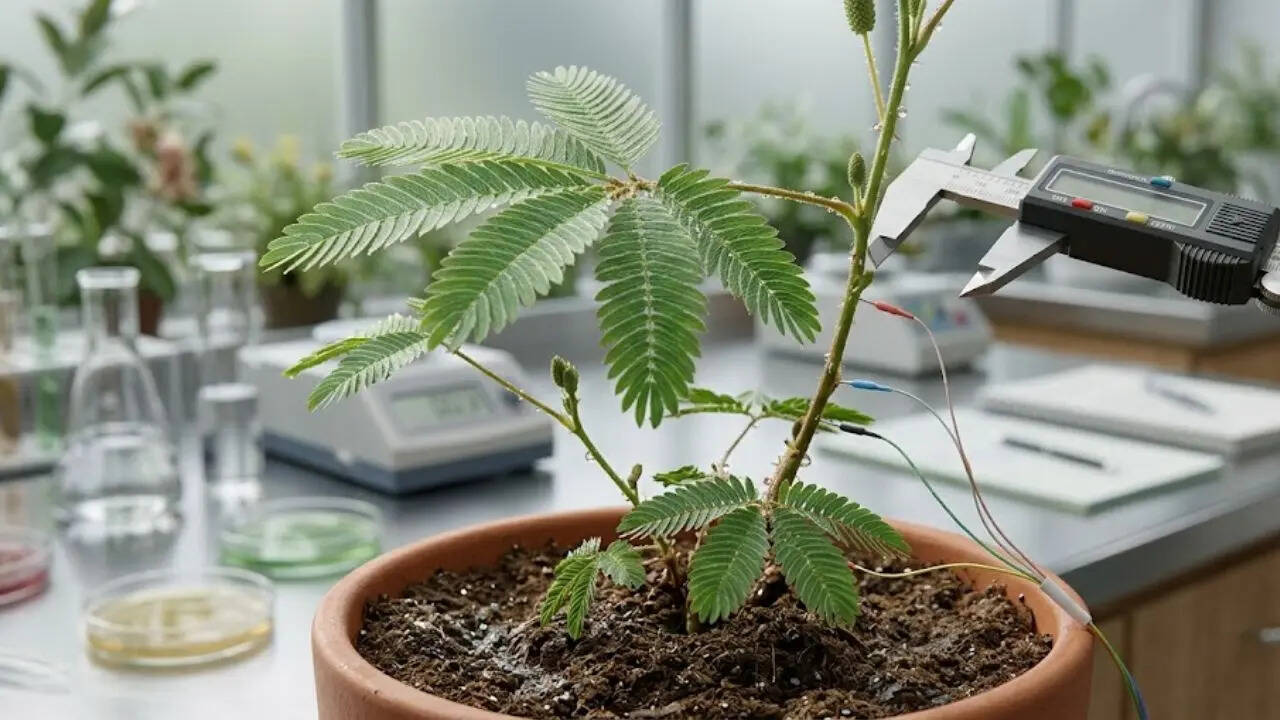
The greenhouse in Munich smelled of damp earth and late-afternoon humidity. I was standing over a low wooden bench, staring at a patch of Mimosa pudica, commonly known as the sensitive plant, or more affectionately, the "shy plant." Beside me, a researcher adjusted a modified glass pipette attached to a electronic micro-syringe. We were looking for a mind where we had been taught none could exist.
To most people, the shy plant is a novelty. Touch its feathery fronds, and they collapse inward, folding up like a tiny green umbrella caught in a gust of wind. It is a defense mechanism, a frantic attempt to look unappetizing to passing herbivores. But what happened next in that laboratory changed how I look at the very fabric of life.
The researcher programmed the syringe to drop a single, precise droplet of water onto the plant's leaves. The fronds snapped shut. We waited. A minute later, another drop. Shut again. But by the seventh or eighth drop, something extraordinary happened. The plant stopped reacting. It stayed open, basking in the artificial light, perfectly indifferent to the water.
It had realized the drops were harmless. It had remembered. And to remember, it had to keep track of time, frequency, and number.
We are obsessed with brains. We treat that three-pound lump of gray matter in our skulls as the exclusive ticket to the intellectual sandbox. If you don't have a central nervous system, standard human logic dictates that you are essentially an organic automaton, a fleshy machine reacting blindly to light and moisture. Yet here was a creature lacking a single neuron, performing a calculation that requires memory, discrimination, and a rudimentary form of counting.
It forces a uncomfortable question upon us. What if intelligence isn't a crown worn only by the highly evolved, but a fundamental property of life itself?
The Chemistry of an Invisible Mind
To understand how a brainless plant counts, we have to strip away our human bias about what "thinking" looks like. When you count on your fingers, your brain relies on electrical signals jumping across synapses, regulated by chemical neurotransmitters like glutamate. It is an intricate, lightning-fast network.
The shy plant uses a parallel system, built from entirely different materials.
Imagine a row of dominos. If you push the first one, the energy cascades down the line. In the Mimosa pudica, that first domino is a physical touch. When a leaf is disturbed, it triggers a sudden shift in the electrical potential of the plant's cell membranes. This is not entirely unlike the action potential that fires along human nerves.
Once this electrical wave is triggered, it rushes through the plant's vascular tissue—the same plumbing system used to move water and nutrients. This wave opens microscopic floodgates, causing charged atoms, specifically calcium ions, to flood into the cells. The sudden influx of calcium changes the water pressure inside the cells at the base of the leaf, known as the pulvinus.
Think of the pulvinus as a tiny, water-filled balloon holding the leaf upright. When the calcium rushes in, water rushes out. The balloon deflates. The leaf collapses.
But a single collapse is just a reflex. The true magic lies in the plant’s ability to recognize repetition.
Consider a hypothetical scenario where we simulate this process on a microscopic level. The first drop of water falls. Calcium floods the cells; the leaf drops. The second drop falls, and the same thing happens. But with each consecutive drop, the residual calcium levels inside those cells do not return entirely to baseline. They leave a chemical footprint. A trace.
The plant is essentially using the accumulation of these ions as a biological abacus. Each drop adds a bead to the wire. When the concentration reaches a specific threshold without any accompanying damage, the plant's internal biochemistry flips a switch. It decides, in a purely chemical sense, that the stimulus is no longer worth the energy it takes to hide.
It has counted the events, evaluated the risk, and chosen to ignore us.
The High Cost of Existential Dread
Plants do not have the luxury of making mistakes. For a green organism rooted in one spot, energy is the ultimate currency.
Every time the shy plant folds its leaves, it pays a massive tax. Closed leaves cannot efficiently capture sunlight. Photosynthesis plummets. The plant is effectively holding its breath, starving itself of energy in order to stay safe from a perceived predator.
If it folds every time the wind blows or every time a harmless raindrop falls, it will eventually starve. Conversely, if it fails to fold when a caterpillar crawls onto its stem, it gets eaten. The stakes are existential.
This is why the ability to count, to differentiate between the erratic, dangerous touch of an insect and the predictable, rhythmic dropping of water, is a brilliant evolutionary adaptation. It is a calculator forged in the fires of survival.
When we watch the plant open back up after repeated exposure to water, we are witnessing a living calculator balancing its checkbook. It is weighing the cost of starvation against the probability of danger. It is an optimization algorithm running in real-time, written in the language of calcium and water pressure.
Dismantling the Human Pedestal
For centuries, Western science operated under a strict hierarchy. We placed humans at the pinnacle of creation, followed by primates, dolphins, dogs, and down through the "lesser" animals, until we reached the bottom: the inert, unfeeling world of flora.
We used this hierarchy to justify our isolation from nature. We convinced ourselves that because plants do not scream, they do not feel. Because they do not have eyes, they do not perceive.
But the closer we look, the more that pedestal crumbles.
Biologists have known for a while that plants communicate. When a willow tree is attacked by webworms, it releases airborne chemicals that warn neighboring trees to spin up their own chemical defenses before the pests arrive. Tobacco plants call in predatory wasps to eat the hornworms devouring their leaves. Forests are connected by vast, subterranean fungal networks—the "Wood Wide Web"—through which trees trade carbon, nurse dying saplings, and warn each other of impending drought.
Now, we must accept that they can also keep score.
This realization brings a profound sense of vertigo. If a plant can count, remember, and learn, then our definition of intelligence is broken. We have defined intelligence by its proximity to human behavior. We look for language, for tool use, for facial expressions. We look for ourselves in the mirror of the world, and when a creature doesn't reflect our image back at us, we declare it blank.
The shy plant reminds us that there are other ways to inhabit this planet. It suggests that consciousness, or at least the processing of information to make autonomous decisions, is not a rare spark in a vast darkness. It is a web woven through every living root, leaf, and cell on Earth.
The Lesson of the Green Abacus
As I watched that little plant in Germany, I felt a wave of humility that was both unsettling and liberating.
We spend billions of dollars searching for intelligent life in the cosmos. We point massive radio telescopes at distant stars, listening for a sequence of numbers, a mathematical broadcast that would prove we are not alone. We want so desperately to find an alien intelligence that can count.
Yet, beneath our boots, in the cracks of our sidewalks and sitting quietly on our windowsills, an alien intelligence has been doing exactly that for millions of years. It speaks in a language of fluid dynamics and electrical potentials that we are only just beginning to decipher.
The next time you walk past a patch of wild greens, or touch the leaves of a sensitive plant and watch them curl away from your finger, pause for a moment. You are not just witnessing a mechanical reflex. You are interrupting a conversation. You are stepping into a quiet mind that is currently taking your measure, running the numbers, and waiting to see what you will do next.