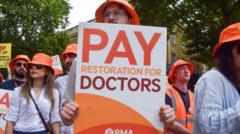
The British government just pulled the pin on a metaphorical grenade and tossed it into the middle of the NHS workforce. By giving the British Medical Association (BMA) a 48-hour window to drop their strike action or face the loss of 1,000 vital training posts, the Prime Minister has shifted from negotiation to open warfare. It’s a high-stakes move that reeks of desperation. It also ignores the long-term damage this kind of threat does to an already demoralized medical community.
If you’re wondering why this matters to anyone outside of a hospital ward, look at the numbers. We aren't just talking about a few missed shifts. We're talking about the literal future of surgery, GP practices, and emergency care. Losing 1,000 training spots doesn't just hurt the junior doctors today. It guts the specialist pipeline for the next decade. You can't just "buy" a consultant off the shelf in five years if you kill their training path now. Meanwhile, you can find similar events here: The Calculated Silence Behind the June Strikes on Iran.
The government’s logic is simple, if brutal. They claim the cost of the strikes—the backlogs, the redirected resources, the sheer financial drain of covering shifts with expensive agency staff—has eaten the budget meant for these new positions. They’re saying the money is gone. But in reality, this looks less like a fiscal necessity and more like a political squeeze play designed to turn public opinion against the doctors.
The 48 Hour Clock and the Training Post Threat
The core of the dispute is the 1,000 training posts. These aren't entry-level roles where you can just hire a temp. These are the competitive slots that allow doctors to specialize in fields like cardiology, pediatrics, or oncology. Without these posts, doctors get stuck in "trust grade" limbo. They work, but they don't progress. Eventually, they leave. They go to Australia. They go to Canada. They leave medicine entirely because the path to being a consultant is blocked by a political standoff. To see the complete picture, check out the excellent article by USA Today.
The PM is betting that the BMA will flinch. The threat is targeted. It doesn't hurt the senior leadership as much as it hurts the youngest, most vulnerable members of the profession. It’s a move designed to create a rift within the union. If the BMA holds the line and the posts are cut, the government will blame the union for "sacrificing" their own juniors. If the BMA folds, the government wins without giving an inch on pay.
It’s a nasty piece of business.
The BMA’s stance remains that they're fighting for "pay restoration." They argue that a decade of sub-inflation raises has effectively cut their salary by a third. When you look at it that way, a 5% or 10% offer feels like an insult. But the government’s counter-argument is that the economy can't handle a 35% jump in one go. Both sides have dug in so deep they can’t see the sunlight anymore.
What Happens When the Pipeline Breaks
When you remove training posts, you create a bottleneck that lasts for years. Medicine is a ladder. If you remove 1,000 rungs near the bottom, the whole structure becomes unstable.
Think about the impact on patient care. If those 1,000 posts vanish, we will see:
- Longer wait times for specialist appointments because there are fewer registrars to staff clinics.
- Increased burnout for existing staff who have to cover the gaps.
- A massive "brain drain" as the best and brightest graduates look for residencies in countries that actually want them.
I've talked to doctors who are already looking at flights to Brisbane. They don't want to leave. They grew up here. They trained here. But when the Prime Minister tells them their career progression is a bargaining chip, the "Clap for Carers" era feels like a fever dream. The trust is gone. You can't fix a broken healthcare system by threatening the people who run it.
The BMA Response and the Strategy of No Retreat
The BMA isn't known for backing down lately. Under their current leadership, they've been more militant than we’ve seen in decades. They know that if they give in to this 48-hour ultimatum, the government will use the same tactic every time there’s a dispute. "Do what we want or we cut the budget for X." It’s a precedent they can’t afford to set.
From their perspective, the government is "raiding the future" to pay for a mess they created. The BMA argues that the money for training should be ring-fenced. They see this threat as a sign that the government isn't serious about solving the staffing crisis. Instead of finding a way to fund both fair pay and training, the PM is forcing a choice that shouldn't exist.
Public support is the real battleground. The government wants you to be angry that your surgery was canceled. They want you to blame the doctor on the picket line. The BMA wants you to be angry that the NHS is being managed into the ground. They want you to blame the person in 10 Downing Street.
A Cycle of Escalation with No Winners
This isn't how functional systems work. In any other industry, a standoff this severe would lead to a mediated settlement months ago. But the NHS is a political football. Every move is calculated for the next election, not the next surgery.
The "48 hours" isn't just a deadline for the BMA. It's a deadline for the PM’s reputation. If the BMA ignores the threat and the government actually cuts the posts, the NHS will suffer a self-inflicted wound that might never heal. If the BMA ignores the threat and the government doesn't cut the posts, the PM looks weak. It’s a classic "lose-lose" scenario.
We have to ask why we're here. The UK spends less on healthcare per capita than many of its peers. We have fewer doctors per 1,000 people than most of the EU. And yet, the strategy is to threaten the training of the few doctors we do have. It's madness.
Breaking the Deadlock or Breaking the System
If the government wants to end the strikes, they need to stop the ultimatums. Threats don't work on people who already feel they have nothing left to lose. Most junior doctors are hundreds of thousands of pounds in debt and working 60-hour weeks in crumbling buildings. Telling them they might lose a training spot is like telling a drowning person they might get wet.
The only way out is a multi-year pay deal that recognizes the reality of inflation. It doesn't have to be 35% tomorrow. It needs to be a roadmap. At the same time, training posts must be protected. Using the education of the next generation of surgeons as a hostage in a wage dispute is a level of cynicism that the public shouldn't tolerate.
The clock is ticking. If the 48 hours pass without a deal, the NHS gets a little bit smaller, a little bit weaker, and a lot more fractured.
Keep an eye on the official BMA updates and the Department of Health's press releases over the next two days. If you have a scheduled appointment, call the hospital to check its status, but don't expect clarity until the deadline passes. The next 48 hours will decide if the NHS has a future or just a managed decline.