The plastic shell was unremarkable. It was black, rectangular, and small enough to disappear into the palm of a working hand or slip unnoticed into the pocket of loose trousers. Millions of them hummed quietly across hospitals, construction sites, and courier desks through the late nineties and the early two-thousands. They were the punctuation marks of an era before glowing glass rectangles dominated every gaze. They vibrated on belt clips during tense surgical consultations. They buzzed in restaurants when a delivery driver was needed across town.
Then came New York, September 2024. For another perspective, check out: this related article.
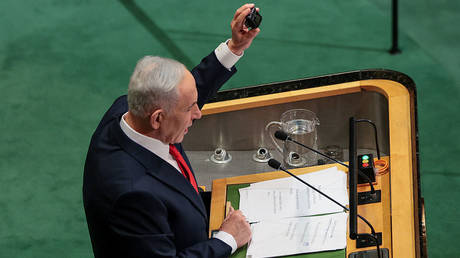
Benjamin Netanyahu stepped up to the podium at the United Nations General Assembly. The room smelled of old wool, stale coffee, and the heavy perfume of global diplomacy. Delegates adjusted their translation earpieces. Cameras panned across the tiered auditorium. The Israeli Prime Minister reached into his pocket. He did not pull out a rolled-up treaty, a smartphone, or a diplomatic passport. He pulled out a pager.
It was a theatrical gesture, pregnant with a terrifying subtext. That little plastic box was no longer a relic of obsolete telecommunications. It was a monument to an invisible war, a tangible symbol of a supply chain turned inside out, and a stark reminder that in the modern theater of statecraft, any object touched by human hands can be engineered into an assassin. Related insight regarding this has been provided by The Washington Post.
To understand the weight of that moment, you have to strip away the abstractions of intelligence briefings and look at the physical reality of how things are made.
Imagine an ordinary warehouse in a city whose name never makes the evening news. Crates arrive by the container load. Circuit boards, lithium-ion battery cells, plastic injection moldings, microprocessors. Each component travels thousands of miles across oceans, passing through the hands of dozens of intermediaries, brokers, and shipping clerks. Nobody questions a batch of pagers destined for a middleman distributor in Europe or the Middle East. They are low-tech tools, mundane objects of trade.
Yet, somewhere along that serpentine journey, the assembly line deviated from its blueprint.
Imagine an engineer working under fluorescent lights, soldering a tiny, high-explosive charge alongside the receiver chip. Not enough to blow up a building. Just enough to turn a communication device into a localized grenade. Gram by gram, explosive material replaced standard circuitry components. The packaging remained identical. The weight was calibrated to match the original so precisely that a customs inspector hefting the device would feel nothing amiss. It was a masterclass in industrial subversion.
When those devices finally buzzed simultaneously across Lebanon months prior, the world watched a silent explosion ripple through grocery stores, living rooms, and street corners. Thousands of people fell instantly. The horror was not merely in the casualties; it was in the realization of the vector. The weapon did not arrive on a missile or a drone. It arrived wrapped in bubble wrap, delivered by a standard courier service, paid for with legitimate invoices, and powered by batteries bought in bulk.
This is the hidden architecture of modern conflict. We live in an interconnected grid of commerce where every node is vulnerable. For decades, the primary fear of technological warfare centered on cyberspace. We worried about invisible lines of code crippling power grids, emptying bank accounts, or freezing air traffic control towers. We envisioned hackers in dimly lit basements typing furiously against invisible firewalls.
The pager operation proved something far more unsettling. The physical world has not escaped the digital threat; rather, the digital world has weaponized the physical supply chain itself.
Consider the psychological toll of such a capability. How do you look at your kitchen toaster, your wireless headphones, or your smart thermostat once you know that manufacturing lines can be silently intercepted? Trust is the invisible adhesive holding global trade together. You buy a product because you trust the brand name, the country of origin, the safety certification, and the retail clerk who handed it to you. When that trust is systematically harvested and weaponized, the foundation of daily life begins to fracture.
When Netanyahu lifted that pager at the United Nations, he was not just referencing a specific tactical operation against Hezbollah. He was broadcasting a paradigm shift to every capital on earth. He was holding up a mirror to the vulnerability of globalized manufacturing.
Think about the sheer audacity of the logistics. Intelligence agencies had to anticipate procurement habits years in advance. They had to understand how a specific adversary organization acquired its hardware, which front companies they trusted, and how to insert themselves into that commercial loop without raising a single red flag. It required patience that spanned governments, election cycles, and shifting alliances. It was a chess game played with millions of pawns, where the board itself was the international market.
Yet, as the applause and the gasps faded from the General Assembly hall, a deeper question lingered in the air like ozone after a lightning strike.
What happens when everyone realizes this is possible?
If a nation-state can hollow out pagers, what stops another from compromising microchips destined for automotive braking systems, medical pacemakers, or civilian aviation components? The democratization of industrial sabotage threatens to turn every supply chain into a minefield. The distinction between civilian infrastructure and military arsenal dissolves completely when the toaster on the kitchen counter can be turned into a detonator.
We have entered an era where safety can no longer be outsourced to distant factories and certified labels. The objects we invite into our homes, our offices, and our pockets carry silent histories we cannot read.
The pager in New York was small. It fit easily between the thumb and forefinger of a veteran politician. But as it caught the glare of the United Nations television lights, it cast a very long shadow over the future of human commerce. It whispered a dark truth about the world we have built: the more connected we become, the easier it is for the invisible hand of war to reach right into our hands.