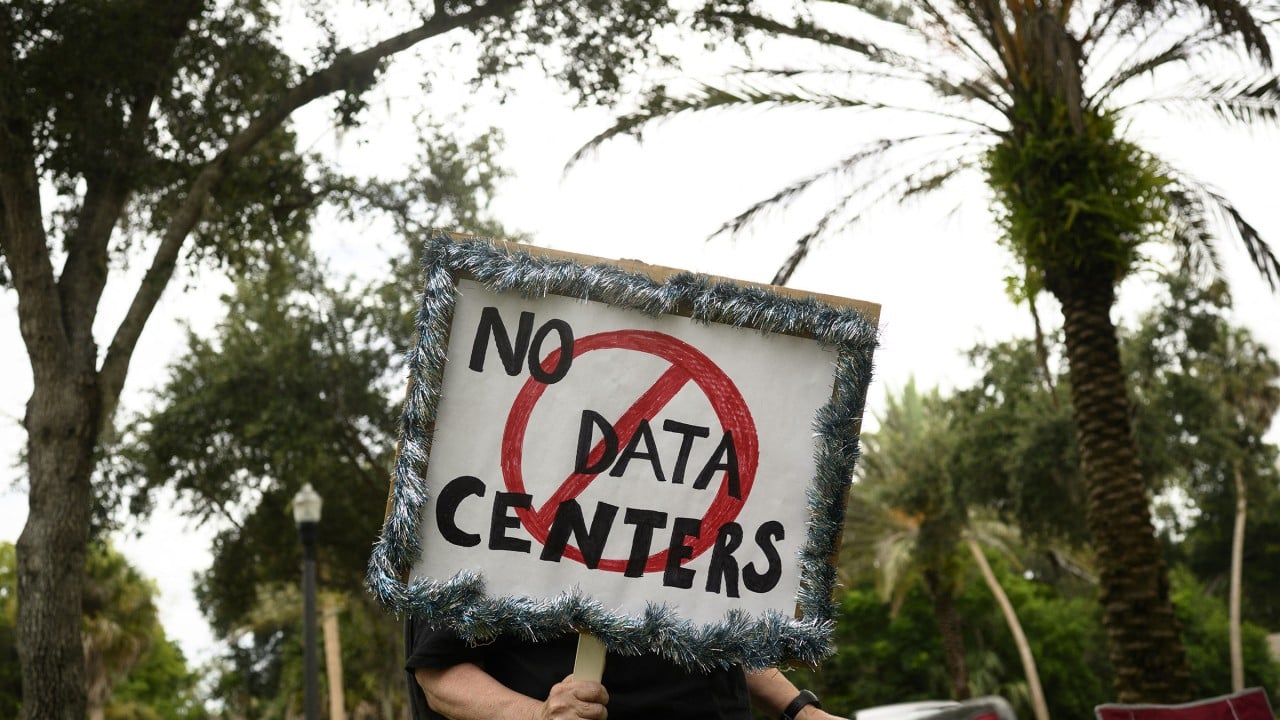
National security arguments fail when they collide with localized, immediate economic friction. While executive policy frames hyperscale AI data center expansion as an existential race against Chinese technological dominance, American voters evaluate these projects through municipal utility bills, grid reliability, and land-use disruption. This divergence creates an acute political bottleneck: geopolitical abstractions cannot offset hyper-local negative externalities.
The Structural Mismatch Between Geopolitics and Municipal Economics
The central failure of the national security pitch lies in its spatial asymmetry. The benefits of domestic compute capacity—macroeconomic productivity, defense modernization, and intellectual property retention—are diffuse and national. The costs of physical infrastructure deployment are concentrated and immediate. For another look, consider: this related article.
When a hyperscale facility enters a regional power market, it alters the local supply-and-demand equilibrium overnight. Unlike traditional industrial manufacturing, which scales employment alongside energy consumption, modern AI training clusters require massive megawatt allocations while sustaining minimal permanent headcount post-construction. Voters observe an entity consuming the electricity equivalent of a mid-sized city without delivering commensurate local payroll expansion.
This dynamic triggers classic public choice friction. Concentrated cost-bearers (residential ratepayers and neighboring property owners) mobilize rapidly through zoning boards, state utility commissions, and local ballot initiatives. Diffuse beneficiaries (national security apparatus and global technology shareholders) lack local political standing. Invoking geopolitical competition with Beijing does not resolve a 15 percent projected increase in regional transmission tariffs. Further coverage on the subject has been published by MarketWatch.
The Three Pillars of Local Infrastructure Friction
Opposition to data center proliferation is rarely ideological; it is rooted in measurable resource constraints across three physical systems.
1. Electrical Grid Capacity and Cost Socialization
AI training workloads require continuous, high-density power with near-zero tolerance for interruption. Integrating 500-megawatt to 1-gigawatt loads into regional transmission organizations (RTOs) forces utilities to accelerate capital expenditures on substations, high-voltage transmission lines, and baseload generation.
Under standard utility rate-making frameworks, infrastructure upgrade costs are frequently socialized across the broader ratepayer base unless regulators enforce strict tariff ring-fencing. Even when hyperscalers fund dedicated interconnects, their presence tightens reserve margins during peak weather events. Voters correctly perceive that industrial load growth degrades grid resilience and drives residential rate hikes.
2. Thermal Management and Water Scarcity
High-density GPU clusters generate extreme thermal loads. Evaporative cooling systems, while energy-efficient, consume millions of gallons of potable or reclaimed water daily. In agricultural corridors or drought-stressed western basins, data center water withdrawals compete directly with municipal supply and crop irrigation.
Closed-loop liquid cooling mitigates ongoing water consumption but increases capital costs and electricity draw. Until closed-loop architectures become the universal baseline, water allocation permits remain a primary choke point for local opposition.
3. Land Use, Acoustic Pollution, and Tax Abatement Asymmetry
Suburban and exurban municipalities frequently offer aggressive property and sales tax abatements to attract data center capital expenditure. However, once operational, these facilities occupy vast acreage, generate continuous low-frequency acoustic hum from cooling fans and backup diesel generators, and place heavy wear on local road networks during multi-year buildouts.
When residents calculate the net fiscal return after accounting for decade-long tax exemptions, the municipal value proposition often turns negative. The promise of winning an international AI arms race carries zero weight in a county commission hearing focused on property tax shifts.
Why the China Framing Fails as a Persuasion Mechanism
Political messaging relies on risk salience. For a threat narrative to override immediate financial self-interest, the threat must feel imminent, personal, and directly mitigated by the proposed policy. The China AI pitch fails on all three counts.
First, the causal chain between approving a local substation in Virginia, Ohio, or Texas and preventing Chinese geopolitical hegemony is too abstract for standard voter heuristics. Voters do not experience model weights or compute deficits in their daily lives; they experience monthly utility statements and transformer noise.
Second, voters recognize a corporate subsidy transfer masked as national defense. When trillion-dollar technology firms lobby for expedited permitting, federal energy subsidies, and weakened environmental reviews under the banner of patriotic necessity, the electorate interprets the effort as rent-seeking. Skepticism intensifies when those same firms maintain global supply chains and international research partnerships.
Third, partisan alignment fractures at the municipal level. Conservative voters who strongly support hawkish trade and technology policies toward China simultaneously oppose federal preemption of local zoning authority and resist corporate eminent domain for transmission corridors. Progressive voters oppose fossil-fuel life extensions—such as delaying coal plant retirements or building new natural gas peaker plants—required to power continuous AI workloads. Both coalitions converge against the infrastructure, rendering national political messaging ineffective.
Quantifying the Infrastructure Cost Function
To understand why political resistance scales non-linearly, operators must examine the infrastructure cost function from the perspective of a regional regulator:
- Marginal Grid Strain: Each incremental 100 MW of continuous load reduces regional reserve margins, exponentially increasing the probability of scarcity pricing during peak demand.
- Employment Elasticity: Construction phases generate temporary spikes in transient labor, straining local housing and healthcare capacity, followed by an operational cliff where permanent staffing drops by over 90 percent.
- Fiscal Lag: Tax abatements front-load municipal revenue losses while delaying infrastructure depreciation recovery.
When policymakers ignore these variables and rely solely on geopolitical rhetoric, they misdiagnose a structural engineering and economic allocation problem as a public relations deficit.
Operational Limitations of Current Policy Remedies
Federal interventions designed to bypass local resistance carry severe secondary risks.
- Federal Permitting Preemption: Stripping state utility commissions and county boards of zoning authority accelerates short-term groundbreakings but guarantees prolonged litigation, state-level regulatory retaliation, and entrenched voter backlash.
- Behind-the-Meter Generation: Co-locating data centers directly with existing nuclear or natural gas plants avoids transmission bottlenecks but removes baseload capacity from the public grid, tightening supply for surrounding communities and inviting regulatory clawbacks.
- Direct Ratepayer Subsidies: Using federal funds to subsidize residential electric bills in data-center-heavy districts masks price signals, encourages inefficient grid consumption, and creates unsustainable fiscal liabilities.
No communication strategy can permanently obscure physical resource constraints. If compute expansion requires cannibalizing residential grid reliability or municipal water tables, voter resistance will harden regardless of executive framing.
Strategic Realignment for Infrastructure Deployment
Winning public consent requires abandoning abstract geopolitical persuasion in favor of binding economic ring-fencing and architectural reform. Hyperscalers and energy policymakers must execute three structural shifts:
- Mandate Full-Cost Tariff Isolation: Utilities and regulators must establish dedicated industrial rate classes requiring data center operators to fund 100 percent of upstream generation, transmission, and substation upgrades, backed by long-term take-or-pay contracts that protect residential ratepayers from stranded asset risk.
- Enforce Zero-Water-Waste Architectures: Permitting authorities should restrict new approvals in water-stressed basins exclusively to closed-loop, non-evaporative cooling systems, eliminating competition with municipal and agricultural water supplies.
- Convert Tax Abatements into Direct Infrastructure Dividends: Municipalities must replace blanket tax exemptions with direct community benefit agreements that route a fixed percentage of facility capital value directly into local grid modernization, school districts, and residential utility bill credits.
Geopolitical dominance in artificial intelligence will not be decided by the volume of national security rhetoric coming out of Washington, but by the engineering discipline and fiscal transparency applied at the county line.