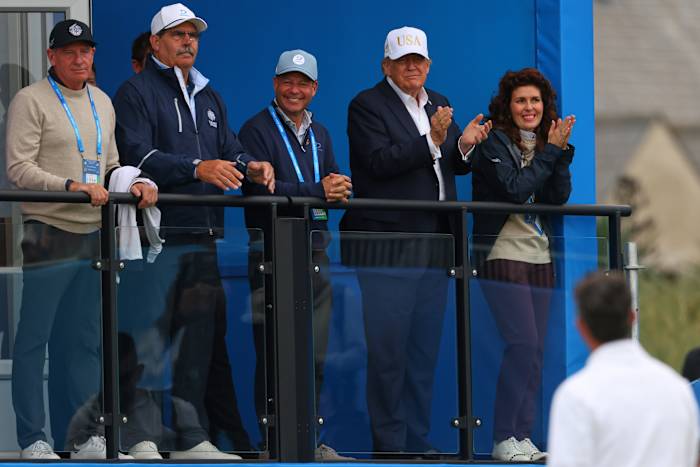
Political capital does not accumulate solely within the legislative chamber or the diplomatic suite; it is frequently negotiated across immaculately manicured fairways. Donald Trump’s affinity for golf and his entrenched relationships with professional athletes represent a specialized form of network orchestration. To dismiss this dynamic as a mere leisure pursuit is to misread how informal access operates at the highest echelons of power and celebrity. By analyzing the structural incentives, economic intersections, and behavioral mechanics governing these high-stakes sporting alliances, we can deconstruct the precise utility of the presidential golf ecosystem.
The Structural Mechanics of Access
In traditional political environments, communication follows rigid protocols. Staff gatekeepers, security clearances, and official schedules create friction that limits candid exchange. The golf course alters this transmission medium by imposing a unique spatial and temporal constraint: participants are locked into a shared physical environment for roughly four to five hours. This enclosure strips away institutional layers, replacing rigid hierarchy with the egalitarian rhythm of the game. For a more detailed analysis into this area, we recommend: this related article.
The mechanics of this environment rely on three distinct operational advantages:
- Pace-Driven Proximity: Unlike a ten-minute drop-in meeting, a round of golf forces sustained physical co-presence. Conversation is distributed across transitions from tee boxes to fairways and greens, allowing complex ideas to be introduced, tested, and refined without the pressure of an immediate clock.
- Behavioral Diagnostics: Golf acts as a psychological revealing agent. Observers and participants alike judge temperament, emotional regulation under failure, ethical adherence to rules, and competitive drive based on how an individual handles a bad lie or a missed putt. For a executive decision-maker evaluating trust, four hours on a course yield more behavioral data than a dozen formal briefings.
- Asymmetrical Networking: For professional golfers, a presidential invitation bridges the gap between elite sports and global political power, cementing status and granting unique proximity to policy discussions. For the politician, association with elite athletes transfers cultural capital, projecting physical vitality and alignment with high-achieving subcultures.
The Economic and Brand Intersection
The relationship between political figures and professional golf is underpinned by mutual brand enhancement. Modern professional golf is a multi-billion-dollar global industry anchored by broadcasting rights, corporate sponsorships, course design portfolios, and tournament infrastructure. When a former president owns, designs, or frequents courses that host major events, the intersection of real estate capital, media visibility, and political influence creates a self-reinforcing loop. For broader context on this development, in-depth coverage can also be found on Bleacher Report.
Consider the transactional nature of this ecosystem through an economic lens:
- Asset Valuation and Real Estate: Championship-tier golf courses function as high-yield institutional assets. Association with top-tier professionals elevates course prestige, driving up membership equity values, green fees, and residential property developments attached to the properties.
- Diplomacy by Proxy: Professional golfers operate within an international arena, traveling continuously across jurisdictions with distinct geopolitical profiles. Engaging with these athletes provides an informal intelligence-gathering mechanism and an alternative diplomatic channel that bypasses traditional state department friction.
- Cultural Distribution: Athletes possess massive, highly engaged direct-to-consumer digital audiences. When a professional golfer shares an endorsement or a personal interaction from the links, it penetrates demographic segments that traditional political media campaigns struggle to reach efficiently.
The Cost Function of Leisure Politics
While the strategic advantages of golf diplomacy are clear, the framework carries distinct liabilities and opportunity costs. Public perception often splits sharply along political lines regarding the optics of presidential leisure.
The primary friction points involve:
- Resource Allocation and Optic Costs: Intensive time commitments to recreational sports can be weaponized by political opponents as evidence of detachment from pressing national or economic crises. The metric of time spent away from traditional office environments serves as a primary opposition talking point.
- Reputational Vulnerability: Tying one's personal brand to external figures—including professional athletes—introduces third-party risk. Controversies surrounding athletes can inadvertently spill over into the political narrative, requiring careful curation of who is granted access to the inner circle.
- Exclusivity Friction: The optics of elite networking can alienate populist voting bases if mismanaged. While access is a powerful currency, the appearance of catering exclusively to ultra-wealthy sporting and real estate circles creates a counter-narrative that must be balanced by broader public engagement strategies.
Strategic Alliance Orchestration
The durability of Trump's engagement with professional golf demonstrates that sports are rarely just sports when intersected with high-level influence. The fairways serve as a private theater where social capital is traded, alliances are forged, and informal negotiations bypass institutional blockages. By recognizing golf as a high-density networking protocol rather than a simple pastime, we uncover the deliberate architecture behind how informal power is consolidated, projected, and sustained in the modern political landscape.