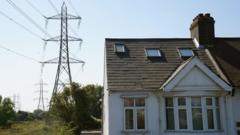
If you live within roughly five hundred metres of a newly planned power line or substation, you might soon see a welcome reduction on your utility statements. The government's scheme promises a handy two hundred and fifty pounds a year off electricity costs for households hosting major grid infrastructure. It sounds like free money. But once you look past the headlines, the policy reveals a much larger financial shuffle that affects millions of people who will never see a dime of that discount.
Let's break down what this actually means for your wallet.
The Real Cost Behind the Pylon Payouts
The UK is racing to double its electricity network capacity to handle a massive influx of renewable power from offshore wind farms and solar arrays. Decades-old transmission lines simply cannot cope. To bypass intense local pushback against the construction of massive metal structures across scenic countryside, officials cooked up a financial incentive often dubbed "pounds for pylons".
Eligible homeowners receive one hundred and twenty-five pounds credited twice a year over a span of a decade. That adds up to two thousand five hundred pounds per household.
Here is the part most reports gloss over. This money isn't appearing out of thin air. The cost of these individual discounts, alongside billions in broader grid reinforcements, gets baked directly into the national network charges. Every single electricity customer across the country shares that burden through standard billing mechanisms. You are essentially chipping in a small amount on your own standing charges to fund the discounts handed to properties sitting right next to the new cables.
Who Actually Qualifies for the Relief
Don't expect a windfall if you've lived next to an industrial-sized power line for the last twenty years. The rules explicitly target new or heavily upgraded overhead transmission projects. If your property already hosts vintage infrastructure built back in the 1960s, you miss out entirely.
The policy aims to soothe a very specific group of people: those facing brand-new visual scars and potential property value hits from upcoming construction. Projects like National Grid's massive reinforcements spanning from Bramford to Twinstead, or regional overhead lines managed by Scottish Power, anchor this rollout. Communities near these designated zones also unlock separate community benefit funds for local projects, pushing total local investments even higher.
Critics argue that a couple of hundred pounds a year doesn't scratch the surface of actual property depreciation or local disruption. On the flip side, proponents maintain that speeding up network expansion prevents billions of pounds in wasted constraint payments—where wind farms are literally paid to turn off because the current grid cannot transport their energy.
Navigating Your Options As Energy Bills Shift
Grid upgrades will continue for the foreseeable future, and network charges will keep evolving. If you want to protect your household budget from creeping infrastructure costs, stop relying on standard variable tariffs that trap you in high default rates.
Take a close look at your quarterly statements to see how much of your payment goes toward standing charges versus actual unit consumption. Use independent comparison tools to hunt down fixed deals that lock in your rates. Keep an eye on local planning notices if you live near designated transmission corridors. If a new project rolls past your back garden, make sure you check your eligibility for every penny of local compensation and bill relief coming your way.