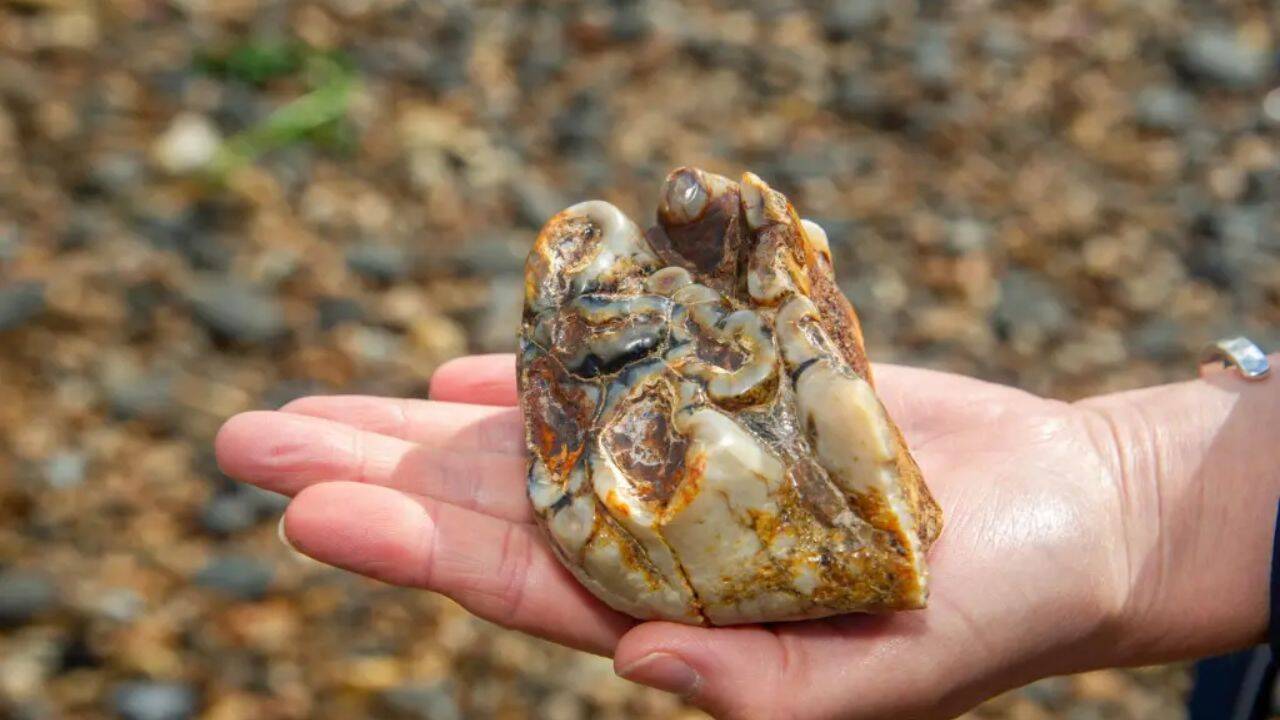
An eleven-year-old boy walking along the windswept shore of Bawdsey, Suffolk, recently picked up a four-inch, rock-like object from the surf. It was not a stone. It was the upper left molar of an Anancus arvernensis, a primitive, straight-tusked elephant that roamed Europe nearly two million years ago. The discovery by Charlie Orchard-Lisle, verified by the Natural History Museum in London, highlights a chaotic reality that academic paleontology quietly grapples with every day. The borders of the British Isles are crumbling into the sea, washing priceless evolutionary data directly into the paths of casual tourists, commercial amateurs, and an unregulated grey market.
The find itself is spectacular. Anancus arvernensis was an evolutionary bridge, standing over eight feet tall at the shoulder, defined by bizarrely long, straight tusks that stretched nearly as far as its body. The creature occupied an era when Europe was transitioning from a lush, subtropical woodland into the volatile cycles of the Ice Age.
When a child stumbles upon a fossilized tooth with its enamel still glinting through coastal mud, it makes for a heartwarming local news feature. Yet behind the headlines lies a structural crisis driven by climate change, accelerating coastal erosion, and a legal framework that treats irreplaceable prehistoric heritage as finders-keepers beach loot.
The Flaw in Britain's Treasure Laws
To understand why significant paleontological finds routinely vanish into private living rooms, one must look at the legal architecture governing British soil. Under the UK Treasure Act, gold, silver, and associated archaeological artifacts belong to the Crown. A Roman coin hoard or a Viking silver torc triggers an immediate, mandatory reporting process.
Fossils enjoy no such protection.
In England and Wales, a fossil generally belongs to the landowner of the beach or cliff where it was found. On public foreshores or areas with permissive access, ancient remains are treated under standard common law principles of finders-keepers, provided the collection is non-commercial and superficial. A two-million-year-old elephant tooth, which holds vital data about the fauna of the Early Pleistocene, carries the same legal weight as a piece of driftwood or a uniquely shaped pebble.
This lack of federal oversight creates a fractured landscape. While responsible amateurs voluntarily log their finds with regional museums or the Natural History Museum, there is no legal mechanism enforcing it. A finder is entirely within their rights to put an Anancus molar on an online auction site or store it in a shoebox under a bed, removing it from the scientific record forever.
The Red Crag Time Machine
The Suffolk coast is unique because of the Red Crag Formation, a highly unstable geological layer consisting of ancient marine shells and terrestrial debris deposited during the Gelasian stage of the Pleistocene. The cliffs at Bawdsey act as a vertical graveyard. They preserve a moment when Britain was still physically connected to mainland Europe by a massive land bridge, allowing megafauna to migrate across what is now the North Sea.
The mechanics of fossil preservation in this region rely on an exquisite balance of chemistry and time. When an Anancus died near a prehistoric river delta, its remains were buried rapidly in mineral-rich sediments. Over hundreds of thousands of years, iron and manganese dissolved in the groundwater permeated the porous bone structure, replacing organic matter with dense rock. The resulting fossils are heavy, dark, and highly distinct from modern bone, often displaying deep red and blue hues owing to the specific mineral cocktail of the Suffolk earth.
Yet the very environment that preserved these specimens is now destroying them.
The Destruction of Data by Sea and Storm
Coastal erosion is the lifeblood of British paleontology, but it is also its greatest threat. Rising sea levels and increasingly severe winter storms tear down the soft cliffs of East Anglia at an alarming rate. Entire sections of the Red Crag collapse onto the beaches each winter, exposing fossils that have been sealed away for millennia.
This creates a high-stakes race against time and tide.
Once a fossil is washed out of the protective matrix of the cliff, its lifespan drops drastically. The relentless grinding action of waves and shingle can obliterate a well-preserved mastodon tooth or prehistoric rhino jaw within weeks, breaking it down into unrecognizable fragments. If a collector or scientist does not spot the object almost immediately after it falls, the sea reclaims the material, reducing history to sand.
The dilemma for the scientific community is one of resources. Academic institutions do not have the funding or the personnel to patrol hundreds of miles of collapsing coastline daily. They are utterly dependent on the public.
The Amateur Pipeline and the Scientific Deficit
The relationship between professional paleontologists and amateur beachcombers is fraught with tension, born out of mutual dependence. Museums rely heavily on the eyes of citizens who walk these shores in all weather conditions. Without these individuals, discoveries like the Bawdsey elephant tooth would simply dissolve in the North Sea.
However, the line between an enthusiastic hobbyist and a commercial poacher is dangerously thin. The global market for fossil megafauna has surged. Mammoth teeth, cave bear skulls, and dinosaur bones have migrated from scientific anomalies to high-end interior design statements for wealthy buyers.
When a valuable specimen hits the beach, the individual who finds it faces a choice. They can hand it over to a museum, gaining little more than a name on a small placard and the gratitude of an underfunded academic department. Alternatively, they can sell it to private collectors across international lines, where a premium Pleistocene specimen can command thousands of pounds.
When fossils enter private hands, science loses more than just a display piece. The modern study of ancient life relies on contextual data known as provenience. Knowing the exact geological layer, the exact coordinates, and the surrounding sediment where a tooth was embedded allows researchers to reconstruct ancient climates, diets, and ecosystems using isotope analysis. Once an object is picked up, wiped clean, and isolated from its resting place without proper documentation, half of its scientific value evaporates.
A System Running Out of Time
The status quo is unsustainable. As climate models predict a dramatic rise in extreme weather events over the coming decades, the destruction of Britain’s fossil-bearing cliffs will only accelerate. Valuable pieces of the European evolutionary puzzle are plunging into the surf every week.
Scotland has attempted to address this vulnerability through the Scottish Fossil Code, which provides clear guidelines for ethical collecting and strongly encourages the reporting of significant finds, backed by regional conservation frameworks. England and Wales possess no equivalent structure with real regulatory teeth.
Relying on the pure coincidence of a family holiday and a child's keen eyesight is a precarious strategy for preserving natural history. The Anancus tooth found at Bawdsey survived two million years of tectonic shifts, ice ages, and sea-level fluctuations, only to risk destruction by a single rough tide or anonymity inside a private display case. Without a coordinated national strategy to catalog, monitor, and legally protect eroding paleontological sites, Britain will continue to let its deep past wash out to sea, one wave at a time.