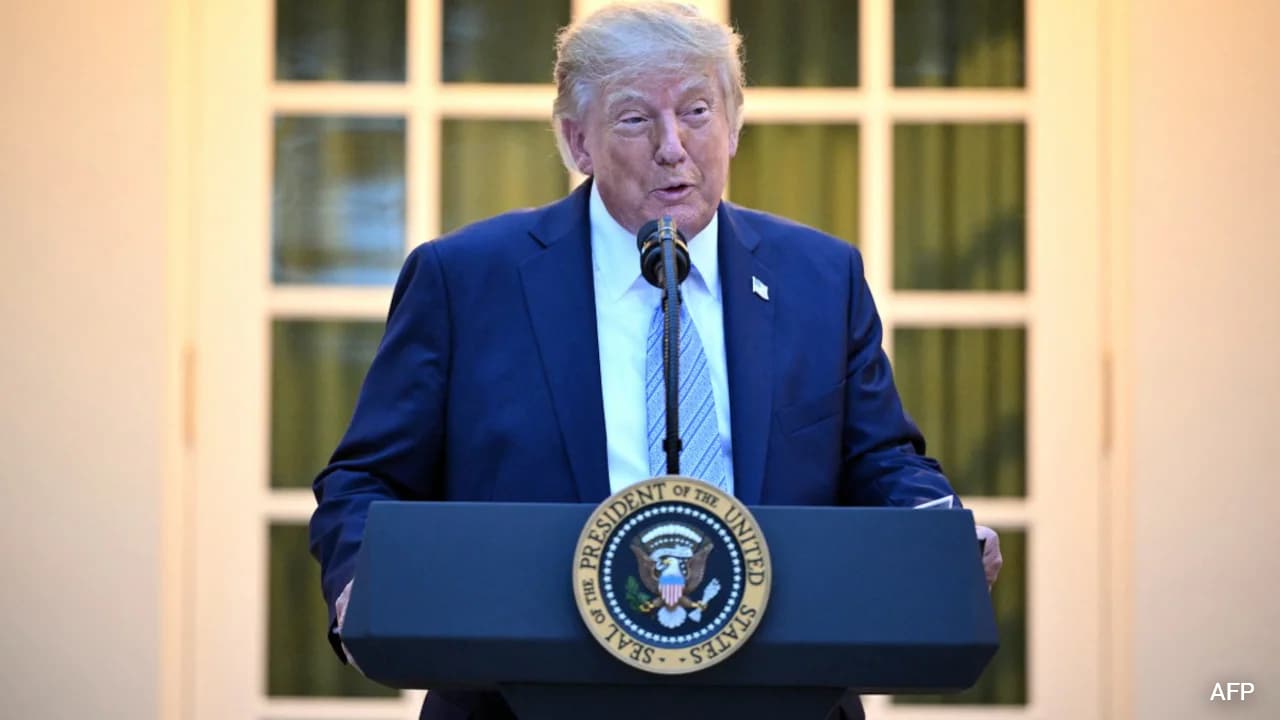
The fluorescent lights of the briefing room hum with a low, predatory frequency.
It is a sound most people never hear, buried beneath the polished audio tracks of cable news broadcasts and the curated outrage of social media timelines. But if you stand there long enough—long enough for the coffee in your paper cup to go cold and the synthetic carpet to feel like lead beneath your shoes—you realize something unsettling. This is not a room designed for the exchange of information. It is a colosseum.
Every word uttered behind that wooden podium is weighed, measured, and weaponized before it even hits the air. When a former president steps up to microphone arrays bearing the heavy insignia of executive power, or fires legal salvos at major networks like CNN and digital publications like Politico, accusing them of conspiring against the republic itself, the shockwaves do not stay contained within Washington, D.C. They ripple outward. They crash against kitchen tables in Ohio, smartphones in rural Texas, and quiet suburban living rooms where families watch the evening news like spectators at a demolition derby.
Labels matter. When the phrase "threat to democracy" is flung across courtrooms and television screens, it stops being a description. It becomes an atmosphere.
To understand why a lawsuit involving a former commander-in-chief and journalistic giants commands such white-hot urgency, we have to look past the dense legalese of complaints and motions. We have to look at the human machinery driving it. Consider a hypothetical television producer sitting in a control room at two in the morning, watching monitors glow with breaking news alerts. Or picture a beat reporter whose phone buzzes incessantly with legal notices, knowing that the cost of defending a sentence can outstrip an entire annual salary. These are not disembodied entities. They are people caught in an escalating machinery of mutual annihilation.
The Architecture of Outrage
Conflict sells. It organizes human attention with the ruthless efficiency of gravity.
For decades, the relationship between political power and the American press was defined by an uneasy, jagged symbiosis. They needed each other. The politician needed the oxygen of publicity; the journalist needed the currency of access. It was a messy marriage built on mutual suspicion. Sometimes, it erupted into open hostility. Think of Richard Nixon’s endless war with the networks, or Thomas Jefferson complaining that nothing in the newspapers was true, except the advertisements.
Yet, something has shifted in the granular texture of our public life. The tension is no longer about a disputed fact or an unflattering photograph. It has transformed into an existential struggle over the nature of reality itself.
When a lawsuit accuses a media outlet of defamation or institutional bias of a constitutional magnitude, the goal is rarely just a monetary settlement. The goal is validation. It is an attempt to codify a narrative into legal precedent. It tells millions of citizens: Do not trust your eyes. Do not trust your ears. The people reporting the news are not just wrong; they are actors in a conspiracy.
Imagine standing in a small-town diner in Pennsylvania, listening to two regulars argue over a headline they saw on their respective phones. One sees a heroic stand against a corrupt media empire. The other sees an authoritarian blueprint designed to silence dissent. They are looking at the exact same screen, reading the exact exact same words, yet they inhabit entirely different universes. That is the true victory of modern political theater. It does not convince the other side; it solidifies the walls of your own bunker.
Inside the Briefing Room
The air in the press briefing room is always slightly too dry.
Reporters live in a state of hyper-vigilance. They track micro-expressions, sudden shifts in syntax, and the subtle repositioning of bodyguards near the doors. When a lawsuit drops—when formal complaints are filed alleging malicious intent and institutional sabotage—the atmosphere shifts from tense to combustible.
Let us be clear about what is happening beneath the surface. Lawsuits against news organizations by powerful political figures create a chilling effect that is hard to measure in court filings. A local newspaper or a mid-sized digital outlet cannot absorb a multi-million-dollar legal defense fund the way a conglomerate can. When titans clash in federal court, the collateral damage is often borne by the smaller, less protected watchdogs who keep local governments honest.
Conversely, defenders of these legal actions argue that accountability cuts both ways. For years, media institutions enjoyed an almost untouchable aura of institutional immunity, wrapped in the protective armor of the First Amendment. When errors were made, corrections were printed on page twelve in a font so small it required a magnifying glass. Critics argue that if journalism is to retain its moral authority, it must face the same reckoning as any other powerful industry when its output crosses the line from reporting into targeted destruction.
Both arguments hold a kernel of uncomfortable truth.
The press has made catastrophic errors in the pursuit of ratings and rapid publication. Trust in journalism has cratered to historic lows, driven not just by external attacks, but by self-inflicted wounds. Sensationalism pays. Nuance does not.
At the same time, criminalizing coverage or using the judicial system to batter critics creates a terrifying precedent. If every unfavorable headline can be reframed as an existential threat to democracy, then democracy ceases to be a system of robust debate and becomes a fragile porcelain doll that must be locked away from the public gaze.
The Cost of a Fractured Reality
We are living through an experiment in mass disorientation.
When political leaders sue media companies, and media companies profit from the resulting outrage, the citizen is left standing in the rubble of shared facts. You cannot have a functioning republic without a baseline agreement on what is happening outside your window. If one side believes the election was stolen by a cabal of journalists and bureaucrats, and the other believes the nation is moments away from an authoritarian coup orchestrated by a single man, compromise becomes impossible.
Compromise requires a shared reality. Without it, politics ceases to be the art of the possible and becomes a zero-sum holy war.
Consider the human cost of this polarization. Families divided across holiday tables because Uncle Jim watches one network and his daughter reads another. Communities torn apart by school board meetings that resemble riot zones. The exhaustion of an entire population that just wants to live a quiet life, pay their bills, and trust that the water coming out of the tap is clean and the news coming out of the television is true.
This is why the legal battles between the White House and major networks are not just political news. They are cultural earthquakes. Every motion filed, every press conference delivered with righteous fury, adds another brick to the wall separating us from one another.
We watch these dramas unfold on our screens, treating them like sports matches. We pick a team. We cheer for our favorite pundit as they eviscerate an opponent. We feel a brief, intoxicating rush of righteous vindication.
Then the screen goes dark. Our reflection stares back at us from the black glass of our phones.
The courtroom lights are off. The lawyers have gone home to expensive dinners. The executives are checking their quarterly ratings. But you are left alone in the quiet, wondering how a society so obsessed with information managed to become so completely, profoundly lost.
The podium remains. The microphones wait. Tomorrow, the cameras will turn back on, and the performance will resume. And the ground beneath our feet will shift just a little bit more.


