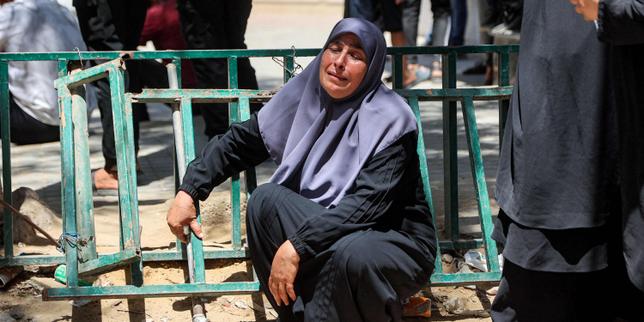
The afternoon heat in the western edge of the Jabalia displacement camp carries a heavy, familiar scent. It is a mixture of dust, frying oil from temporary market stalls, and the unmistakable, stale dampness of thousands of canvas tents packed together under a relentless July sun.
In the middle of this chaos stood a small, makeshift police post. It was not a fortress. It was a fragile attempt to anchor an anchorless society.
Inside, a handful of officers were attempting to manage the small, agonizing friction points of a population living on top of one another. Arguments over water lines. Disputes over marketplace space. Missing children. For a population trying to survive the fragile, daily violations of a ceasefire signed months ago in October 2025, these officers represented the last thin line between community and complete collapse.
Then came the high-pitched, metallic whine of a drone.
A single flash of white light tore through the market noise. The blast wave shattered the surrounding wooden stalls and shredded the canvas of nearby tents. When the black smoke lifted from the Al-Faluja area, the police post was gone, replaced by a crater of pulverized concrete and twisted iron.
Eight people died in that single second.
Among them was Colonel Mohammed Marwan Salem, the director of the station. He was not a combatant entrenched in a tunnel; he was an official attempting to dictate traffic and keep the peace in a refugee camp marketplace. Beside him died five of his personnel, including a female officer who had been working the desk, and a civilian bystander who happened to be standing too close to the doorway when the sky fell.
The dry wire reports from foreign agencies will record this as a standard Tuesday afternoon exchange. They will quote the official military press releases stating that four of the dead were active Hamas operatives gathered to plan attacks, neutralized to mitigate an immediate threat. They will note, with clinical detachment, that the police force operates under the internal administration of Gaza.
But the statistics fail to capture the true weight of what is dissolving here.
Consider what happens when you systematically eliminate the people who hand out food tickets, settle neighborhood brawls, and direct traffic. You do not just kill individuals. You kill the very concept of order.
For the people living in the tents around Shadia School, the local police officer is not a geopolitical symbol. He is the person who stops someone from stealing your blankets. She is the person you go to when a family member goes missing in the crowd. When those uniforms disappear, the vacuum left behind is filled by a raw, terrifying lawlessness.
The bodies were rushed to Al-Shifa Hospital in Gaza City. It is a routine that the staff there can perform in their sleep. Wash the dust from the skin. Identify the features. Wrap the remains in white cloth. Type the names into a database that already holds tens of thousands of entries.
This is the reality of a ceasefire that exists only on paper. Since the truce was declared last October, over 1,100 Palestinians have been killed in persistent, localized strikes across the strip. On the other side, Israeli families have buried five soldiers and a defense contractor, proving that the quiet promised by diplomats has not found its way to the ground. Both sides trade daily accusations of betrayal, while the people caught in the middle simply watch the sky and wait for the next strike.
Earlier that same morning, down south in Khan Younis, a ten-year-old boy named Moataz was hit by heavy machine-gun fire in the Al-Mawasi area. His family carried his bleeding body toward Nasser Hospital, running through the sand, watching his life slip away before they could even reach the main road.
He died in their arms. He became another number. Another file to be sorted.
It is easy to get lost in the macro-narrative of this conflict—to view it as a massive, chess-like struggle between armies and political factions. But the real tragedy is microhistorical. It is found in the specific loss of a father who went to work at a police desk to earn a meager living, or a woman who thought her uniform might offer a shred of authority in a place where everything else had been stripped away.
The international community watches from a distance, pledging funds for a recovery that never quite begins, while the infrastructure of daily life is chipped away, piece by piece. Ninety percent of Gaza’s civilian infrastructure is gone. Now, even the human infrastructure—the teachers, the medics, the local station chiefs—is being erased.
As twilight falls over Jabalia, the market slowly tries to resume its rhythm. People walk past the charred crater where the police post stood hours before. There are no yellow police tapes to cord off the scene, no forensic teams analyzing the debris. There is only a group of young men clearing away the largest pieces of rubble with their bare hands, trying to make room for the fruit carts to return tomorrow morning.
Without Colonel Salem or his officers to guide the crowds, the market is louder tonight, more tense, and infinitely more fragile. The thin line holding the camp together has grown just a little bit thinner.

