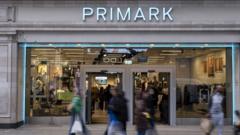
Sarah stands in the middle of a Primark aisle. She is twenty-four, clutching a coffee cup that went cold twenty minutes ago, staring at a stack of ribbed knit sweaters. She doesn't need another sweater. But the price tag reads twelve pounds, and in this economy, that number feels like a warm hug. It is a psychological anchor.
She pulls out her phone. She checks Amazon. She scrolls through the latest drops on Shein. She is hunting, not just for a garment, but for the satisfaction of winning a game she didn't realize she was playing. Also making waves in this space: Why Canva Founders Are Handing Out 150 Million Dollars in Malawi With No Strings Attached.
For years, Primark was the stubborn holdout. While the world rushed toward the glow of screens and the promise of next-day doorstep delivery, Primark stayed anchored to the physical. It built its empire on the architecture of the treasure hunt—the fluorescent lights, the chaotic bins, the tangible heft of fabric in hand. It relied on the assumption that you couldn’t replicate the rush of a bargain without the dust and the tactile friction of a crowded store.
But the digital winds have shifted. The grocery giants have been playing a different game for years, using stock availability and price visibility to turn the act of buying bread and milk into a data-driven science. Now, Primark is learning their language. Additional insights on this are detailed by The Economist.
They are rolling out a new inventory system that feels invisible to the customer, yet it is as loud as a siren to the competition. It is a digital map of their physical world.
(Note: This description of the inventory system is a synthesis of current retail tracking technology, which uses real-time data to sync stock levels with customer-facing platforms, transforming the store from a warehouse into a beacon for online shoppers.)
The strategy is simple, yet brutal. By allowing customers to view stock availability online, Primark is no longer just selling clothes. They are selling certainty.
Think about the last time you traveled across town for a specific item, only to find the shelf empty. The frustration is visceral. It’s a puncture wound in the brand experience. By providing this digital visibility, Primark is effectively colonizing the consumer's headspace before they even leave the house. They are forcing the customer to make a choice: drive to the store where you know the item exists, or surrender to the uncertainty of a competitor’s shipping timeline.
It is a supermarket tactic. It turns the retail floor into a logistical coordinate.
Consider what happens next: the competition is forced to respond. If Primark can signal exactly where a sweater sits in a specific store, why can't the online-only giants offer the same precision for their own logistics? The line between the digital storefront and the physical aisle is blurring until it vanishes entirely.
This isn't about clothes. It is about control.
I remember walking into a high-street store during my teenage years. I felt overwhelmed. The sheer volume of product was a wall of noise. I didn't know what was in stock, I didn't know what was worth my time, and I certainly didn't know if I was getting the best deal. I left empty-handed, defeated by the opacity of the experience.
The new Primark approach attempts to strip away that uncertainty. It is an act of translation. It turns the chaotic reality of a retail store into a neat, predictable row of digital search results. It invites the customer to do the work, to plan their trip, to treat the physical store like a pantry they are checking before they cook dinner.
But there is a shadow here. Efficiency often comes at the cost of the unexpected. The joy of the treasure hunt—the accidental discovery of that one scarf buried in a pile of denim—is stifled by the cold efficiency of an "In Stock" notification. When you go looking for a specific target, you stop seeing the rest of the store. The store becomes a utility. A machine.
The grocery industry perfected this. They mastered the art of the list. They made sure you knew exactly where the milk was, and exactly how much it cost, so you wouldn't spend a second more in the store than necessary. By adopting this, Primark is betting that the modern shopper values time and accuracy over the serendipity of the browse.
They are betting that in a world of infinite choice, the only way to win is to make the choice feel inevitable.
Critics argue that this will cannibalize impulse buys. They say that by telling the customer exactly what is there, you lose the chance to sell them what they didn't know they wanted. But look at the numbers. The cost of losing a customer because they couldn't find what they wanted is far higher than the potential loss of a few extra impulse purchases. The new math is cold. It is clinical. It is effective.
The invisible stakes are even higher than the price war itself. This is a battle for the definition of "convenience." Is convenience having it delivered to your door? Or is convenience knowing exactly where to find it right now?
Primark is betting on the latter. They are betting on the footfall of a generation that has grown tired of the gambling nature of online shipping, tired of returns, tired of waiting. They want the instant gratification of the physical world, but they demand the navigational precision of the digital one.
It is a hybrid existence. We are all living in the hyphen between online and offline.
Every time Sarah refreshes that page to see if her size is still available at the city center branch, she is participating in a massive, real-time negotiation between logistics and desire. The store is no longer just a place to buy things. It is a node in a network. A signal.
The true genius of this move isn't the technology. It’s the psychology. It is the realization that in an age of anxiety, the greatest luxury you can offer a customer is the guarantee that their effort will be rewarded.
As the sun sets over the shopping district, the neon sign of the store flickers to life. It doesn't look like a computer terminal. It doesn't look like a data center. It looks like a shop. But deep in the back-office, behind the shifting piles of fabric and the weary staff restocking shelves, the hum of the servers matches the heartbeat of the inventory.
The world is changing. The shelves are being digitized, the aisles are being mapped, and the hunt for the bargain has been replaced by the hunt for the signal.
We walk into the store with our phones held high, our path already charted by the invisible wires of the stock count. We think we are choosing to shop. We think we are finding a deal.
In reality, we are just following the light, hoping the sweater is still waiting for us in the size that fits.
The transaction is finished before we even reach the register. The store has already won.