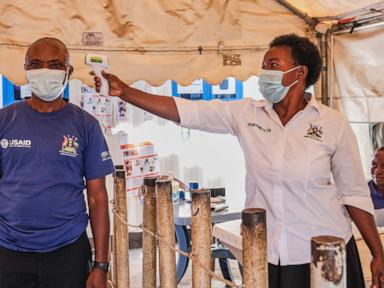
Humidity clings to a border crossing long before the road turns to mud. It sits on the collar of a shirt. It weighs down the plastic clipboards held by health workers under a tin awning.
At a crossing between Uganda and the Democratic Republic of the Congo, a line painted on asphalt—or simply implied by a shift in uniforms and languages—carries a weight that feels almost physical. On one side, a market vendor might be counting shillings; on the other, a family might be grieving a cousin whose fever came on too fast. Viruses do not check passports. They hitchhike on heat, sweat, exhaustion, and the desperate urgency of people trying to get home. Learn more on a similar issue: this related article.
When Uganda tightens its Ebola border controls and requires returnees from the Congo to pay for quarantine, headlines often read like cold administrative decrees. A policy shift. A budget line. A restriction at a checkpoint. Yet behind every screening tent and every payment receipt sits a human bargain forged under fear, scarcity, and survival.
To understand why a government draws a harder line—and why charging for isolation is both a practical gamble and a moral fault line—you have to look at what happens in the quiet hours when a thermometer beeps and nobody wants the number to be high. Further journalism by WebMD highlights similar views on this issue.
The Quiet Threshold at the Checkpoint
Imagine a hypothetical traveler—let's call her Beatrice—standing beneath a buzzing fluorescent bulb at a border post after three weeks caring for a sick aunt across the river in the Congo. (Note: Beatrice is a composite, hypothetical character created to illustrate typical border dynamics rather than a specific real individual.)
Her ankles ache from a long bus ride. Her bag holds a folded wrapper, a bar of soap, and a few crumpled bills that barely cover the rest of her journey home to Kampala. She has no rash. She has no bleeding. She feels mostly worn out, the way anyone feels after sleeping on hard benches and worrying around the clock.
A health officer raises an infrared scanner toward her forehead. Click. A number flashes. Maybe it is normal. Maybe it is borderline. Maybe the heat of the afternoon sun has pushed her skin temperature just high enough to trigger a second look.
In that second look, everything changes. The conversation shifts from routine transit to risk assessment. Where were you? Who did you touch? Did your aunt have diarrhea, vomiting, unexplained bruising, or a fever that refused to break?
Ebola virus disease is cruel precisely because its early mask looks ordinary. Fever. Fatigue. Muscle pain. Sore throat. Headache. In a region where malaria, typhoid, and everyday exhaustion are constant companions, early symptoms do not announce themselves with sirens. They whisper. A person can cross a porous border feeling merely unwell, only to grow dangerously infectious days later as viral loads climb and bodily fluids become the primary vehicle of transmission.
Border controls exist to catch what slips through the cracks of ordinary life. Screening questionnaires, temperature checks, handwashing stations, and isolation referrals are the front line of containment. Yet anyone who has spent time near busy crossings knows a hard truth: borders in the Great Lakes region are porous by history and necessity. Families span both sides. Trade keeps kitchens stocked. People walk footpaths through bushland when formal gates feel too slow or too costly. Tightening rules at the main gate is necessary, but it never seals every path.
Why Money Enters the Isolation Room
Quarantine sounds simple on paper. Separate potentially exposed people for a set observation window—typically 21 days for Ebola, matching the maximum incubation period—and monitor them daily so that if symptoms erupt, care begins immediately without exposing a whole neighborhood.
In practice, quarantine is a logistics puzzle wrapped inside a human crisis.
Someone has to pay for the mattress, the clean sheets, the meals three times a day, the sanitation supplies, the security and nursing staff, and the waste management required for suspected viral hemorrhagic fever cases. Public health budgets across East and Central Africa face relentless competing pressures—maternal health, malaria nets, vaccines, road maintenance, clinic staffing. When outbreaks flare across the border, emergency spending spikes fast.
Requiring returnees from an affected area like the Congo to pay for their own quarantine is often framed by policymakers as a way to ease the strain on taxpayers and state coffers. If you travel into a high-risk zone and return during an active threat, the logic goes, sharing the cost of precautionary confinement helps keep the system solvent.
Except public health rarely behaves like a tollbooth.
Think about what happens when a price tag is attached to staying put. Fear already tempts people to hide a fever. Add a steep fee to the prospect of being held away from work and family for three weeks, and the temptation to slip past a checkpoint—or underreport travel history—grows sharper. If a returnee cannot afford the quarantine fee, what happens? Do they borrow at high interest? Do they plead at the desk while officials weigh exceptions? Do they turn around toward an unmonitored crossing?
Every loophole created by financial strain is a door left ajar for an outbreak.
A containment policy only works if the people it governs can afford to comply without destroying their livelihoods.
Even when fees are modest or tiered, the emotional calculus is heavy. Missing three weeks of daily wages or small-scale trading can mean falling behind on rent or school fees. Quarantine is not just a room with a locked door; it is an interruption of life itself.
Lessons From Past Storms and Human Habits
To grasp the stakes, it helps to step back from the immediate news cycle and look at how Ebola outbreaks have unfolded in the region over the years.
Ebola was first identified in 1976 near the Ebola River in what is now the Democratic Republic of the Congo, alongside a nearly simultaneous emergence in South Sudan. Since then, repeated outbreaks—most notably the massive 2014–2016 West African epidemic and severe flare-ups in eastern Congo—have taught hard lessons.
Outbreaks rarely explode solely because a virus is clever. They explode when trust erodes.
When communities view health workers with suspicion, when rumors spread faster than accurate guidance, or when isolation centers feel punitive rather than protective, people hide their sick relatives at home. Traditional burials involving close physical contact with a deceased loved one have historically been major transmission flashpoints, not out of malice, but out of deep love and cultural reverence for the dead.
Uganda has earned international recognition over decades for building strong surveillance and rapid-response muscles against viral hemorrhagic fevers like Ebola and Marburg. Early detection, contact tracing, ring vaccination when applicable vaccines are deployed, and swift isolation have repeatedly kept sparks from turning into wildfires.
Yet strength in past responses does not make the next one automatic. Each new cross-border alert tests the same fragile trust all over again. If border measures feel heavy-handed or financially punishing without clear support, cooperation frays. If measures are too lax, a single undetected chain of transmission can cross a district before anyone connects the dots.
The Invisible Stakes Beneath the Policy
Sometimes the most important part of a public health story is what you cannot see in a press briefing.
You do not see the nurse wiping sweat from her brow inside personal protective equipment during a sweltering afternoon, knowing that a single tear in a glove or a moment of fatigue carries real risk. You do not see the shopkeeper in a border town watching traffic slow down and wondering whether customers will stay away for months. You do not see the quiet dread of a mother whose child has a mild fever, torn between rushing to a clinic and fearing what isolation will cost the rest of her household.
And you do not see the counterfactuals—the chains of infection that never happened because a checkpoint caught a fever early, or because a returnee stayed put for twenty-one days and walked out healthy. Prevention is thankless work. When it succeeds, nothing dramatic occurs. The story that never happens gets no headline.
This is where honesty matters most. Public health policy is not a neat equation with a painless answer. Governments have real financial limits and real obligations to protect their broader populations from preventable catastrophes. Citizens have real economic survival pressures and real fears of losing freedom, income, or dignity in an unfamiliar facility.
Pretending there is an effortless balance is dishonest. Choosing clarity over comfort means recognizing both truths at once: strict border vigilance can save lives, and financial barriers to quarantine can push risky behavior into the shadows.
What Makes Containment Actually Hold
If tightening border controls and charging for quarantine are two pieces of a response, what determines whether the strategy protects people instead of alienating them?
First, clarity and fairness at the point of contact. Travelers need to know the rules before they cross—what triggers screening, what quarantine entails, how costs are calculated, and whether exceptions or safety nets exist for those facing genuine hardship. Ambiguity breeds panic and bargaining at the gate.
Second, humane conditions inside isolation. Quarantine feels radically different when rooms are clean, food is reliable, communication with loved ones is supported, and medical staff treat detainees like neighbors rather than suspects. Dignity lowers resistance.
Third, community partnership along the border. Health authorities cannot police every footpath through tall grass or every canoe landing along a river. Local leaders, cross-border traders, and community health volunteers understand movement patterns far better than distant ministries. When local voices help shape response plans, compliance rises naturally.
Fourth, speed and transparency. Information is an antidote to rumor. Explaining why controls are tightened—and lifting or adjusting them transparently as epidemiological risk changes—shows that measures are tied to evidence rather than politics or profit.
Standing at the Edge of the Road
Night falls quickly near the equator. Lanterns flicker along roadside stalls. The heat eases just enough to breathe more easily, though the air still holds the memory of the day.
Somewhere along a border road, another bus approaches a checkpoint. Another forehead is scanned. Another family weighs distance, money, fever, and hope in the span of a single breath.
A border is a thin line drawn across living land, where people share blood, trade, grief, and survival long before any map was inked. How a nation guards that line—and how it treats the people caught on either side of a fever—reveals what it values most when fear is in the air.