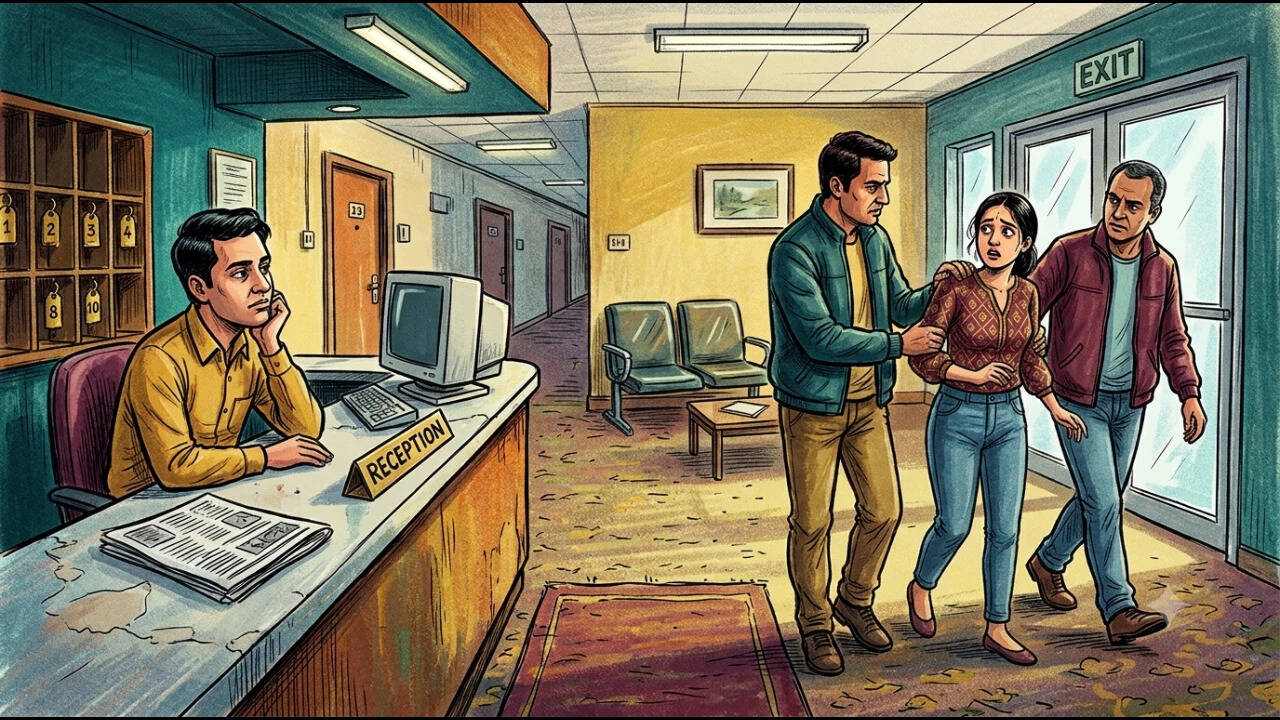
Fluorescent light hums above a scuffed counter. A fifteen-year-old girl asks to use the lobby phone.
Across the counter stands an employee who knows the people holding her. He says no.
That single refusal—and the months of quiet complicity that surrounded it—sat at the center of a federal courtroom in Atlanta in September 2026. A jury ordered Lincoln Bancorp LLC, the former owner of a Super 8 hotel on Old National Highway in College Park, Georgia, to pay $164 million to the survivor, identified in court filings as J.R.. Jurors divided the award into $44 million in compensatory damages and $120 million in punitive damages, deliberating for roughly two hours before returning what her attorneys described as the largest sex trafficking verdict in the country.
Numbers like $164 million look clean on a screen. They look like a ledger entry or a headline ticker.
They are not.
Behind that figure are 120 days of captivity spread across 2020 and 2021, starting when J.R. was fifteen and stretching into her sixteenth year. Behind it are hallways that smelled like cheap bleach and stale cigarettes, keycards handed out for short stretches, and a front desk where safety was treated like a perk reserved for regular guests.
When a Room Becomes a Cage
Most travelers think of a hotel room as a pause button. You drop a bag, kick off your shoes, lock the deadbolt, and sleep. For a survivor of trafficking, that same deadbolt can keep help out just as easily as it keeps strangers away.
According to court testimony from the Atlanta trial, J.R. was repeatedly brought to the property by traffickers over a period totaling 120 days. Testimony at trial indicated that an employee refused to help her or let her use the hotel phone because he knew she was associated with the traffickers. Former housekeepers also testified that commercial sex occurred around the clock, young girls were regularly on the property, and staff rented rooms by the hour or half-hour. Even more striking, testimony and statements from her legal team alleged that the operator would warn traffickers when police were coming.
Think about what a phone on a hotel counter represents. It is bolted to the desk or resting beside a register. It costs nothing to dial three digits. Yet for a teenager stripped of her phone, her cash, and her freedom, that piece of plastic can be the difference between another night in the dark and walking out into daylight.
Consider what happens next: a property produces a training document on paper claiming staff received instruction against trafficking, while housekeepers testify they never saw or heard of it. Paper policies do not stop a predator at 2:00 a.m. People do.
To make the human stakes concrete, imagine a hypothetical front-desk clerk named Marcus working a late shift along a busy highway corridor near a major airport—not an accusation against any real worker, just a clear lens into how everyday routines harden. Marcus has worked twelve-hour shifts for years. He sees quick cash payments, constant foot traffic to the same door, and exhausted teenagers who never carry their own bags. If he treats every anomaly as "not my business," his silence becomes part of the room rate. If he picks up the phone, everything changes.
The Law Behind the Verdict
Why sue a hotel owner instead of only chasing the traffickers who may already be in prison or on the run?
Follow the money.
Traffickers often have few traceable assets, move constantly, and vanish from view. Properties, by contrast, sit on physical real estate, collect steady room revenue, and operate under federal law. J.R.'s lawsuit was brought under the civil remedy provision of the Trafficking Victims Protection Reauthorization Act, codified at 18 U.S.C. § 1595. In plain terms, that statute allows survivors to sue not only traffickers, but also businesses that knowingly benefit—financially or otherwise—from participating in a venture that the business knew or should have known was engaged in trafficking.
That phrase—knew or should have known—is where courtrooms become battlegrounds.
A property owner rarely leaves a signed memo saying, "Facilitate child exploitation." Instead, juries weigh patterns. Repeated cash payments for short stays. Heavy traffic coming and going from one room. A minor paired with an older adult who controls money and identification. Staff observations brushed aside or ignored. When those red flags stack up like dominoes, claiming willful blindness gets harder to defend.
Verdicts also collide with insurance reality. Even when a jury hands down a massive judgment, collecting it can spark another fight over whether commercial policies cover intentional or knowing misconduct. Still, the signal to operators across the hospitality industry is unmistakable: turning a blind eye carries a price tag that can wipe out years of room revenue in a single afternoon.
Why This Hits So Close to Home
I have stood in fluorescent-lit lobbies at midnight with a roll-on bag and a tired spine, waiting two minutes for someone to emerge from a back office. You notice the scuff marks on the tile. You notice the plastic chair bolted near the ice machine. Most of the time, nothing darker than a delayed flight is happening on the other side of the wall.
Yet that ordinary familiarity is exactly what makes trafficking hard to believe until you face the evidence. We want to imagine exploitation looks like dramatic movie villains in windowless warehouses. In reality, it often hides inside ordinary commercial spaces—along highway exits, near airport corridors, behind familiar signs—where convenience and profit tempt operators to look away.
Admitting how easily an institution can rationalize inaction is uncomfortable. It is scary to think a child can ask for help across a counter and be turned away. It can even feel confusing to sort through legal terms like compensatory versus punitive damages, or civil liability versus criminal prosecution, when all you really want to ask is how an adult could look at a scared teenager and say no.
You do not need a law degree to grasp the moral math. Use a simple metaphor—purely as a lens for understanding incentives, not a literal comparison: imagine a tollbooth operator who waves through smugglers every night for a cut of the toll, then claims ignorance when the highway patrol arrives. Once the penalty outweighs the profit, the gate starts coming down.
In the Atlanta case, J.R. took the witness stand before a room of strangers and told her story. Her attorneys noted that she chose to remain anonymous in court filings to protect her privacy, yet her testimony carried enough weight that jurors reached their decision quickly. Her lawyer also pointed out that the verdict alone will not magically erase sex trafficking, though making it far more expensive to ignore can help slow it down.
What Real Accountability Looks Like
A check can never hand back fifteen or sixteen. Money cannot erase 120 days of fear or rebuild trust overnight.
What a record verdict can do is shatter the illusion that a locked register and a stack of unread binders count as compliance. Real accountability requires habits that survive shift changes, turnover, and busy weekends:
- Training that reaches the floor: Housekeepers, front-desk clerks, maintenance workers, and managers all see different slices of daily life on a property. If workers have never seen training materials or do not know what warning signs to report, policies exist only on paper.
- Clear escalation without fear: Staff need a direct, unambiguous path to alert management and law enforcement when something feels wrong, rather than worrying that reporting trouble will cost them their job.
- Zero tolerance for shortcuts: Renting rooms by the hour or half-hour, ignoring repeated cash transactions, or tipping off people trying to evade police turns hospitality into a liability trap.
Anyone traveling or working in service can also stay awake to the world around them. You do not need to play detective or put yourself in harm's way. If you see someone who appears fearful, controlled, or underage in a situation that feels wrong, contacting local law enforcement or reaching out to the National Human Trafficking Hotline at 1-888-373-7888 (or by texting 233733) puts trained help in motion.
No.
That one word at a hotel counter echoed all the way to a federal jury box in Georgia, turning years of silence into a reckoning that no balance sheet can quietly absorb.