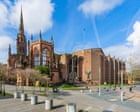
John Hutton’s Great West Screen at Coventry Cathedral did not survive the blitz, because it was built to heal the scars left behind. When a production crew erecting a stage for a music event shattered one of its monumental engraved glass panels, the fracture lines extended far beyond the West Midlands. It exposed a quiet, systemic crisis facing historic preservation across the UK.
The incident at Coventry is not an isolated mishap. It is the predictable consequence of a high-stakes financial gamble. Cash-strapped heritage sites are increasingly transforming into commercial entertainment venues to survive, forcing ancient architecture to coexist with heavy touring infrastructure.
The damage occurred during the setup for a high-profile electronic music event. Workers maneuvering scaffolding and lighting rigs made contact with the mid-20th-century masterpiece. The impacted pane, featuring one of Hutton's signature ethereal angels, suffered significant fracturing.
While the cathedral’s leadership quickly issued statements emphasizing that the damage was accidental and that restoration experts were already on-site, the public reaction exposed a deep undercurrent of anxiety. For decades, the church has walked a tightrope between sacred preservation and commercial viability. This time, the rope snapped.
The Financial Desperation Behind the Stage Lights
To understand why a massive sound system was being rigged next to priceless post-war art, look at the balance sheets. The Church of England receives no direct funding from the government for the maintenance of its cathedrals.
The cost of keeping a medieval or mid-century cathedral dry, safe, and open to the public runs into thousands of pounds every single day. Traditional collection plates and modest entry fees no longer cover the bills.
Cathedrals have evolved. They are now corporate event spaces, film sets, and concert halls.
| Venue | Notable Commercial Usage | Primary Preservation Risk |
|---|---|---|
| Coventry Cathedral | Electronic music concerts, graduation ceremonies | Proximity of heavy rigging to fragile glass structures |
| Durham Cathedral | Major Hollywood film productions (Avengers, Harry Potter) | Heavy foot traffic, structural load limits from camera cranes |
| Gloucester Cathedral | Period drama filming, large-scale public art installations | Superficial stone damage, micro-climate shifts from lighting |
This commercial pivot creates an immediate, physical conflict between the venue's original purpose and its new economic engine. Rock concerts require immense power, massive steel stages, and crews working under tight deadlines. Historic glass and stone require stillness, climate control, and meticulous care. When these two worlds collide, the older world invariably loses.
The Illusion of Foolproof Protection
Event promoters routinely promise that their operations are governed by ironclad risk assessments. They point to rubber matting, protective barriers, and strict load-in protocols designed to isolate historic fabric from the chaos of a live production.
These measures offer a false sense of security.
No conservation plan survives contact with a hurried road crew trying to meet a midnight teardown deadline. The human factor remains the weakest link in the chain. Temporary event staff are rarely schooled in the vulnerability of the spaces they occupy. To a local stagehand hired for a twelve-hour shift, a 70-year-old engraved glass window can look exactly like a standard commercial storefront.
Furthermore, the hidden threat is often worse than direct impact.
Sub-bass frequencies generated by modern sound systems can induce acoustic resonance in historic stained glass and leaded windows. Over multiple hours, these vibrations loosen the lead cames, weaken ancient mortar, and introduce micro-fractures into the glass itself. The damage from a concert might not manifest as a dramatic, sudden shatter. It often appears months later as a mysterious structural failure that the venue must pay to fix.
The Problem with Hutton's Glass
The Great West Screen is particularly vulnerable to modern event hazards because of how it was made. John Hutton spent a decade creating the ninety figures that populate the massive transparent wall. He did not paint the glass; he used a process called hand-engagement grinding.
Using modified dental drills and industrial abrasive wheels, Hutton cut directly into the surface of the glass.
This technique creates a breathtaking aesthetic effect, where the figures seem to float in mid-air, catching the shifting English light. However, from a structural standpoint, every cut, groove, and indentation made by the drill is a deliberate introduction of stress concentration points. The glass is inherently compromised by the art itself. When an external force or severe vibration hits a pane treated this way, the energy naturally travels straight to the deepest cuts, turning a minor bump into a catastrophic failure.
The Invisible Insured Loss
When historic assets are damaged, the public is usually assured that insurance will cover the cost of restoration. This defense misses the point of conservation entirely.
You can hire the finest conservators in Europe to piece a shattered pane back together. You can use modern optical adhesives to make the cracks nearly invisible to the naked eye. But the original artistic integrity of the object has been permanently altered. The continuous piece of glass touched by the artist's hand is gone, replaced by a stabilized jigsaw puzzle.
In the insurance market for heritage sites, premiums are skyrocketing.
Every time a high-profile incident occurs, underwriters adjust their risk models. Cathedrals that rely on commercial events to pay their bills are finding that the cost of insuring those events is eating deeper into their profit margins. It is a cycle of diminishing returns.
Reforming the Sacred Event Space
The incident at Coventry should serve as a catalyst for a complete overhaul of how historic venues manage commercial partnerships. Turning away commercial revenue entirely is a financial impossibility for most dioceses. The solution lies in a radical shifts in operational control.
Heritage sites must establish non-negotiable physical boundaries that treat artwork not as a backdrop, but as an active hazard zone.
If an event requires rigging that comes within three meters of a vulnerable structure, the event must be redesigned or canceled. Promoters should be forced to pay for independent, cathedral-appointed conservation clerks-of-works who possess absolute stop-work authority on the floor during load-in and load-out.
[Safe Zone: No Equipment] ---> [Buffer Zone: Monitored] ---> [Active Production Area]
      (Glass Screen)                 (3-Meter Gap)               (Stage & Rigging)
The current model relies too heavily on the goodwill of external production companies. That trust is broken. Only rigid, legally binding operational frameworks can protect these spaces from the financial pressures that threaten to hollow them out from the inside.
The Myth of the Replicable Future
There is a dangerous sentiment among some modern venue managers that anything broken can simply be remade. Digital scanning and 3D printing have made the reproduction of historical artifacts easier than ever. If a stone pillar chipped, or a window shattered, a machine can theoretically output a perfect replica.
This philosophy reduces living history to a theme park.
The value of Coventry Cathedral’s West Screen lies precisely in its status as a physical witness to the post-war reconstruction of Europe. It is a monument to resilience. When a piece of that witness is destroyed because a production company needed to squeeze a few more light fixtures onto a truss, the loss is total. No digital facsimile can replace the historical weight of the original object.
The fracture at Coventry is a warning written in glass. If the caretakers of England's architectural heritage continue to prioritize short-term commercial windfalls over structural defense, they will eventually find themselves presiding over pristine, empty stages surrounded by the ruins of what they were supposed to protect.