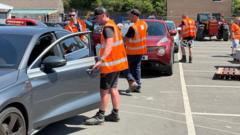
The heatwave had already turned the air into a thick, suffocating weight before the taps started sputtering.
It was mid-August. The thermometer outside the kitchen window read 101 degrees Fahrenheit. Inside, the refrigerator hummed a tired, desperate tune, struggling to keep the milk from turning. When you are trapped in a heatwave of that magnitude, water ceases to be a utility. It becomes a fixation. You think about the cold shock of it against your skin. You think about the condensation pooling at the base of a tall glass. You think about survival.
Then, the pressure dropped.
A low, guttural groan echoed through the plumbing of thousands of homes, followed by a hiss of trapped air, and finally, a pathetic trickle of brown-tinged liquid. Somewhere beneath the baked asphalt of the main highway, a critical water main had ruptured. The earth had shifted, cracked under the dual strain of shifting ground and unprecedented demand, and just like that, the modern illusion of effortless infrastructure vanished.
For three days, a community was forced to live in the nineteenth century while enduring twenty-first-century heat. Now, months after the mud has dried and the pipes have been patched, the financial reckoning has arrived. But a credit on a monthly utility bill cannot wash away the memory of what happens when the most basic element of human survival suddenly becomes a threat.
The Kettle and the Cauldron
Consider Sarah. She is not a real person, but she represents three different mothers on the same suburban block who spent forty-eight hours hovering over a stovetop.
With the air conditioning units straining to keep indoor temperatures below eighty degrees, Sarah had to light a gas burner. To make the tap water safe from the bacteria that rushes into depressurized systems, she had to boil it.
Think about the physics of that moment. The kitchen is already stifling. Sweat stings your eyes. To protect your children from gastrointestinal illness, you must deliberately introduce more heat into your living space. You stand over a giant pot, watching the bubbles slowly rise, waiting for that rolling boil that guarantees safety. The steam rises, sticking to your clothes, turning your home into a sauna. Then, you wait hours for it to cool down because drinking hot water in a triple-digit heatwave feels like an interrogation tactic.
This was the reality for over twenty-five thousand households during the peak of the summer heat. The local water company issued a "Boil Water Notice" via a text alert that arrived hours after the water had already turned brackish.
When a major pipe bursts, the pressure inside the system drops instantly. This drop creates a vacuum. Groundwater, dirt, and whatever pathogens are lurking in the soil can get sucked into the cracked line. The water company knew this. They followed protocol. They sent the alerts, mobilized the repair crews, and began the agonizingly slow process of testing samples for E. coli and other contaminants.
But protocols do not account for human misery. They do not account for the elderly man living alone on the third floor of an apartment complex with no elevator, staring at a dry tap, wondering if he has the stamina to walk to the supermarket for plastic jugs that are already sold out.
The Currency of Inconvenience
When the crisis finally broke and the tests came back clean, the water company did what modern corporations do. They calculated the damages. They looked at the regulatory frameworks, huddled with their legal teams, and announced a compensation package.
Every affected customer would receive a automatic credit on their next bill. A fixed sum to cover the electricity used to boil the water, the inconvenience of the disruption, and the cost of buying bottled alternatives.
On paper, the math is clean. In reality, it is an insult.
How do you price the anxiety of a parent who realized their toddler drank a full glass of tap water half an hour before the emergency text message arrived? What is the monetary value of the dignity lost when you have to use a bucket of pool water to manually force your toilet to flush?
The utility company looks at a broken pipe as an engineering failure with a quantifiable financial remedy. The people who rely on that pipe experience it as a betrayal of the social contract. We pay our taxes, we pay our monthly bills, and in exchange, we are permitted to forget where our water comes from. We trust that the invisible network of iron and concrete beneath our feet will always perform its silent miracle. When it fails, the vulnerability is staggering.
The compensation being offered is a drop in a very dry bucket. It covers the tangible costs—the crates of water bought at a premium from price-gouging corner stores—but it completely ignores the invisible labor of crisis management. It ignores the small businesses, the local diners that had to close their doors during their busiest weekend of the summer because they could not wash dishes or serve coffee. A flat-rate credit does not cure the lost revenue of a family-owned restaurant operating on razor-thin margins.
The Ghost in the Infrastructure
The true problem lies deeper than a single ruptured seam in a piece of metal. It rests in the fact that our cities are built on a foundation of aging ghosts.
Much of the water infrastructure in the developed world was laid down decades ago, designed for a climate that no longer exists and a population size that has long since been eclipsed. Pipes are meant to expand and contract, but they are not meant to withstand weeks of relentless, baking drought followed by sudden, violent torrents of storm run-off. The earth shifts like an awakening giant, and the rigid iron below snaps like a dry twig.
The water company treated this incident as an isolated anomaly, an act of God compounded by bad luck. But look at the data across the country. Main breaks are increasing in frequency. The grid is whispering its exhaustion, and we are only listening when the taps run dry.
Imagine the logistics of the repair itself. Men in heavy, rubberized gear descending into a muddy trench in mid-day heat, the air thick with humidity and the smell of wet clay. They work with heavy wrenches and welding torches while the sun beats down on their necks. They are sweating as profusely as the citizens who are cursing their name. It is a brutal, thankless race against time to clamp a wound in the city's throat.
They fix the pipe. The water rushes back. But the trust remains fractured.
The Long Pour
Yesterday, I turned on my kitchen faucet. The water ran clear, cold, and immediate.
I held a glass under the stream, watching the bubbles rise and dissipate in seconds. It was a mundane act, one I have performed thousands of times without a single thought. But as I raised the glass to my mouth, I hesitated. I looked at the clarity of the liquid, suddenly hyper-aware of the miles of dark, pressurized tunnels it had traveled to reach my kitchen. I thought about the thousands of people who had stood in their own kitchens just a few weeks ago, watching that same metal tap yield nothing but a dry hiss.
The compensation checks will arrive in the mail. The line item on the bill will show a negative balance, a temporary reprieve from the monthly expense. People will pocket the money, buy their groceries, and move on.
But the next time the weather report warns of a record-breaking heatwave, thousands of people will quietly walk to their pantries and check their supply of bottled water. They will look at their taps not with unthinking confidence, but with a faint, lingering doubt. They will remember that civilization is only ever a few pounds of water pressure away from chaos, and that when the system breaks, no amount of corporate compensation can cool a house or quiet the fear of a dry throat.


