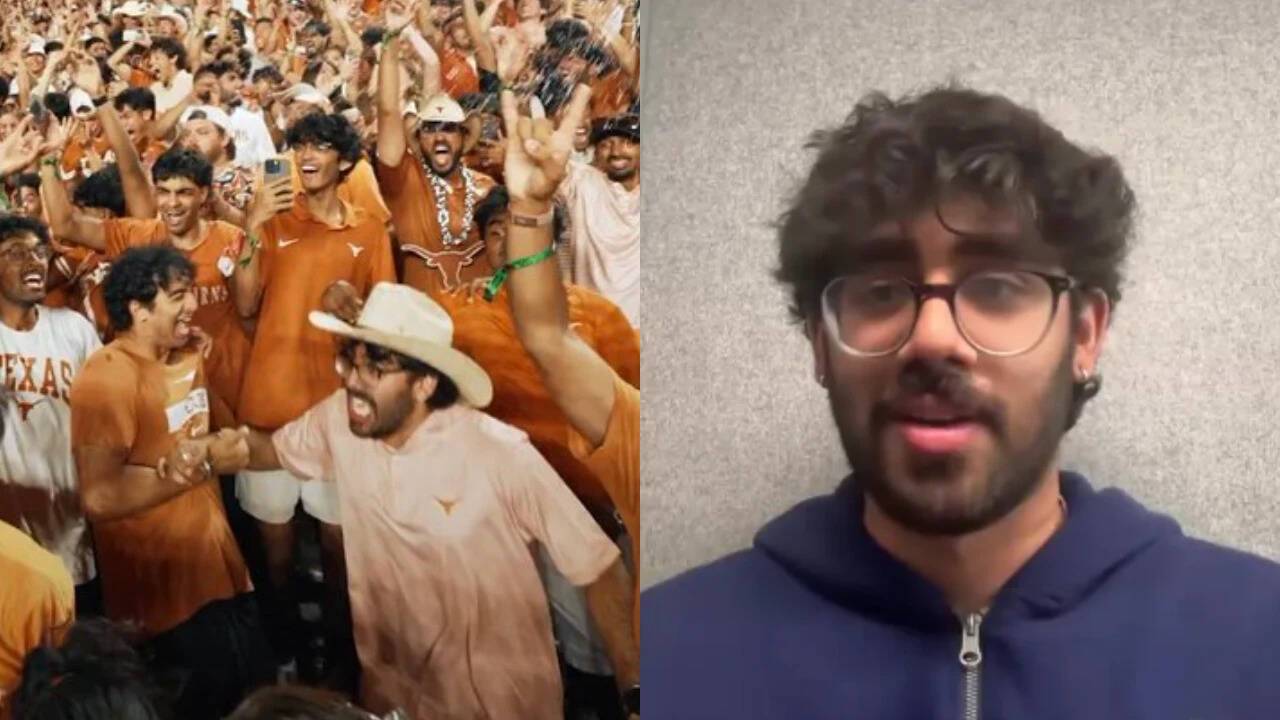
The stadium lights do not care who you are. They arc overhead in massive banks of white phosphorus, cutting through the autumn chill, bathing forty thousand people in an artificial noon. The sound is a living thing. It rolls down the tiers of concrete, a great, rhythmic wave of roaring throats and plastic clatters that vibrates right through the soles of your sneakers.
For Dhairya Gupta and Rahul Kodali, that sound was supposed to be a weekend release.
They are American citizens. They grew up on the geometry of suburban driveways, the sound of screen doors slamming in the heat, the specific cultural rhythm of Friday night routines and local sports fandoms. They bought their tickets. They put on their team colors. They walked through the turnstiles alongside strangers with painted faces and hot dogs in hand, expecting what everyone expects from a football match: ninety minutes of tactical anxiety, intermittent cheering, and the communal warmth of belonging to a crowd.
Instead, they walked into a mirror that shattered.
Somewhere in the upper tiers, or perhaps a few rows down, a smartphone lens tilted. It did not capture a game-winning touchdown or a brilliant defensive stop. It captured Dhairya and Rahul standing in the stands, holding the simple, ordinary posture of fans. Within hours, that footage was stripped of its context, tagged with venom, and shoved into the digital sewers where algorithmic outrage turns human faces into targets.
We talk about the internet as a network, a tool, a library, a marketplace. We forget that it is also an arena filled with spectators holding stones.
Consider what happens to a person when their face is suddenly weaponized. You wake up, you drink your coffee, you check your phone, and you discover that thousands of strangers have decided you do not belong where you were standing. They have scrutinized the slope of your nose, the color of your skin, the fact of your presence, and turned them into an indictment. They have looked at American citizens enjoying a public pastime and declared, through a wall of anonymous handles, that citizenship is conditional.
That is the quiet terror of this moment. It is not just the words hurled in the comments, though those are vile enough. It is the sudden, jarring realization that the baseline contract of public life—the silent agreement that you can walk down a street, sit in a stadium, or buy groceries without your existence requiring a defense—has been revoked.
Dhairya and Rahul did not step onto a political stage. They did not ask to become test cases for the boundaries of belonging. They went to watch a game.
And that is where the architecture of modern malice becomes so insidious. It hunts in ordinary places. It lies in wait at grocery stores, in subway cars, in restaurant booths, and yes, under the stadium lights. It takes the most mundane expressions of civic participation—a Saturday afternoon out—and stains them with fear.
When you strip away the sanitized language of social media policy and public relations statements, you are left with a very raw, very old human injury: the deliberate expulsion of a neighbor from the community.
We have built a culture that encourages this kind of casual banishment. Every day, millions of people scroll through feeds designed to provoke suspicion. Every day, algorithms reward the person who can find an "other" in a crowd. We have gamified division. We have turned observation into surveillance, and surveillance into an invitation to harass.
When Dhairya and Rahul's images were dragged through the mud, something essential was broken not just for them, but for the thousands of others who saw the story and recognized their own faces in the frame. Because every person of color in this country carries an invisible checklist in their head. Am I allowed to be loud here? Am I allowed to cheer too hard? If someone bumps into me, do I apologize twice to prove I am harmless?
Joy requires safety. You cannot truly abandon yourself to the thrill of a close game, the laughter of a shared joke, or the beauty of a public space if a part of your brain is constantly scanning the perimeter for threats.
The stadium lights are still burning. Next weekend, thousands more will file through the turnstiles. They will buy overpriced programs, spill mustard on their sleeves, and scream until their voices crack.
The question is not whether the games will go on. The question is whether we can reclaim the spaces between us from the people who sit in the dark, recording our lives with malicious intent, waiting for the moment they can convince the world we are strangers in our own home.
Dhairya and Rahul went to watch a football match. They deserved to come home with nothing heavier on their minds than a missed call or a blown referee's call. Instead, they carry the weight of a system that looked at them and saw an argument instead of a human being.
Until we fix that mirror, none of us are truly safe in the crowd.


